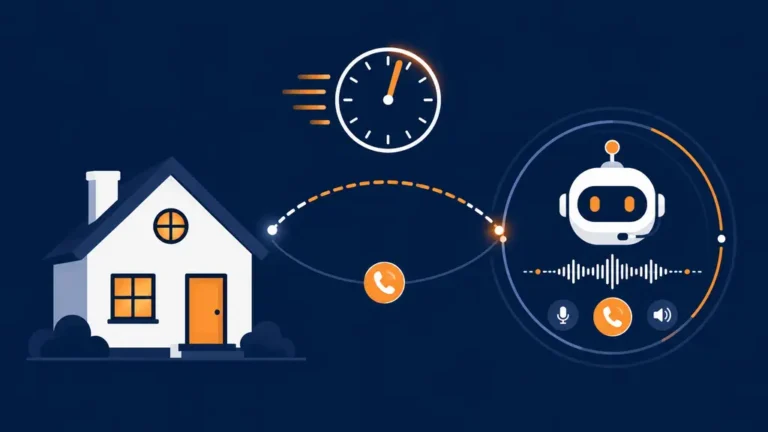


AI calling for plumbers is an automated phone system that holds real conversations with your callers and leads, answering inbound calls, calling web form submissions back within a minute or two, booking appointments into your schedule, and following up on estimates. It is not voicemail and it is not a recorded message. It is a voice agent that talks the way a well-trained office manager would.
The reason plumbers and other home service operators care is narrow and practical. You are in a crawl space at 2pm on a Tuesday. Your phone rings. You cannot answer. The caller hangs up and dials the next plumber on the list. That plumber picks up. You lost the job before you finished the one you were on.
This guide covers what the technology does for home service trades, where it pays back fastest, what it costs, the consent rules that apply, and the situations where it is the wrong purchase.
TL;DR
Home service leads are won on response time. Widely cited lead response research finds that the business responding first captures a large majority of the jobs, and that leads contacted within 5 minutes convert far better than leads contacted after 30. An AI voice agent calls a new web lead back in 60 to 90 seconds, answers when every tech is on a job, books into your calendar, and covers nights and weekends. Setup with a managed provider runs about 3 to 5 business days.
It does not generate leads. If your phone is not ringing, this fixes nothing, and you should spend the money on demand generation instead. It also will not rescue a business whose techs do not show up to the appointments it books.
Key takeaways
- Most home service businesses lose more jobs to slow callbacks than to price.
- An AI voice agent can call a new form submission back inside 90 seconds, day or night.
- For plumbers the four highest-return plays are emergency intake, estimate follow-up, service reminders, and paid lead response.
- Booking into the tech calendar with a short triage question means fewer second trips for parts.
- Consent, calling hours, and opt-out rules still apply, and an established customer relationship is not a blanket permission.
- Managed setup takes roughly 3 to 5 business days and needs no technical skill from your side.
- It is the wrong buy if your problem is lead volume rather than lead response.
Table of contents
- What AI calling for plumbers is
- The lead problem every home service business knows
- Why speed to lead decides the job
- How home service businesses cover missed calls
- After-hours coverage that holds up
- Appointment setting without a receptionist
- Four plays that work for plumbers
- How other trades use it
- Consent and calling rules
- What it costs
- What the first 30 days look like
- When it is the wrong fit
- AI calling for plumbers FAQ
- The bottom line
What AI calling for plumbers is
AI calling for plumbers is an automated voice system that conducts real conversations with callers and leads on behalf of a plumbing or home service business, without anyone on your end picking up the phone. The system answers, asks questions, understands the answers, and takes an action such as booking a slot or escalating an emergency.
For a plumbing company, that generally covers five jobs.
- Calling every inbound web lead back within about 90 seconds of the form submission, while you are still under a sink.
- Answering incoming calls when every tech is out and nobody is free to pick up.
- Asking about the problem, the address, and availability, then booking straight into your scheduling system.
- Reminding confirmed appointments 24 hours and 2 hours ahead to cut no-shows.
- Following up on quotes that went quiet, usually 48 to 72 hours after the estimate went out.
None of it requires hiring an office manager, training a receptionist, or adding an hour of payroll.
The lead problem every home service business knows
The problem in home services is almost never interest. Most plumbers get steady inbound from Google Local Services Ads, Yelp, Angi, Thumbtack, and their own site. The problem is what happens in the 20 minutes after a lead arrives.
Homeowners with an active leak, a dead furnace, or a tripped panel call three or four businesses at once. They book the first one that responds like a real company. A callback three hours later reaches someone who already has a truck scheduled.
That is a response time problem wearing a marketing problem’s clothes. Spending more on ads while the callback gap stays open just raises the cost of the leads you lose. Our speed to lead breakdown covers the mechanics in more depth.
Why speed to lead decides the job
Speed to lead is the gap between a prospect submitting an inquiry and hearing back from you. Lead response research has pointed the same direction for years. Contact inside 5 minutes and conversion runs dramatically higher than contact after 30 minutes, and the first responder wins a large share of the jobs outright.
In home services the effect is sharper than in most categories, because urgency is real and the customer is shopping in parallel. The businesses losing these jobs are rarely losing on price or workmanship. They are losing to a faster phone.
Here is what it looks like in practice. A homeowner submits a water heater replacement request at 3:14pm. At 3:15pm the AI calls. The conversation runs 90 seconds and the appointment lands Thursday at 10am. At 3:18pm a competitor calls the same homeowner, who tells them a plumber is already booked. Nothing about that outcome involved being the better company. It involved being four minutes earlier.
How home service businesses cover missed calls
Every operator solves this somehow. Most of the options have a real cost that does not appear on an invoice.
| Approach | Typical response time | Cost shape | Main drawback |
|---|---|---|---|
| Voicemail and call back later | Next morning | Free | Caller has booked someone else by then |
| Forward to owner cell | Immediate when free | Free, paid in burnout | Owner takes calls at 11pm and on Sundays |
| Human answering service | Minutes | Per minute or per call | Takes messages, rarely books into your calendar |
| In-house receptionist | Immediate in business hours | Roughly $30,000 to $45,000 per year plus benefits | One person, one call at a time, no nights |
| AI voice agent | Seconds, around the clock | Monthly service fee | Handles routine intake well, complex jobs still need a human |
The honest comparison is not AI against a receptionist. A good office manager beats an AI on a difficult customer every time. The comparison is AI against the calls that currently reach nobody at all.
After-hours coverage that holds up
Emergencies do not keep business hours. A burst pipe at 11pm, a furnace that quits Saturday morning, a breaker that will not reset on a Sunday. Those are the moments customers need you most and are least tolerant of a voicemail greeting.
Most small and mid-size companies pick one of two bad options. Forward everything to a personal cell, which means somebody is on call permanently and eventually stops answering. Or let it ring out and work the callback queue in the morning, by which point half those homeowners have hired someone else.
An AI voice agent gives you a third. After-hours calls are answered, details and problem description captured, and the call either books a next-day slot or escalates a genuine emergency to the on-call tech. The customer gets a response. The tech gets woken only for the calls that justify it. The morning queue shrinks because the routine has already been sorted from the urgent.
Stop losing callbacks
See it answer a call from your own list
We will set up a live test against your intake questions and scheduling flow. It takes about 30 minutes and you keep the call recording.
Appointment setting without a receptionist
Booking a home services call means capturing an address, understanding the problem, and finding a window that suits both the customer and the truck. A trained receptionist does this well. They also cost roughly $30,000 to $45,000 a year with benefits, take vacations, get sick, and cannot handle five simultaneous calls on a busy Monday morning.
An AI agent books with no salary, no sick days, and no hold music. It writes into your scheduling platform in real time, so the slot is gone before the customer hangs up.
For plumbers there is a second benefit that owners tend to notice faster than the booking rate. The intake conversation doubles as light triage. Asking whether this is an active leak, a drain clog, a water heater fault, or a fixture swap puts that answer in the tech’s hands before they load the van. Fewer trips back to the supply house means more jobs per day from the same crew.
Four plays that work for plumbers
Plumbing businesses have a specific set of scenarios where this pays back quickly. These four are where most of the return sits.
1. Emergency intake
A homeowner with water on the floor is hiring whoever picks up. The AI answers on the first ring, captures the address and the problem, and grades urgency. True emergencies escalate to the on-call tech straight away. Everything else gets booked. Nothing sits in voicemail.
2. Estimate follow-up
Plumbing estimates go cold because life gets in the way, not because the customer chose someone else. A call 48 to 72 hours after the quote goes out, asking whether they have any questions about it, recovers a meaningful share of jobs that would otherwise vanish. This is the highest-return play on the list because you have already paid to acquire the lead.
3. Service reminders
Water heaters want flushing annually. Drains benefit from a yearly clean. Customers forget both. A reminder campaign across your past-customer list turns dormant records into scheduled work without anyone making manual calls. Check your consent position before running these to old records.
4. Paid lead response
Local Services Ads and similar paid channels are priced on speed. Responding in minutes rather than half an hour converts substantially better, which means the same ad budget produces more booked jobs. Calling those leads the instant they land is the cheapest performance improvement available to most plumbers.
How other trades use it
The principles carry across home services with small variations by trade.
- HVAC. Demand spikes hard. In July a company in a hot climate can see three to four times normal call volume and cannot staff up in time. A voice agent absorbs the surge with no added overhead during the highest-revenue weeks of the year.
- Electrical. Homeowners submit the same form to several contractors at once. Speed matters as much as it does for plumbers, and the callback that lands first usually books the survey.
- General contracting and remodeling. Longer decision cycles. A kitchen or bathroom project usually needs two or three touches after the estimate. An automated follow-up sequence keeps you present without a salesperson spending three hours a week on the phone.
- Landscaping and lawn care. Seasonal rebooking is close to ideal. Spring and fall outreach to existing customers is a simple conversation with an existing relationship behind it, so booking rates run high.
Consent and calling rules
Automated calls are regulated, and being a small local business does not exempt you. The rules that matter most to home service operators are consent, calling hours, and opt-outs.
Calling a customer back after they submitted a form asking you to call is a different situation from cold-dialing a purchased list, and the second one needs a much stronger consent record. An existing customer relationship helps for service and follow-up contact, but it is not blanket permission for marketing calls using an artificial or AI-generated voice. Honor stop requests immediately and keep them applied across every campaign, not just the one that took the call.
The FTC guidance on the Telemarketing Sales Rule is the plain-language starting point, and covered sellers must refresh calling lists against the National Do Not Call Registry at least every 31 days. A managed platform can enforce calling windows, scrub lists, and log opt-outs for you. It cannot decide whether your reminder campaign counts as marketing. Confirm that with counsel before you run it.
What it costs
Pricing varies widely by provider and by how much of the work sits with the vendor. Self-serve and per-minute tools sit at the low end and leave setup, integrations, and monitoring with you. Fully managed deployments cost more because they include the configuration, the scheduling integration, and someone watching performance.
Bigly Sales managed deployments start around $2,500 per month and scale with call volume and campaign complexity. Our pricing page sets out how that is structured. Smaller shops running lower volumes will find cheaper per-minute options on the market, and for a single-truck operation that may well be the right call.
The comparison worth running is not the monthly fee against zero. It is the monthly fee against the value of the jobs currently lost to slow callbacks. If you are missing four bookable calls a week at an average ticket of a few hundred dollars, the arithmetic tends to settle itself.
What the first 30 days look like
Most home service businesses see something measurable inside two weeks. A realistic sequence looks like this.
- Week 1 to 2. The agent is live on inbound lead callbacks. Fewer leads fall through. The calendar starts filling more predictably.
- Week 2 to 3. The first estimate follow-up campaign runs. Some previously cold quotes convert. These are jobs that were already lost.
- Week 3 to 4. After-hours coverage is fully live. The first overnight bookings appear and the owner stops being the first point of contact at midnight.
- Month 2 onward. Steady state. You have enough call data to tighten the scripts for your most common job types and can start a past-customer maintenance campaign.
The feedback owners give most often at the 30-day mark is that they had no idea how many leads were leaking out through slow response until the leak stopped.
When it is the wrong fit
This is worth saying plainly, because the technology gets oversold. AI calling does not create demand. If your phone rings four times a week, the problem is marketing, and money spent here will not move revenue. Fix lead flow first.
It is also a poor fit where every job is bespoke and high-touch, such as custom build work where the first conversation is effectively a consultation. And it does nothing for a business that books appointments it cannot staff. An agent that fills a calendar you then miss creates angry customers faster than voicemail ever did.
Bigly Sales is a managed calling layer, not a field service management system and not a CRM. It works alongside the scheduling software you already run. If what you need is dispatch and invoicing, that is a different category of product.
AI calling for plumbers FAQ
What is AI calling for plumbers?
It is an automated phone system that handles inbound calls, lead callbacks, appointment booking, and estimate follow-up using an AI voice agent. The agent holds a real conversation rather than playing a recording, captures the address and problem, and books into your scheduling system. For plumbers the practical effect is that every lead gets a fast, consistent response even when every tech is out on a job.
Can it answer my phone while I am working?
Yes. That is the main use case for most plumbers. The agent answers in real time, gathers the caller’s details and problem description, and books an appointment directly into your calendar. Your techs do not have to stop work to take routine intake calls. Genuine emergencies can be configured to escalate to whoever is on call rather than being booked as a standard slot.
How fast does it call back a web form?
With the form connected to the system, the callback typically goes out 60 to 90 seconds after submission. That window is the whole point. Lead response research consistently shows contact within 5 minutes converting far better than contact after 30, and in home services the customer is usually calling several companies at once, so the first real response tends to take the job.
Does it work for after-hours calls?
Yes, and it is often where owners notice the value first. Instead of forwarding everything to a personal cell or letting calls go to voicemail overnight, the agent answers, gathers information, and either books a next-day appointment or escalates a true emergency. The on-call tech only gets woken for calls that warrant it, and the morning callback queue is much shorter.
Can it reduce appointment no-shows?
It can help. Automated reminder calls 24 hours and 2 hours before a booked slot cut no-show rates, which matters because a missed appointment costs you a technician’s time as well as the job. Reminders are not a complete fix. Customers who booked reluctantly still cancel. But recovering even a portion of blocked-out time that would otherwise be wasted pays for itself quickly.
Will it recover estimates that went cold?
Often, yes. A follow-up call 48 to 72 hours after sending an estimate, asking whether the customer has questions about the quote, brings back a meaningful share of jobs that would otherwise go quiet. This is usually the highest-return use case for plumbers because you already paid to acquire the lead and produce the quote. The incremental cost of the follow-up call is small.
Is it legal to use AI calls for my business?
It is lawful when used within the rules. The requirements that matter are having an appropriate consent basis, calling within permitted hours, honoring opt-outs immediately, and being straightforward about who is calling. Returning a call to someone who just submitted your form is a very different position from cold-dialing a bought list. Confirm your specific campaigns with counsel rather than relying on a vendor’s assurance.
How much does it cost for a home service business?
It varies by provider and by how much work the vendor takes on. Per-minute and self-serve tools sit at the low end and leave setup and monitoring with you. Bigly Sales managed deployments start around $2,500 per month and scale with volume and complexity. The number to weigh it against is the revenue currently leaking through missed and slow callbacks, not zero.
How long does setup take?
With a fully managed provider, about 3 to 5 business days. That covers configuring the voice and conversation flow, connecting your scheduling system, and testing before anything goes live. Complex integrations or multi-location operations can take longer. You should expect to spend an hour or two describing your services, your intake questions, and how you want emergencies routed.
Do I need technical skills to run it?
No. With a managed provider the technical setup is handled for you. You supply information about your services, your service area, and your scheduling preferences, and the provider configures and maintains the system. Day to day your team works from a dashboard showing call logs, recordings, and bookings. Most plumbers who use it never touch a configuration screen after launch.
The bottom line
Home service jobs are won by whoever responds like a real business first. That is a solvable operations problem, and for most plumbers it is cheaper to solve with a voice agent than with another hire. The agent answers when nobody can, calls new leads back inside 90 seconds, books into the calendar, and works nights and weekends without complaint.
Be clear-eyed about the limits. It will not create demand, it will not close a complicated remodel, and it will not save you from a schedule you cannot staff. Where it earns its keep is the gap between a lead arriving and someone reaching them, which is exactly where most home service revenue quietly disappears.
Built for the trades
Turn missed calls into booked jobs
Bring your intake questions and scheduling tool and we will show you the setup end to end. About 30 minutes, no commitment.