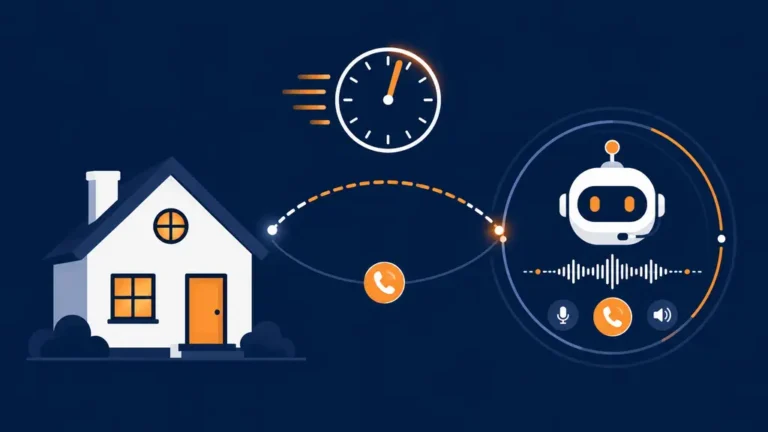



AI outbound calling for insurance agents is a voice system that dials a new lead within seconds of it arriving, qualifies the prospect in natural conversation, and transfers only the ready ones to a licensed producer. It is not a robocall and it is not a dialer. It is the first-response layer that sits in front of your agents.
Insurance sales is a volume business with a compliance problem built into the middle of it. Insurance agents contact 50 to 100 leads on average to write one policy. Those leads arrive from digital forms, aggregators, referrals, and campaigns, often at the same moment, often outside business hours, and almost always with a short attention window before the prospect moves on.
That math does not work at human speed without a compromise somewhere. In most agencies the corner being cut is manual compliance, and the TCPA prices that mistake at 500 dollars per violating call, rising to 1,500 dollars where the violation is willful.
TL;DR
Insurance agents lose shared leads on response time, not on price. A quote form typically reaches three or four agencies at once, and the one that holds a real conversation first usually keeps the account. AI outbound calling closes that gap by dialing within seconds at any hour and handing the producer a qualified prospect with context attached.
The compliance stakes are specific. Prior express written consent under the TCPA is required before an AI-voiced marketing call, statutory damages run 500 dollars per call and 1,500 dollars for willful violations, and revocation of consent has to propagate across every channel you use.
This is the wrong purchase if your lead flow is under a few hundred a month, if your consent records are thin, or if you want AI to quote and bind. It qualifies and routes. Licensed humans still sell the policy.
Key takeaways
- Insurance agents need 50 to 100 leads per written policy, so speed and consistency decide the economics.
- The three failures in insurance outbound are slow first response, thin pre-qualification, and follow-up that stops after two attempts.
- The FCC’s February 2024 ruling treats AI-generated voices as artificial or prerecorded voice under the TCPA, so prior express written consent applies.
- The FCC one-to-one consent rule was vacated in January 2025 and never took effect, though it remains a sound internal policy.
- Residential leads are won on speed. Commercial leads are won on qualification depth before the handoff.
- After-hours leads get a real conversation instead of voicemail, and producers arrive to qualified CRM records.
- Aged lead reactivation is the cheapest pipeline most agencies own, with a 2 to 3 percent reactivation rate on 20,000 records producing 400 to 600 conversations.
Table of contents
- What AI outbound calling for insurance agents is
- Why lead follow-up breaks down for insurance agents
- How the workflow runs, step by step
- The TCPA rules insurance agents cannot ignore
- Residential, commercial, and aged leads qualify differently
- What happens to leads that arrive after hours
- Turning an aged lead database into pipeline
- How to evaluate an AI calling vendor
- What this will not do for insurance agents
- How Bigly Sales approaches insurance outbound
- Insurance AI calling FAQ
- The bottom line
What AI outbound calling for insurance agents is
AI outbound calling for insurance agents is a managed voice system that initiates outbound calls to consented leads, conducts a natural language qualification conversation, and either transfers the prospect live to a licensed agent or books a consultation on the calendar. Everything the prospect says is transcribed, structured, and written back to the CRM.
The distinction that matters legally and operationally is that this is not a recorded message broadcast to a list. The system holds a two-way conversation, listens for intent and hesitation, detects opt-out language in plain English, and stops when it should stop.
It is also not a dialer, and it is not a CRM. Bigly does not sell either of those. If your problem is that your producers cannot dial fast enough, a dialer is a cheaper answer. This is a different approach, aimed at the leads no human was ever going to reach in time.
Why lead follow-up breaks down for insurance agents
Insurance agents running outbound lead follow-up hit the same three failures in the same order, whatever the line of business.
Failure one: response time
A homeowner submits a quote request online. Within seconds that lead has also reached three other carriers. Industry benchmark studies consistently show the agency that holds the first real conversation wins the large majority of shared leads.
The average agency response time is measured in hours. Producers have call lists to work. Managers have other priorities. Leads submitted at 8pm sit untouched until morning. By the time a human dials, the prospect has already spoken to a competitor or stopped paying attention. The pattern is the same one described in our guide to speed to lead, and insurance is the vertical where it costs the most.
Failure two: qualification
When producers do reach a lead, they burn the first several minutes gathering information a machine could have collected before the call began. Ownership status, coverage type, current provider, budget range, and timeline are all mechanical questions. That time is expensive when a producer works a 50-to-1 lead-to-policy ratio.
Failure three: follow-up consistency
Most conversions require multiple contacts, yet most insurance agents abandon a lead after one or two unanswered attempts. The leads that would have converted on the fifth or sixth touch simply never receive one. Human follow-up discipline degrades under volume, and no amount of coaching fixes that permanently.
How the workflow runs, step by step
- Step 1. Instant speed to lead. The moment a lead enters the pipeline from a web form, an aggregator, or a campaign, the system places a call within seconds regardless of hour. No queue, no shift dependency.
- Step 2. Natural language qualification. The AI runs a real conversation rather than a menu. It collects coverage type of interest, current provider, ownership status, approximate budget, and timeline, and it listens for hesitation as well as answers.
- Step 3. Compliance enforcement. Before the call is placed, consent for that specific lead is verified. State dialing windows are enforced automatically. Do Not Call suppression runs in real time. Opt-out language triggers immediate cross-channel suppression.
- Step 4. Live transfer or booking. When the lead meets your criteria, the call transfers to a licensed agent with the full conversation context attached, or a consultation is booked directly on the calendar.
- Step 5. CRM sync. Transcript, recording, qualification answers, and disposition are pushed to the CRM after every call. No manual logging and no data gaps.
The TCPA rules insurance agents cannot ignore
Insurance sits at the intersection of high call volume and strict regulatory oversight, which makes compliance an operational requirement rather than a legal formality. Insurance agents carry that exposure personally in many states, not just at the agency level.
The FCC’s February 2024 declaratory ruling confirmed that AI-generated voices are treated as an artificial or prerecorded voice under the TCPA. Every AI outbound marketing call to a consumer therefore requires prior express written consent, the same standard that has always applied to prerecorded telemarketing. State attorneys general gained explicit enforcement authority against AI robocalls under the same ruling.
The one-to-one consent rule was vacated
This is the point most published guidance still gets wrong. The FCC adopted a one-to-one consent rule that would have ended bundled consent through lead generators, but the Eleventh Circuit vacated it in January 2025 and it never took effect. There is no legal requirement today that a consumer name your agency individually on the lead form.
Prior express written consent under the TCPA remains the operative standard. Bundled consent captured on an aggregator form that lists multiple sellers is still lawful, and it is also the weakest position to defend when a plaintiff’s firm comes looking. Adopting one-to-one consent as internal policy is worth doing on litigation risk alone, and it costs you very little if your lead vendors already support it.
Revocation is the requirement that actually bites
The FCC rule that does take effect concerns revocation of consent. When a consumer revokes by any reasonable means, in any channel, the suppression must propagate across every channel you use to reach them, and it must apply within a short fixed window. A prospect who tells your AI agent to stop calling has also opted out of your SMS program. Build that logic before you scale the dialing, not after.
The rest of the checklist
- AI identity disclosure. Disclose the use of an AI agent at the start of the call, before any sales content, in clearly audible language rather than a rushed disclaimer.
- Dialing windows. Federal rules restrict calls to between 8am and 9pm in the recipient’s local time. Florida, Oklahoma, and Washington impose stricter versions with additional frequency and consent requirements.
- Registry synchronization. The Federal Trade Commission’s guidance on complying with the Telemarketing Sales Rule requires covered sellers to scrub against the National Do Not Call Registry on a fixed cycle, and internal suppression lists apply on top of it.
- Record retention. Keep the consent artifact, the call recording, and the disposition together. A consent record you cannot produce on demand is not a defense.
Manual management cannot reliably enforce all of this at scale. One distracted producer who misses a state window or fails to log an opt-out creates exposure that grows with call volume. At 500 dollars per violating call, a 10,000-call campaign carries a theoretical maximum exposure in the millions, which is the number that ends up in a demand letter whether or not it ever reaches a verdict. Our TCPA compliance overview covers the full framework.
Residential, commercial, and aged leads qualify differently
Not every insurance lead qualifies the same way, and the AI script has to reflect that. Treating all three the same is the most common configuration mistake insurance agents make in month one.
| Lead type | Buyer urgency | First-touch target | What AI should gather | Handoff trigger |
|---|---|---|---|---|
| Residential | High, comparison shopping in real time | Under 60 seconds | Ownership status, coverage type, current premium, timeline | Live transfer as soon as criteria are met |
| Commercial | Moderate, running an ROI analysis | Same business day | Business type, employee count, current carrier and renewal date, decision authority | Booked appointment with full profile |
| Aged database | Low until circumstances change | Batched, off-peak | Whether the original need still exists, what changed | Transfer only on confirmed re-intent |
Residential
Homeowners, renters, auto, and life prospects decide emotionally and quickly. Start with the two fastest intent signals, ownership status and coverage type, then gather current premium, roof condition for home, or driving history for auto. If the prospect qualifies, transfer live within seconds of hitting the threshold.
Commercial
A small business owner evaluating general liability or workers’ compensation is not responding to urgency. Decision timelines are longer and purchase authority often sits with more than one person. Prioritize decision-maker identification and business profile before routing. An extra 90 seconds of AI qualification produces a materially better producer conversation on the other end, and it stops your most expensive people from opening cold.
Insurance pilot
Put every lead on a call in under a minute
We will map your lead sources, consent records, and transfer rules to a live AI campaign. Setup review takes about 30 minutes.
What happens to leads that arrive after hours
This is the part agency owners ask about first. When a lead arrives at 9pm, the AI agent starts a real conversation. Not a phone tree and not a recording. It asks what your producer would ask: what coverage they are looking for, what their current situation is, whether they own or rent, and what their timeline looks like.
All of it is captured and written to the CRM before your team arrives. The producer does not open the callback cold. They already know who the person is, what they need, and how to approach the conversation.
We analyzed 2 million calls for one client last month. One of the clearest patterns in that data was that leads receiving a fast real response, including outside business hours, converted at a materially higher rate than leads that waited until the next day. That pattern is invisible when you review calls one at a time.
Turning an aged lead database into pipeline
Most insurance agents sit on a database of leads that did not convert the first time. Those records are the cheapest pipeline the agency owns, and manual teams almost never work them.
A prospect who submitted a homeowners inquiry 18 months ago may not have converted because the timing was wrong, but they were qualified. Circumstances change. Renewal dates arrive. Life events create new coverage needs. A rate increase makes a previously rejected quote look reasonable.
AI outbound calling lets an agency re-engage that database at scale, contacting thousands of records over a weekend for a fraction of one producer’s monthly cost. As an illustration, a 2 to 3 percent reactivation rate against 20,000 aged records produces 400 to 600 qualified conversations with people who already raised their hand once. Against new lead costs that commonly run 50 to 150 dollars each, the arithmetic on reactivation is not close.
One caveat that matters. Aged records need their consent status re-verified before you dial them, and consent that has gone stale is a reason not to call rather than a technicality to work around.
How to evaluate an AI calling vendor
Insurance agents evaluating this category should ask six questions, in this order.
- Who owns the phone numbers, and are they registered? If the vendor cannot tell you whether your numbers are whitelisted with the carrier analytics providers, your answer rate will decay within weeks no matter how good the voice model is.
- How is consent verified before the dial, not after? Ask to see the actual pre-call check. Post-call reconciliation is not compliance.
- How are state dialing windows and frequency caps handled? The answer should be automatic enforcement at the system level, not a setting your operations manager maintains.
- What happens when someone says stop in the middle of a sentence? Ask for a recording of a real opt-out. Language-aware detection and keyword matching are not the same thing.
- Who tunes the campaign? Self-serve tools hand you a script editor. Managed platforms assign someone to refine qualification logic against real outcomes.
- What does the exit look like? Confirm you keep your recordings, transcripts, and number pool if you leave.
Bigly sits in the managed category rather than the self-serve one, and it is more expensive than a script-editor tool for that reason. That is the honest trade.
What this will not do for insurance agents
The AI does not quote, bind, or give coverage advice, and it should not. It gathers facts and routes to a licensed human, because anything past that is unlicensed activity in most states.
It will not rescue a bad lead source. If your consent records are thin or your aggregator is reselling the same form six times, faster dialing multiplies the complaint volume rather than the policy count.
It will not replace producers. It removes the discovery minutes and the after-hours gap so producers spend their time on prospects who are already engaged. Agencies that buy this expecting a headcount reduction are usually disappointed. Agencies that buy it expecting a higher contact rate per producer are usually not.
How Bigly Sales approaches insurance outbound
Bigly Sales is a fully managed AI outbound calling platform for insurance agents and other regulated verticals, including health, life, auto, property and casualty, and commercial lines. It is used by agencies and by call centers running on behalf of insurance agents.
The difference between Bigly and a self-serve tool is the infrastructure that operates around every call rather than the voice technology inside it. Before a single call is placed, Bigly buys and registers dedicated numbers and whitelists them with the analytics engines that decide labeling, which are Hiya for AT&T, TNS for Verizon, and First Orion for T-Mobile. Hundreds of numbers are deployed with local presence matched to your territories, and volume is distributed so per-number velocity stays inside carrier thresholds. That is why Bigly campaigns run answer rates in the 40 to 65 percent range while unmanaged outbound typically sees 10 to 20 percent.
Compliance is enforced at the system level. Consent is validated before every call. State dialing windows, velocity caps, and holiday restrictions apply without manual oversight. Suppression runs in real time and opt-out detection propagates across voice and SMS immediately.
Every call produces a transcript, a recording, and structured qualification data in your CRM, and campaign tuning is continuous against real outcomes. The same infrastructure supports the other verticals listed on our industries page, and the vertical detail for this one lives on the insurance page.
Insurance AI calling FAQ
Is AI outbound calling legal for insurance lead follow-up?
Yes, when it runs on proper compliance infrastructure. The FCC’s February 2024 ruling classifies AI-generated voices as artificial or prerecorded voice under the TCPA, so prior express written consent is required for marketing calls to consumers. Agencies must hold that consent, enforce state dialing windows, run real-time Do Not Call suppression, and disclose the AI at the start of every call. Platforms that enforce those requirements automatically make the model viable at volume. Platforms that leave it to your staff do not.
Is one-to-one consent required before an AI call?
No. The FCC adopted a one-to-one consent rule, but the Eleventh Circuit vacated it in January 2025 and it never took effect. Prior express written consent under the TCPA remains the operative standard, and bundled consent captured through a lead generator is still lawful. That said, one-to-one consent is a sensible internal policy. It is the strongest record to hold if a plaintiff’s firm challenges the call, and most quality lead vendors can already supply it.
How quickly can AI contact a new insurance lead?
Within seconds of the lead record being created, regardless of time of day, producer availability, or queue depth. The trigger is a webhook or API event from your form, aggregator, or CRM rather than a person noticing a new row. In practice the constraint is not the AI, it is how fast your lead source delivers the record to you. Aggregators that batch deliveries every 15 minutes will cap your response time no matter what dials the number.
What information can AI gather before transferring to a licensed agent?
Coverage type of interest, ownership status for home, vehicle, or business, current provider and renewal date, approximate budget or current premium, and timeline. For commercial lines it can also identify the decision-maker, capture business type and employee count, and assess coverage history. The producer receives all of it before the conversation starts, which removes the redundant discovery questions that make a first call feel like a form.
How does AI handle an opt-out during a call?
A properly designed system detects opt-out intent in natural language rather than matching the single word stop. If a prospect says do not call me again, or asks to be removed in any phrasing, the AI ends the call, records the opt-out, and propagates suppression across every outreach channel immediately. This is more reliable than manual compliance, which depends on a tired human doing the right thing on their sixtieth call of the day.
Do insurance agents still need producers if AI qualifies the leads?
Yes. The AI gathers facts and routes. It does not quote, bind, or advise on coverage, and in most states doing so would be unlicensed activity. What changes is where producer time goes. Instead of dialing lists and running discovery, licensed staff spend their hours on prospects who are already engaged and already qualified. Agencies that buy this as a headcount reduction usually regret it. Agencies that buy it as a capacity multiplier usually do not.
What answer rates should an agency expect?
Unmanaged outbound programs commonly run 10 to 20 percent answer rates because their numbers get labeled by carrier analytics engines. Managed infrastructure with registered numbers, controlled per-number velocity, and A-level call authentication runs materially higher, in the 40 to 65 percent range in Bigly campaigns. The variable that moves this most is not the voice model. It is whether someone is actively managing number reputation across the three analytics providers.
Will this work for a small agency?
Usually not, and that is the honest answer. Managed AI outbound is built for teams processing at least a few hundred leads a month, where the infrastructure cost spreads across enough volume to make sense. A two-producer agency writing 30 policies a month will get more from a fast manual callback discipline and a tighter lead source than from an AI calling platform. Revisit it when lead flow outgrows the phones you have.
How long does implementation take?
Number acquisition and carrier registration are the long pole rather than the AI configuration. Expect a couple of weeks before live traffic in most cases, with the first week spent on consent mapping, qualification criteria, transfer rules, and CRM field mapping. Agencies that arrive with clean consent artifacts and a documented qualification standard move faster than agencies that are defining both for the first time during onboarding.
The bottom line
Insurance agents do not lose shared leads on price or on product. They lose them on the hours between the form submission and the first real conversation, and on the follow-up attempts nobody made. Those are structural problems, and no amount of coaching removes them permanently.
An AI first-response layer fixes the structure. It calls in seconds, at any hour, at any volume, and it hands your licensed people a prospect who is already talking. Get the consent records and the number infrastructure right first, because dialing faster on a weak list only makes the complaints arrive sooner.
Built for regulated lines
Qualified transfers, not more dials
Registered numbers, automatic consent and window enforcement, and live transfers to your licensed producers. See it against your own lead flow.