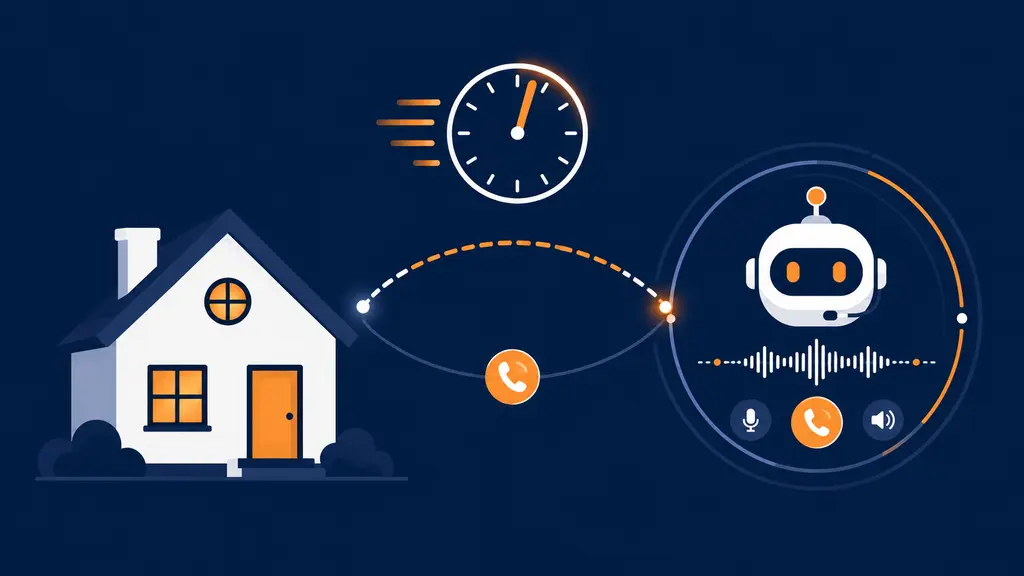


An AI voice agent for real estate is a voice automation system that calls or answers buyer and seller leads, holds a natural-language conversation, asks qualification questions, books appointments, and writes the outcome into the CRM without waiting for a human to make first contact. It sits in front of your agents, not in place of them.
Real estate has always rewarded fast follow-up, and the math has not changed. A buyer sees a listing and submits a form. A seller asks what their home is worth. The window of intent is short, and your team is in showings, in meetings, or asleep. New leads arrive at 9 p.m. on a Saturday.
This guide covers what an AI voice agent for real estate does, which lead types it suits, how it qualifies a buyer or seller, where a human agent still has to take over, and what United States telemarketing law requires before you point it at a list.
TL;DR
An AI voice agent for real estate answers or calls new buyer and seller leads within minutes, runs a structured qualification script, books showings and consultations, and pushes clean notes to the CRM. It fits inbound web inquiries, seller valuation requests, open house follow-up, missed calls, and aged database reactivation.
The 2025 National Association of REALTORS Profile of Home Buyers and Sellers reports that 52% of buyers found the home they purchased through an online search, which is why a slow response to a digital lead costs real money. On the legal side, an AI-generated voice is treated as an artificial or prerecorded voice, so covered consumer telemarketing calls generally need prior express written consent before you dial.
Do not buy one if your business runs on referrals and repeat clients, if your volume is low enough that you personally call every lead within ten minutes, or if you cannot document where your leads came from.
Key takeaways
- An AI voice agent for real estate handles first response and qualification, not the relationship.
- 52% of buyers found their home through an online search, so digital lead response is a revenue workflow, not an admin task.
- The best-fit lead types for an AI voice agent for real estate are inbound web inquiries, seller valuation requests, open house follow-up, missed calls, and aged CRM contacts.
- Booking is only useful when the calendar, CRM, and routing rules are connected to the same workflow.
- An AI-generated voice falls under artificial or prerecorded voice rules, so consent quality decides whether a campaign is lawful.
- Scrub against the National Do Not Call Registry at least every 31 days and suppress opt-outs on the spot.
- Measure appointment rate, show-up rate, and agent acceptance rate, not call volume.
Table of contents
- What the term means
- Why response speed decides who gets the client
- Six ways teams deploy one
- How the agent qualifies a buyer or seller
- Compared with a human inside sales agent
- Which lead types fit best
- Booking showings and consultations
- What TCPA compliance requires
- Why managed infrastructure matters
- The metrics that actually matter
- How Bigly Sales works with real estate teams
- Frequently asked questions
- The bottom line
What an AI voice agent for real estate is
An AI voice agent for real estate is a software system that speaks with buyer and seller leads over the phone, asks the discovery questions a trained inside sales agent would ask, identifies the next step, and routes qualified prospects to the right person on the team. It works on inbound calls and outbound follow-up, and it does not sleep.
What it is not is an agent replacement. It cannot advise on pricing strategy, read a nervous seller across a kitchen table, or negotiate an inspection credit. It handles the layer of work that happens before any of that is possible, which is finding out who is real and who is ready.
The practical value is coverage. Leads arrive in the evening, on weekends, during open houses, and in the gap between two showings. A first-response layer that is always available closes the gap that costs teams the most deals.
Why response speed decides who gets the client
Real estate leads are worth the most while intent is fresh, and the team that responds first usually starts the relationship. Online search is now central to how buyers find homes. The National Association of REALTORS 2025 Profile of Home Buyers and Sellers reports that 52% of buyers found the home they purchased through an online search, ahead of the 27% who found it through an agent.
That matters because digital leads do not wait politely for one agent. A buyer submits multiple inquiries. A seller contacts more than one team. Someone who fills in a form at night keeps browsing and books with whoever replies clearly first.
The Harvard Business Review speed-to-lead study, still the most cited work on this, found that companies responding to web leads within five minutes were far more likely to make contact and qualify the lead than companies that waited thirty minutes. That study is not real estate specific and it is old enough that it should not be quoted as fresh brokerage data. The operational lesson survives anyway. Fast response improves your odds of a real conversation.
The takeaway is narrow. Do not let high-intent leads sit untouched. A working AI voice agent for real estate can respond within minutes, confirm why the person got in touch, collect the details your agent will need, and book a next step while the prospect is still paying attention. Our note on speed to lead covers the measurement side in more detail.
Six ways teams deploy an AI voice agent for real estate
The best use cases are structured, repeatable, and end in a clear outcome. None of them require the system to be charming.
- Inbound web lead response. The agent calls or answers new buyer and seller inquiries within minutes, confirms the reason for the inquiry, and begins qualification.
- Buyer qualification. Timeline, budget, preferred location, property type, financing status, and whether the buyer is already represented.
- Seller intake. Property location, selling timeline, motivation, current listing status, and whether the seller wants a valuation or a consultation.
- Appointment and showing booking. Offer available slots, confirm the time, and sync to the calendar and CRM.
- Open house follow-up. Call attendees the next day, confirm interest, and identify who wants a private showing.
- Aged database reactivation. Work old CRM contacts to find the small percentage who are back in the market and suppress the rest.
These are repetitive and important at the same time, which is the exact combination that human agents handle worst. Producing agents should not spend their best hours chasing every low-intent inquiry by hand.
How the agent qualifies a buyer or seller
A well-configured AI voice agent for real estate qualifies a lead by running your existing discovery sequence consistently, adapting to the answers, and sending a clean summary to the CRM before a human follows up. Most teams already have the sequence. The system just stops it from being skipped at 7 p.m. on a Friday.
The buyer sequence
Open by identifying who the call is on behalf of and referencing the specific inquiry, listing, or search that triggered it. Ask about timeline, then location and property type, then budget and whether the buyer has spoken to a lender. Ask whether they are already working with an agent, because that answer changes everything downstream. If they qualify, offer a showing or consultation. Then log the answers, the summary, the appointment, and the disposition.
The seller sequence
Ask for the property address, the estimated timeline, the reason for selling, the current listing status, the expected price range, and whether they want a valuation or a full consultation. Sellers are usually comparing teams, so the booking offer should come earlier than it does with buyers.
The goal is not to make the system sound clever. The goal is consistency. If the lead is not ready, log it. If the lead is qualified, route it with context. If the lead asks not to be contacted again, detect the intent and update suppression immediately.
An AI voice agent for real estate compared with a human ISA
An inside sales agent, or ISA, handles first contact, qualification, appointment setting, and follow-up so producing agents can focus on showings, negotiations, and closings. That model works well once a team has enough volume to justify the headcount.
The weaknesses are coverage and consistency. Human ISAs work shifts, take breaks, vary in tone and discipline, and are not there at eleven at night. They are also expensive for a team that needs coverage but is not ready for a full-time hire.
| Capability | Human ISA | AI voice agent | Who should own it |
|---|---|---|---|
| First response at any hour | Shift dependent | Continuous | AI |
| Script consistency | Varies by person and day | Identical every call | AI |
| Appointment booking | Strong | Strong when calendar is connected | Either |
| Reading emotional hesitation | Strong | Weak | Human |
| Pricing and negotiation talk | Strong | Should not attempt | Human |
| Cost at low volume | High fixed cost | Usage based | AI |
The honest reading of that table is that the two overlap on about half the job. AI should not touch complex objections, relocation stress, family constraints, pricing strategy, or a high-value listing conversation. First layer automated, relationship layer human.
Which lead types fit an AI voice agent for real estate best
Not every lead should be handled the same way. AI voice works best when the source is repeatable and the goal is clear.
Inbound buyer inquiries from brokerage sites, listing pages, paid search, and landing pages are the highest-fit source. The goal is a fast response, confirmed interest, and a booked showing or consultation.
Seller valuation requests need speed most of all, because the seller is almost certainly comparing agents. Confirm location, timeline, property details, and whether they want a consultation.
Open house follow-up works because the visitor has already shown physical interest. A next-day call sorts the browsers from the buyers.
Aged CRM contacts are the least glamorous and often the highest return, because most teams never worked them properly the first time.
Missed-call follow-up and after-hours inquiries round out the list. Both are pure coverage problems, which is what automation solves best. Both also require the campaign to be configured lawfully before you turn it on, which is covered further down.
See it on your leads
Hear an AI agent qualify a buyer lead
We will run your qualification script, your calendar rules, and your handoff on one call. Twenty minutes, nothing to install.
Booking showings and consultations
An AI voice agent for real estate can book showings and consultations when it is connected to the team calendar, the CRM, and the routing rules. Booking is the clearest use case because most leads do not need a long conversation. They need a confirmation and a time.
In practice the exchange is short. The agent references the property or search that prompted the inquiry, asks whether the person would rather see the home or speak with an agent first, offers two or three slots, confirms, and sends the details.
For buyer leads the appointment is usually a showing or a buyer consultation. For seller leads it is a listing consultation or valuation call. For open house leads it is a follow-up showing.
Booking is only worth automating if it stays attached to the rest of the process. The call summary, the lead answers, and the assigned agent all have to travel with the appointment. A calendar invite with no context just moves the discovery work onto the person who least wanted it.
What TCPA compliance requires before you dial
For covered consumer telemarketing calls using an AI-generated, artificial, or prerecorded voice, real estate teams generally need prior express written consent before dialing, plus compliance with do-not-call, opt-out, calling-window, and state-law rules.
In February 2024 the FCC confirmed that AI-generated voices fall under the Telephone Consumer Protection Act rules for artificial or prerecorded voice calls. A dynamic, modern-sounding voice is still an artificial voice as far as the statute is concerned.
The FTC Telemarketing Sales Rule applies on top of that, covering disclosures, misrepresentations, calling hours, caller ID transmission, abandoned calls, business records, and do-not-call obligations. The FTC publishes its own compliance guidance for the Telemarketing Sales Rule, which is worth reading before a campaign rather than after.
On do-not-call, the federal baseline is not real-time validation before every dial. Covered sellers and telemarketers must update calling lists against the National Do Not Call Registry at least every 31 days. For high-volume calling, treat that as a floor and check suppression much closer to the moment of dialing.
Plan for opt-outs from the start. Consent may be revoked by any reasonable means, and callers must honor do-not-call and revocation requests within a reasonable time not exceeding 10 business days. The cross-channel provision of the FCC revocation rules takes effect on January 31, 2027, meaning a revocation given in one channel applies to that caller across channels. For an automated system, immediate suppression is the only workable standard. If a lead says stop calling me, remove me, or do not contact me, the system should log it, timestamp it, suppress the number, and block further campaign calls.
Why managed infrastructure matters
A basic voice tool can make calls. That is not the same as an AI voice agent for real estate that is ready to qualify leads. What a team needs is a workflow, and a workflow has to answer questions before launch.
- Where did the lead come from and what did they consent to
- Is the number eligible for contact and inside the allowed calling window
- What script will be used and what questions will be asked
- What happens if the lead wants a showing, is already represented, or opts out
- What gets pushed to the CRM and who receives the qualified lead
That is the difference between unmanaged voice software and a managed program. A managed platform helps build the campaign, configure the flow, connect the CRM, apply suppression logic, capture call records, and monitor performance.
No platform removes compliance risk, and any vendor claiming otherwise is selling you something. Legality still depends on lead source, consent quality, campaign purpose, script language, recipient type, state rules, and how your team uses the system. The defensible claim is narrower. Managed infrastructure reduces the chance that compliance and follow-up depend entirely on someone remembering to do them. If you are comparing vendors on that axis, see our guide to TCPA compliant AI calling platforms.
The metrics that actually matter
Call volume is the vanity metric of this category. It tells you the system is switched on and nothing else.
Track contact rate to see whether your numbers and calling times are working. Track qualified lead rate to see whether the script is separating real prospects from browsers. Track appointment rate and show-up rate together, because an agent whose bookings do not show has an over-eager script, not a busy calendar.
Track agent acceptance rate, which is the share of routed leads your producing agents agree were worth the handoff. It is the fastest way to find a qualification threshold set too loosely.
Track opt-out rate by lead source. A source with a high opt-out rate is usually a consent problem, and it is cheaper to find it in a dashboard than in a demand letter.
Then track closed revenue attributable to AI-qualified leads. Everything above it is diagnostic.
How Bigly Sales works with real estate teams
Bigly Sales runs managed AI voice agents for teams that want the workflow operated rather than assembled. For real estate teams, that covers inbound lead response, buyer qualification, seller intake, appointment booking, open house follow-up, aged database reactivation, and CRM-ready call logging.
An AI voice agent for real estate is only as good as the workflow behind it, so we help define the qualification flow, collect the right information, route qualified prospects, capture transcripts and recordings where permitted, and push results into the CRM. For teams buying portal leads or running paid campaigns, the routing and logging matter as much as the conversation.
The caveat is the same one we give everyone. This will not fix a lead source with bad consent records, and it will not make an unqualified lead worth an agent’s afternoon. It removes the delay and the inconsistency in front of the work your agents are actually good at.
AI voice agent for real estate FAQ
What is an AI voice agent for real estate?
It is a software-based voice system that calls or answers buyer and seller leads, holds a natural-language conversation, asks qualification questions, captures lead details, books appointments, and updates the CRM. It works as an automated first-response and qualification layer sitting in front of your producing agents rather than as a replacement for them.
How fast can it respond to a new lead?
Within a minute of the lead entering the CRM in most configurations, including evenings and weekends when your team is unavailable. Speed is the main reason teams adopt it. The relevant comparison is not the AI against your best agent, it is the AI against how long that lead would otherwise sit before anyone called it.
What questions should it ask a buyer lead?
Timeline, preferred location, property type, budget range, financing or pre-approval status, and whether the buyer is already working with an agent. That last question matters most, because a represented buyer changes what your team can and should do next. Finish by offering a showing or consultation and logging the disposition.
Can it book showings and consultations?
Yes, when it is integrated with your calendar and CRM. It can offer available times, confirm the appointment, book showings or consultations, and send the details to the assigned agent. The important part is that the call summary and the lead answers travel with the booking so the agent is not starting discovery from scratch.
Is AI voice calling for real estate TCPA compliant?
It can be, when the campaign follows the applicable TCPA, FCC, FTC, do-not-call, consent, opt-out, calling-window, and state telemarketing requirements. The FCC confirmed in February 2024 that AI-generated voices fall under the rules for artificial or prerecorded voice calls, so covered consumer telemarketing generally requires prior express written consent before dialing.
Which real estate leads suit AI qualification best?
An AI voice agent for real estate suits high-volume and repeatable sources. Inbound web inquiries, buyer leads from listing pages and paid search, seller valuation requests, open house follow-up, missed-call callbacks, and aged CRM contacts. Referral and repeat-client leads are a poor fit, because those relationships depend on the person calling being someone the client already knows.
Will leads be annoyed that they are talking to AI?
Some will, and you should plan for it rather than hope otherwise. Disclosing what the caller is early tends to reduce friction rather than increase it, and a system that hands off cleanly to a human on request performs better than one that tries to stay in the conversation. Track opt-out rate by source to see the real answer for your market.
Does it replace an inside sales agent?
It replaces the repetitive part of the role, not the role. Teams that keep their ISA and move them onto escalated conversations, agent coordination, and higher-value follow-up tend to get more out of both. Teams that cut the ISA first and configure the system afterwards usually end up with fewer appointments than they started with.
How do I measure whether it is working?
Contact rate, qualified lead rate, appointment rate, show-up rate, agent acceptance rate, opt-out rate by lead source, and closed revenue from AI-qualified leads. Call volume is not a success metric. If appointments rise but show-up rate falls, the qualification threshold is too loose and the script needs tightening.
What does it cost compared with hiring an ISA?
Pricing is usage based rather than a fixed salary, which is why it appeals to teams that need coverage but cannot justify a full-time hire. The comparison is not purely financial though. An ISA can handle situations the system cannot, so the sensible question is which portion of the workload each should carry at your volume.
The bottom line
Real estate teams do not usually lose leads through lack of effort. They lose them because the response system breaks down. Leads arrive while agents are busy, follow-up happens late, notes get missed, old contacts sit untouched, and after-hours inquiries wait until morning.
An AI voice agent for real estate fixes the timing and the consistency. An AI voice agent for real estate gives you a faster first response, a qualification process that runs the same way every time, cleaner CRM data, and a better-briefed handoff. It does not give you trust, advice, negotiation, or a closed deal. Let the system handle first contact, discovery, booking, and routing, and let your agents handle the part clients actually hire them for.
Start with your database
Find out what your aged leads are worth
Send us a sample list and we will map the qualification flow, the routing, and the compliance controls it needs. No build, no commitment.