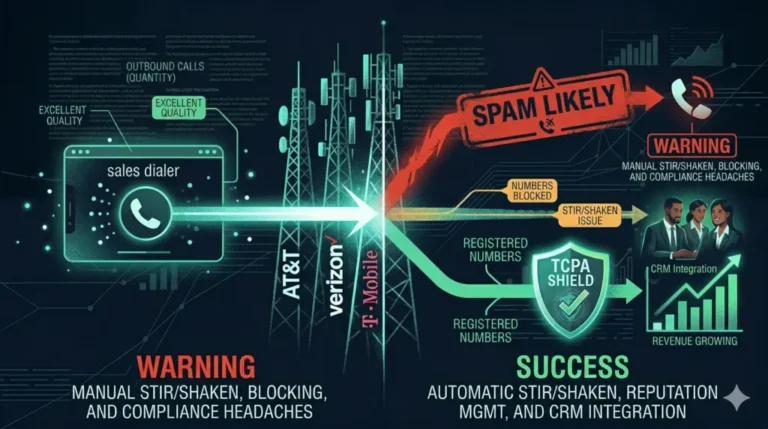



A sales call script is a written framework for an outbound call that sets the opening, the qualifying questions, the value statement, the objection responses and the close, so the rep spends attention on the prospect rather than on what to say next. It is a structure to work from, not lines to read aloud.
Below are 32 sales call scripts covering cold calls, follow-ups, objections, expansion, referrals, voicemail and gatekeepers. Each one is short on purpose. Long scripts get abandoned in the first 20 seconds of a real call.
Everything here was rewritten for 2026, including the compliance section, which now reflects the current state of consent law rather than the rules people still repeat from 2024.
TL;DR
A sales call script should fit on one screen and cover five things: a reason for calling, two or three qualifying questions, a one-sentence value statement, prepared answers to your four most common objections, and a specific next step. Anything longer gets ignored under pressure.
Scripts raise the floor, not the ceiling. They make a new rep competent in a week and stop a good rep from improvising past a hard objection. They will not create demand where none exists, and a script read word for word performs worse than no script at all.
Key takeaways
- Every effective sales call script has five parts: opening, qualifying questions, value statement, objection handling and a specific close.
- Keep the whole thing under roughly 150 words of spoken text so a rep can hold it in working memory.
- Ask for a small, concrete next step rather than a vague agreement to stay in touch.
- Answer objections with a question, not a counterargument, in the first response.
- Voicemails should run 20 seconds and give exactly one reason to call back.
- The FCC one-to-one consent rule was vacated in January 2025 and never took effect, but prior express written consent under the TCPA still applies.
- Cross-channel revocation of consent becomes a requirement on January 31, 2027, so build the plumbing for it now.
Table of contents
- What a sales call script is
- The five parts every sales call script needs
- Cold sales call scripts
- Follow-up and re-engagement scripts
- Objection handling scripts
- Expansion, referral and closing scripts
- Voicemail, gatekeeper and event scripts
- Which sales call script to use when
- How to customize a sales call script
- Mistakes that kill outbound calls
- Compliance rules for outbound calling
- Where AI helps and where it does not
- Sales call script FAQ
- The bottom line
What a sales call script is
A sales call script is a documented conversation plan that gives a rep a tested opening, a set of qualifying questions, a value statement, prepared objection responses and a defined close for one specific calling scenario. The scenario matters. A script written for a cold B2B prospect will fail on a warm inbound lead, and the reverse is worse.
Scripts serve two jobs. They shorten ramp time for new reps, because a structure can be taught in days while judgment takes months. And they standardize what gets tested, because you cannot improve a pitch that changes on every call.
Why reading a script fails
Prospects hear recitation immediately. The fix is to memorize the structure and the first sentence, then speak the rest normally. Reps who internalize the shape of the call sound prepared. Reps who read sound like a recording.
The five parts every sales call script needs
The opening
State who you are, why you are calling this specific person, and ask permission to continue. A reason tied to something observable about their business outperforms a generic benefit claim.
Qualifying questions
Two or three questions that establish whether there is a real problem, a budget and a decision path. Ask about the current situation before you ask about the goal, because people describe problems more honestly than ambitions.
The value statement
One sentence connecting what they just told you to what you do. If it works without their answer, it is a pitch rather than a value statement.
Objection handling
Prepared responses to your four most frequent objections. The first move on any objection is a clarifying question, never a rebuttal.
The close
A specific, small next step with a time attached. Twenty minutes on Thursday beats a follow-up sometime next week.
Cold sales call scripts
1. B2B cold call, no prior contact
Use when the prospect has never heard from you.
“Hi [Name], this is [You] with [Company]. I know I am calling out of the blue. We work with [role] at [industry] companies who are dealing with [specific problem]. Is that something on your list this quarter, or am I off base?”
2. B2C cold call for a considered purchase
Use for consumer products with a real decision behind them.
“Hi [Name], this is [You] from [Company]. I am calling because you looked at [product category] recently. Most people at that stage are weighing [option A] against [option B]. Which one are you leaning toward?”
3. Trigger event cold call
Use after funding, a hire, an expansion or a product launch.
“Hi [Name], I saw [Company] just [event]. When that happens, [function] usually gets stretched within about 60 days. How are you planning to cover that?”
4. Competitor displacement opener
Use when you know their current provider.
“Hi [Name], this is [You] at [Company]. I know you are running [incumbent]. I am not calling to talk you out of it. I want to ask one question: what is the thing it still does not do for you?”
5. Industry insight opener
Use when you have real data for their vertical.
“Hi [Name], we just finished looking at [metric] across [number] [industry] companies. The average came in at [figure]. Do you know roughly where you sit on that?”
6. Short permission-based opener
Use when call time is tight.
“Hi [Name], this is [You] from [Company]. This is a sales call. Can I have 30 seconds to tell you why, and then you decide?”
7. Referral-sourced cold call
Use when someone pointed you to them.
“Hi [Name], [Referrer] at [Company] suggested I call you. They were dealing with [problem] and thought you might be looking at the same thing. Are they right?”
Follow-up and re-engagement scripts
8. Warm follow-up after a download or form fill
“Hi [Name], this is [You] from [Company]. You picked up [asset] on [day]. Most people who grab that are trying to solve [problem]. What made you look?”
9. Follow-up after a demo
“Hi [Name], thanks again for the time on [day]. You mentioned [concern] at the end and I did not answer it fully. I have the answer now. Do you have five minutes?”
10. Follow-up on an unanswered call
“Hi [Name], I tried you [day] about [topic]. I will keep this short. Is [problem] still a priority, yes or no? Either answer helps me.”
11. Reconnecting with a lost lead
“Hi [Name], this is [You] at [Company]. We spoke back in [month] and the timing was wrong. I am calling because [what changed]. Worth another look, or should I close the file?”
12. Long-term nurture check-in
“Hi [Name], you asked me to circle back this quarter. I am doing that. Has anything moved on [initiative], or is the timeline still the same?”
13. Post-webinar follow-up
“Hi [Name], you joined our session on [topic]. The question that came up most afterward was [question]. Was that one of yours?”
14. Post-trade-show follow-up
“Hi [Name], we met at [event] near the [landmark] stand. You said you were looking at [topic]. I promised to follow up with [specific thing]. Is now a bad time?”
Outbound at scale
Run these scripts without hiring more reps
See how an AI voice agent works a call list, handles objections and books the meeting straight into a calendar. A live walkthrough takes 20 minutes.
Objection handling scripts
15. Not interested
“Fair enough. Most people say that before they know what it is about. Can I ask what you are using today for [problem]? If it is working, I will leave you alone.”
16. Too expensive
“That is a reasonable reaction to the number. What are you comparing it against, the cost of doing nothing or another quote? The answer changes what I show you next.”
17. Send me more information
“Happy to. So I send the right thing rather than a brochure, what is the one question you need answered before this is worth your time?”
18. We are happy with our current provider
“Good, that means they are doing their job. When does that contract come up? I will call you 60 days before, and until then I will stay out of your way.”
19. We are not looking right now
“Understood. Is that a budget timing thing or a priority thing? If it is priority, I will stop. If it is timing, tell me the month and I will call then.”
20. We need more time to decide
“That is fine. What has to be true by [date] for this to be a yes? If I can help get one of those items resolved, tell me which.”
21. I am not the decision maker
“Thanks for saying so. Two things then. Who owns this, and what would you want them to know about it? I would rather you look good bringing it to them than have me cold call them.”
22. How are you different from [competitor]?
“Honestly, on [shared capability] we are similar. Where we differ is [specific difference], and it only matters if [condition] applies to you. Does it?”
Expansion, referral and closing scripts
23. Upsell to an existing customer
“Hi [Name], you have been on [plan] for [duration] and your [usage metric] has grown [amount]. There is a version of this that fits that better. Want me to run the numbers?”
24. Win-back for a lapsed customer
“Hi [Name], you were with us until [month]. I am not going to pretend I know why you left. Can you tell me, so I know whether it is fixed?”
25. Asking for a referral
“You mentioned [result] earlier. Who else do you know dealing with the same thing? I am not asking for a warm intro, just a name and whether I can use yours.”
26. Discussing return on investment
“Let us use your numbers rather than mine. You said you handle about [volume] a month at [cost]. At [our rate], that is [figure]. Does that math match how you would calculate it?”
27. Closing the deal
“It sounds like [summary of their situation] and this fits. The next step is [specific action] and it takes [time]. Should I send it today or Monday?”
Voicemail, gatekeeper and event scripts
28. Voicemail, first attempt
“[Name], it is [You] at [Company], [phone number]. Calling about [one specific thing relevant to them]. If it is not relevant, ignore this and I will not chase you. [Phone number] again.”
29. Voicemail, final attempt
“[Name], [You] at [Company], last message from me. I will assume [problem] is handled and close the file. If that is wrong, [phone number].”
30. Getting past a gatekeeper
“Hi, I am hoping you can point me the right way. I need whoever owns [function] at [Company]. I am with [Company] and this is a sales call, so if the answer is no, that is fine. Who should I ask for?”
31. Appointment setting only
“Hi [Name], this is [You] at [Company]. I am not going to pitch you on this call. I want 20 minutes on your calendar to show you [specific thing]. Does Thursday morning or Friday afternoon work better?”
32. Time-sensitive offer
“Hi [Name], one reason for the call. [Offer] ends [date]. I did not want you to hear about it afterward. Is it worth 10 minutes, or should I skip it?”
Which sales call script to use when
Picking the wrong sales call script for the situation is the most common cause of a bad outbound call. This is the short version of the decision.
| Script type | Use when | Ask for | Realistic outcome |
|---|---|---|---|
| Cold call | No prior relationship | 30 seconds of attention | Low connect rate, useful qualification |
| Trigger event | Something changed at their company | A short discovery call | Best cold conversion of the group |
| Warm follow-up | They took an action first | A specific meeting slot | Highest conversion, shortest call |
| Objection handling | Mid-conversation resistance | A clarifying answer | Keeps the call alive or ends it cleanly |
| Expansion | Existing customer with growth signals | Permission to model the numbers | Fastest revenue per call |
| Voicemail | No answer after two attempts | One callback reason | Low response, high branding value |
How to customize a sales call script
Start every sales call script the same way, by replacing the placeholders with language your buyers actually use, taken from recorded calls rather than from your website. The phrase your marketing team likes is rarely the phrase the prospect says.
Cut anything that is true of every vendor in your category. If a competitor could say the same sentence, it is not doing work in your script.
Then test one variable at a time. Change the opening for two weeks while holding everything else steady, measure connect-to-conversation rate, and keep the winner. Changing three things at once teaches you nothing.
Set the length rule and enforce it
Cap spoken script text at roughly 150 words. If a section will not fit, it belongs in the objection library rather than in the main flow. Our AI calling glossary defines the terms used across these scripts if any are unfamiliar.
Mistakes that kill outbound calls
Talking through the first objection instead of asking what caused it. The clarifying question is worth more than any rebuttal you have prepared.
Asking for too much at the close. A 60-minute strategy session is a large request from a stranger. Twenty minutes with a stated agenda gets accepted far more often.
Leaving three-minute voicemails. Nobody listens past 25 seconds. Give a name, a number, one reason and the number again.
Calling without checking the do-not-call list first, and calling outside permitted hours. Both are compliance failures rather than technique failures, and both are entirely avoidable.
Compliance rules for outbound calling
Outbound calling in the United States is governed principally by the Telemarketing Sales Rule and the Telephone Consumer Protection Act. The FTC publishes the operative guidance on required disclosures, calling hours, do-not-call obligations and recordkeeping in its guide to complying with the Telemarketing Sales Rule.
Three practical rules apply to every script on this page. Identify yourself and your company at the start. Honor a do-not-call request on the call itself, not just in the CRM afterward. Stay within permitted calling hours for the recipient’s time zone rather than yours.
The one-to-one consent rule
You will still see the FCC one-to-one consent requirement described as binding. It is not. The Eleventh Circuit vacated it in January 2025 and it never took effect. Prior express written consent under the TCPA remains the operative standard for automated marketing calls and texts.
Adopting one-to-one consent as internal policy is still sensible, because it removes the shared-lead ambiguity that drives most litigation. The change that is genuinely coming is cross-channel revocation, which takes effect on January 31, 2027 and will require that a revocation received through any channel be honored across all of them. Our guide to TCPA-compliant calling platforms covers what that means for automated outbound programs.
Where AI helps and where it does not
AI voice agents run structured scripts well. Appointment setting, qualification, follow-up on form fills and confirmation calls are all cases where the conversation has a defined shape and a defined success condition. An agent will work a list of 2,000 numbers at the same energy on call 1,900 as on call one, which no human team does.
Complex negotiation, relationship repair and multi-stakeholder deals are not those cases. Neither is any call where the prospect is angry. The practical split most teams land on is that automation handles the top of the funnel and human reps handle everything after the first qualified conversation, which is the pattern described on our speed to lead page.
The honest caveat
Automated outbound amplifies whatever your script already does. A weak sales call script called 2,000 times produces 2,000 bad impressions faster than a human team could. Fix the script on a small human-dialed sample before you scale it.
Sales call script FAQ
How long should a sales call script be?
Keep spoken text to roughly 150 words. That is about 60 seconds of talking, which is all the structure a rep can hold under pressure while also listening. Objection responses live in a separate reference sheet rather than in the main flow. If your script runs longer than one screen, it will be abandoned partway through the first difficult call and never used again.
Should reps read a sales call script word for word?
No. Memorize the opening sentence and the structure, then speak naturally through the rest. Prospects detect recitation within a few seconds and disengage. The value of a script is that it prevents a rep from freezing on an objection or forgetting to ask for a next step, not that it produces identical wording on every call.
What is the best opening line for a cold call?
State who you are, give a specific reason for calling this person, and ask permission to continue. Reasons tied to something observable about their business outperform generic benefit claims by a wide margin. Naming the call as a sales call also works surprisingly well, because it removes the pretense the prospect is already suspicious of and shortens the first ten seconds.
How do you handle the not interested objection?
Ask a question rather than pushing back. Something like asking what they use today for the problem gives you information and gives them a way to stay in the conversation without conceding anything. If the answer shows the problem is genuinely handled, close the call politely. Arguing with an early brush-off converts rarely and damages the brand for later attempts.
How many follow-up calls should you make?
Most teams stop too early. Three to five attempts across two weeks is a reasonable range for a warm lead, spaced across different times of day. Cold prospects justify fewer. Set an explicit stop rule and say it out loud on the final voicemail, because telling someone you are closing the file produces callbacks more reliably than another polite message.
What should a sales voicemail say?
Four things in about 20 seconds: your name and company, your phone number, one specific reason relevant to that person, and your phone number again. Do not describe the product. The only job of the voicemail is to earn a callback or to be ignored cleanly. Repeating the number is the single highest-value habit, because people are usually writing it down late.
Do outbound sales calls still work in 2026?
Yes, for considered purchases and for business-to-business selling, though connect rates are lower than they were five years ago. What changed is the cost of trying. Automated dialing and AI agents made it economical to work lists that would not have justified a human rep, which shifted the calculation from whether calling works to which segments justify a human on the line.
Is the FCC one-to-one consent rule in effect?
No. The Eleventh Circuit vacated it in January 2025 and it never took effect. Prior express written consent under the TCPA remains the standard for automated marketing calls. Many organizations adopted one-to-one consent as internal policy anyway, because it reduces exposure in shared-lead disputes. The requirement that is genuinely coming is cross-channel revocation of consent, effective January 31, 2027.
Can AI run these scripts on real calls?
For structured scenarios, yes. Appointment setting, lead qualification, form-fill follow-up and confirmation calls all have a defined shape and a clear success condition, which is what automation needs. Negotiation, escalations and multi-stakeholder deals are not good candidates. Most teams automate the first contact and route qualified conversations to a human rep within the same call.
How do you measure whether a script is working?
Track connect rate, conversation rate, meetings booked per hundred dials and show rate for booked meetings separately. Connect rate measures your list and your dialing times. Conversation rate measures the opening. Meetings per hundred dials measures the whole script. Show rate catches the failure where reps book meetings by being vague about what happens next.
The bottom line
A sales call script is a floor, not a ceiling. It makes a new rep useful in days, stops an experienced rep from improvising past a hard objection, and gives you something concrete to test. What it cannot do is create demand, and no wording fixes a badly built list.
Pick three or four scripts from this page that match how you actually sell, cut the placeholders down to language your buyers use, and run them for two weeks before changing anything. Then decide which of those calls still need a person. If you want to see what that looks like at volume, our pricing page shows how automated outbound is costed.
Try it on your list
Watch an AI agent work your outbound scripts
Bring one of your own scripts and a sample list. We will run it live and show you the transcripts and booked outcomes. Takes about 20 minutes.