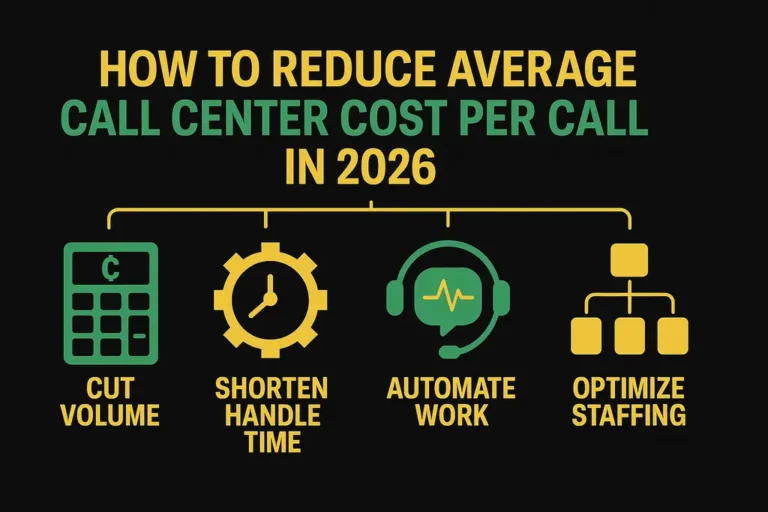



Call center challenges are the recurring operating problems that pull a support or sales floor away from its service targets, and almost all of them fall into six groups: demand, people, technology, customer experience, cost and compliance, and automation.
This guide lists 25 of them. Each one gets the symptom you will actually notice on the floor, the metric it damages, and the first fix that moves that metric. Nothing here needs a new platform to get started.
Read it as a triage list rather than a to-do list. Most centers can fund three or four real changes a year, so there is a prioritization section further down for deciding which call center challenges to take first.

TL;DR
Twenty-five call center challenges, sorted into six clusters, each with the first fix that actually moves the number. If you can only fund one thing this year, fix queue overflow first, because hold time drives abandonment, abandonment drives repeat calls, and repeat calls inflate the volume that caused the overflow.
Set one rule before you start. No new tool goes live until you have measured the metric it is supposed to move for at least four consecutive weeks beforehand, because without that baseline you will never know whether it worked. If your floor handles under roughly 200 contacts a day, most of this is over-engineering, and you will get more out of fixing your schedule and your training by hand.
Key takeaways
- Most call center challenges are downstream of two things: demand you did not forecast and people you did not keep.
- Hold time and abandonment feed each other, so queue work usually returns more than any other single fix.
- Attrition costs more than the raise that would have prevented it, because you pay for recruiting, training, and a long ramp twice.
- Integration gaps show up as agent handle time, not as an IT ticket, so measure screen switching before you buy anything new.
- Automation fails when there is no obvious path to a human, and customers punish that harder than they punish a slow queue.
- Regulation is an operating cost, not a legal footnote, and it belongs on your weekly quality scorecard.
- Baseline every metric for four weeks before you change anything, or you will argue about attribution for the next year.
Table of contents
- What call center challenges are
- Demand and queue challenges
- People and staffing challenges
- Technology and data challenges
- Customer experience challenges
- Cost, compliance, and scale challenges
- AI and automation challenges
- Which call center challenges to fix first
- Mistakes that make call center challenges worse
- Call center challenges FAQ
- The bottom line
What call center challenges are
Call center challenges are the structural and operational problems that stop a contact center from hitting its service, quality, and cost targets on a repeatable basis. They are not one-off bad days. A bad day is a storm or an outage. A challenge is the thing that makes every storm hurt more than it should.
The distinction matters because the two need different responses. A bad day needs a callback offer and an apology. A challenge needs a change to staffing, tooling, process, or policy that survives the next storm.
Every item below is written the same way. First what you will see, then what it costs you, then the first move. Where the fix is a product category Bigly Sales does not sell, such as workforce management software or a CRM, the copy says so plainly.
Demand and queue challenges
These four call center challenges show up in the queue before they show up anywhere else. They are also the cheapest cluster to improve, because most of the work is forecasting and routing rather than hiring.
1. Volume spikes you did not forecast
A product change, a billing run, a weather event, or a press mention pushes contact volume well past what you staffed for, and the queue never recovers inside the same shift.
First fix: build a weekly forecast from the last 13 weeks of interval data and overlay your known events calendar. Then agree in advance what gets switched off at each overflow threshold, whether that is callback offers, deferred outbound, or a message on the IVR.
2. Long hold times and abandonment
Customers wait, then hang up, then call back later, which adds volume to a queue that was already long. This is the loop that makes a staffing shortfall look worse than it really is.
First fix: offer a callback rather than a hold slot once the estimated wait passes a threshold you set and publish. Measure abandonment by interval rather than by day, because a daily average hides the two hours where the damage happens.
3. Low first contact resolution
Issues take two or three contacts to close. Each repeat is a contact you pay for twice, and the customer counts every one of them against you.
First fix: sample 30 repeat contacts and code why the first attempt failed. In most centers it comes down to a few causes, usually missing authority to issue a credit, a knowledge gap on one product, or a handoff that drops context. Fix the top two before you touch anything else.
4. Routing that sends calls to the wrong place
Calls land with agents who cannot resolve them, so they get transferred, and every transfer adds wait time and resets the customer story back to zero.
First fix: measure transfer rate by skill and by IVR path. A path with a high transfer rate is a badly worded menu option, not a badly trained agent. Rewrite the option in the customer’s words rather than in your org chart’s words.
People and staffing challenges
This cluster produces the most expensive call center challenges, because every gap here is paid for twice, once in recruiting and once in the productivity lost while a replacement ramps.
5. Agent attrition
Agents leave inside their first year, often inside their first 90 days, and you carry the recruiting cost, the training cost, and a long ramp before the replacement is productive.
First fix: run stay interviews at day 45 rather than exit interviews at month nine. Ask what would make the person leave, and act on the two answers you hear most. Pay is often not the top answer. Schedule control and a visible path to a second role usually rank higher.
6. Skill gaps on newer products
Agents handle the old catalog well and stall on anything launched in the last two quarters, which shows up as longer handle time and more escalations on exactly the products you most want supported.
First fix: tie every release note to a short mandatory micro-lesson and a two-question check before the product goes live. Track escalation rate by product so the gap appears as a number rather than as anecdotes.
7. Burnout and low morale
Absence rises, quality scores drift down, and your best people start declining the overtime they used to take. Repetitive work and back-to-back difficult contacts cause this faster than volume alone.
First fix: cap consecutive complaint or collections contacts per agent per shift and build a real recovery task into the rotation. Recognition helps, but only after the workload problem is fixed. Recognition on top of an unmanageable queue reads as an insult.
8. Rigid scheduling
Your staffing plan cannot flex to the shape of the day, so you are overstaffed at 7am and underrun at 2pm, and the people you do have are in the wrong place.
First fix: introduce split shifts and short mid-day blocks before you hire. Above roughly 50 agents, workforce management software earns its cost here. That is a category Bigly Sales does not sell, and it is still the right buy for a floor of that size.
Technology and data challenges
Technology call center challenges rarely announce themselves as technology problems. They arrive disguised as handle time, quality scores, and agent complaints.
9. Legacy on-premise systems
Your platform cannot add a channel, cannot scale for a peak week, and every change needs a vendor ticket and a maintenance window.
First fix: stop scoring this as an IT project and price it as an operations one. Add up the change requests you filed last year, the hours you waited on them, and the seasonal capacity you could not buy. That total is the business case for moving to a cloud platform.
10. Integration gaps and data silos
Agents move between four systems to answer one question, and nobody has a single view of the customer, so the same information gets asked for twice.
First fix: watch ten calls and count screen switches. Then integrate the two systems responsible for the most switching. Full consolidation is a multi-year program. Two connectors is a quarter.
11. Thin analytics and reporting
You have daily averages and nothing else, so you can see that yesterday was bad without being able to say which interval, which skill, or which contact reason caused it.
First fix: get to interval-level reporting on four numbers before you buy an analytics suite. Offered volume, service level, abandonment, and first contact resolution. Most platforms already export these and nobody is reading them.
12. Keeping pace with tool changes
Vendors ship features faster than your team can adopt them, so you pay for capability you never turn on, and agents keep using the workaround they learned in month one.
First fix: run one adoption review a quarter. Pick the two shipped features most relevant to your top contact reason, enable them for one team, and measure for four weeks before rolling them out to everyone.
Fix the queue
Answer every call, including the overflow
Bigly Sales AI agents pick up the contacts your team cannot reach and hand qualified conversations to a person. A working setup takes a few days, not a quarter.
Customer experience challenges
These are the call center challenges your customers can name. Everything above stays invisible to them until it turns into one of these five.
13. Falling customer satisfaction
Scores drift down across a quarter without a single obvious cause, which usually means several small failures stacking on the same journeys.
First fix: stop reading the score and start reading the verbatim comments attached to the lowest quartile. Group them into no more than five themes. Fix the top theme completely rather than all five partially.
14. Expectations you never set
Customers expect a resolution timeline you never promised, then treat your normal process as a failure. That gap is a communication problem, not a service problem.
First fix: publish your actual timelines and state them out loud on every contact where the answer is not immediate. An accurate five-day promise beats a vague “as soon as possible” every time.
15. Complex, multi-step queries
Products get more configurable, so a single question now touches billing, provisioning, and a policy exception, and no one agent owns the whole path.
First fix: assign a named owner to the contact rather than to the step. If the resolution needs three teams, one agent still stays on it and reports back. Ownership beats routing on this class of problem.
16. Inconsistent brand voice across channels
The same question gets three different answers depending on whether it arrived by phone, chat, or email, and that erodes trust faster than a slow response does.
First fix: write one answer library and make it the source for every channel. Audit ten contacts per channel per month against it. Consistency is a content problem before it is a training problem.
17. Shifting channel preferences
Demand migrates between voice, chat, messaging, and self-service faster than your staffing model does, so you end up over-resourced on a channel that is shrinking.
First fix: report volume by channel monthly and treat a two-month trend as real. Cross-train for the channel that is growing before you hire for it.
Cost, compliance, and scale challenges
This cluster contains the call center challenges most likely to reach your executive team, because each one carries a dollar figure or a legal exposure.
18. Rising cost per contact
Wages, tooling, and telecom all climb while your budget holds flat, so cost per contact rises even when volume does not.
First fix: separate contacts you want from contacts you caused. Anything driven by a billing error or a confusing form is demand you can remove at the source. That is the only cost reduction that does not hurt service.
19. Changing regulation
Consent, recording, disclosure, and calling-window rules move, and outbound teams are usually the last to hear about it.
First fix: put compliance items on the same weekly quality scorecard as tone and accuracy so they get audited weekly rather than annually. The FTC guidance on complying with the Telemarketing Sales Rule is the baseline for outbound, and the Bigly Sales legal and compliance overview covers how this applies to automated calling. Confirm your own program with counsel.
20. Scaling without losing quality
You double headcount and quality scores fall, because your training and coaching model was built for a floor half the size.
First fix: fix the ratio before the headcount. One team lead per twelve to fifteen agents is a workable planning number. Hiring past that ratio buys capacity and costs consistency.
21. Data security and privacy
Agents handle payment details and personal data across several systems, and any one of those systems can become the incident.
First fix: reduce what agents can see. Mask card numbers, restrict exports, and log access. The FTC guide to protecting personal information works as a practical starting checklist, and the Bigly Sales security page covers how customer data is handled on the platform.
AI and automation challenges
Automation removes some call center challenges and creates four new ones. These four decide whether a deployment survives past its pilot.
22. AI pilots that never scale
A small pilot works, everyone is pleased, and eighteen months later it still handles two percent of volume because nobody owned the rollout.
First fix: name an operations owner, not an innovation owner, on day one. Give the pilot a volume target and a date. A pilot without a scale target is a demo with a budget attached.
23. Chatbot and voicebot limits
Automated assistants handle simple cases and fail on edge cases, and the failure mode is usually a loop rather than a graceful exit.
First fix: cap the number of clarification attempts and hand off to a person once the cap is hit. Then read the transcripts of every handoff for a month. Those transcripts are the highest-value backlog you will find.
24. Over-automation with no escape hatch
Customers cannot reach a person, so they escalate on social media instead, which costs you more than the call you avoided.
First fix: make the route to a human obvious and short on every automated flow. Automation should absorb routine work and get out of the way the moment a contact stops being routine.
25. Agent resistance to change
Agents assume automation is a headcount plan, so adoption stalls and workarounds spread faster than the training does.
First fix: be specific about what changes. If AI is handling first contact and after-hours overflow so agents get better conversations, say that, then show the queue data proving it. Vague reassurance produces exactly the resistance it is meant to prevent. For automated outbound specifically, the Bigly Sales speed to lead breakdown shows where the handoff line usually sits.
Which call center challenges to fix first
Rank the clusters rather than the individual items. The order below works for most centers under 300 seats, because it puts the self-reinforcing loops first and the long programs last.
| Cluster | First symptom | Metric it damages | First fix | Planning horizon |
|---|---|---|---|---|
| Demand and queue | Waits spike at predictable hours | Service level, abandonment | Interval forecast plus callback offers | 2 to 4 weeks |
| People and staffing | New hires leave inside 90 days | Attrition, quality score | Day 45 stay interviews | 1 to 2 quarters |
| Technology and data | Agents switch screens constantly | Handle time, first contact resolution | Integrate the two worst systems | 1 quarter |
| Customer experience | Satisfaction drifts with no single cause | CSAT, retention | Theme the lowest quartile comments | 4 to 8 weeks |
| Cost, compliance, scale | Cost per contact rises on flat volume | Cost per contact, audit findings | Remove self-inflicted demand | 2 quarters |
| AI and automation | Pilot stalls at low volume | Containment, adoption | Name an operations owner | 1 to 2 quarters |
Planning horizons are estimates for scoping conversations, not published benchmarks. Your own numbers will move them. Score each cluster on what it costs you today and how long the fix takes, then take the cheapest short fix first so you have a win to fund the next one.
Mistakes that make call center challenges worse
Buying software before defining the metric. If you cannot say which number should move and by how much, the tool gets judged on impressions and renewed on inertia.
Fixing five things at once. You lose attribution, and next year you repeat the same argument about which change actually worked.
Treating attrition as a recruiting problem. Recruiting harder into a floor people keep leaving is the most expensive way to hold headcount flat.
Shrinking the queue by making yourself harder to reach. Hidden phone numbers and dead-end automation move the contact somewhere you cannot measure, usually a public review.
Reporting daily averages to leadership. Averages hide the two intervals where most of the damage happens, so the reported picture stays calm while the customer experience does not.
Call center challenges FAQ
What are the biggest call center challenges right now?
The three that cost the most are unforecast volume spikes, agent attrition inside the first year, and integration gaps that force agents to work across several systems. They compound each other. Short staffing lengthens the queue, a longer queue makes the job harder, and a harder job raises attrition. Most centers get further by breaking that loop at the queue than by attacking any single item on its own.
How do you reduce call center hold times without hiring?
Offer a callback once the estimated wait crosses a threshold you have set, so the customer keeps their place without holding the line. Then find the intervals where abandonment concentrates and reshape the schedule around them rather than adding headcount across the whole day. Removing self-inflicted contacts, such as calls caused by a confusing invoice, also cuts demand at the source and holds the gain permanently.
Why is agent attrition so high in call centers?
The usual drivers are schedule inflexibility, repetitive high-stress contact mixes, and no visible path to a second role. Pay matters, but in most exit data it ranks below those three. Attrition is also self-reinforcing, because each departure raises the load on everyone who stays. Stay interviews at around day 45 catch the problem while the person is still reachable rather than after they have already accepted another offer.
How do you measure whether a fix worked?
Baseline the metric for at least four consecutive weeks before you change anything, and change one thing at a time. Report at interval level rather than in daily averages, because averages hide the specific hours where service fails. Agree the success threshold in writing before launch. Deciding what counts as success after seeing the results is how organizations talk themselves into keeping tools that did nothing.
Does AI solve call center challenges or add to them?
It does both. AI reliably absorbs repetitive first-contact work, after-hours coverage, and outbound follow-up a human team cannot reach in time. It also introduces new problems: pilots that never scale, automated flows with no clean exit to a person, and agent distrust. The deployments that last name an operations owner, set a volume target with a date, and keep the route to a human short and obvious.
What is a realistic first contact resolution target?
Rather than copying an industry figure, measure your own rate for a month and then improve on it. Sample 30 repeat contacts and code why the first attempt failed. Most centers find two or three dominant causes, usually a missing authority to resolve, one product knowledge gap, or a handoff that loses context. Fixing those causes moves the number more than any target-setting exercise will.
Should a small call center buy workforce management software?
Usually not below about 50 agents. Under that size, split shifts, a published events calendar, and a spreadsheet forecast built from 13 weeks of interval data cover most of the benefit. Above roughly 50 agents the scheduling math stops being manageable by hand and the software pays for itself. Workforce management is not a category Bigly Sales sells, and it is still the right purchase at that scale.
How do compliance rules affect call center operations?
They set hard limits on when you can call, what you must disclose, how consent is captured, and how recordings are stored. For outbound teams the Telemarketing Sales Rule and the TCPA are the baseline, and several states add requirements on top. The practical move is to audit compliance items on the weekly quality scorecard alongside tone and accuracy. Confirm your specific obligations with counsel.
What should a call center fix in its first 90 days?
Build an interval-level view of offered volume, service level, abandonment, and first contact resolution, then leave it running untouched for four weeks. Pick one queue fix and one people fix and run them together, since those two clusters move fastest. Leave technology consolidation and automation rollouts for a later quarter. Both need the baseline data the first 90 days produces.
The bottom line
Call center challenges are mostly loops rather than isolated faults. Volume feeds hold time, hold time feeds abandonment, abandonment feeds repeat contacts, and repeat contacts feed volume again. Break one link and several numbers move together.
Pick the cheapest fix in the cluster costing you most today, baseline it for four weeks, and change one thing at a time. That is slower than a platform migration and it is the approach that leaves you with numbers you can defend. Check what automation can absorb on the Bigly Sales pricing page before you commit to headcount you may not need.
See it live
Put an AI agent on your overflow this week
Walk through your queue data with our team and see which contacts an AI agent can take today. The call runs about 20 minutes.