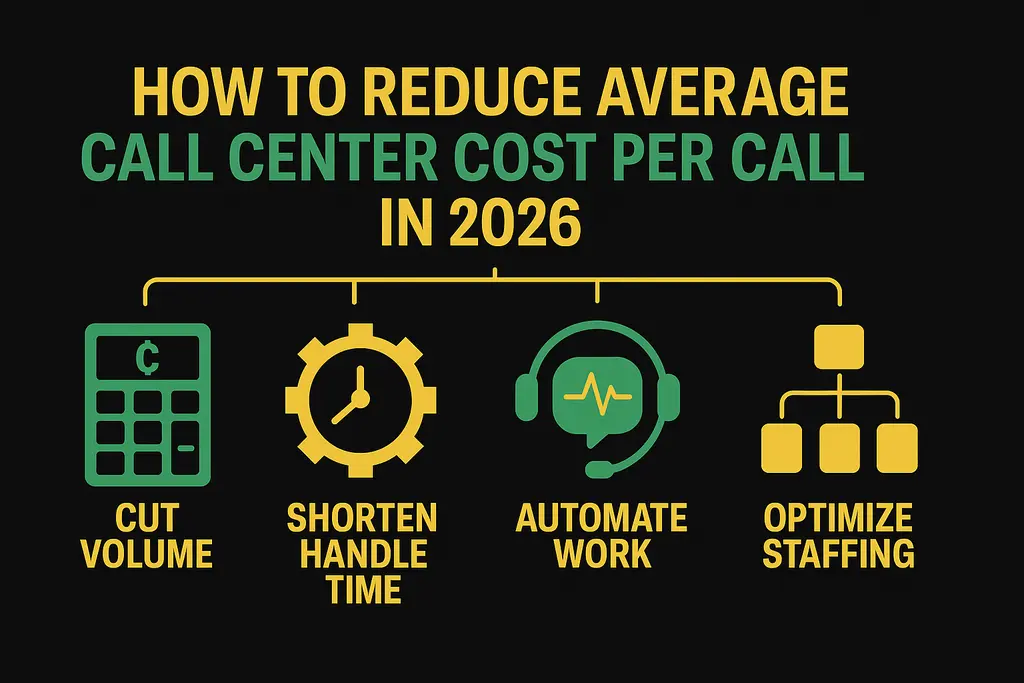


Cost per call is the average amount your call center spends to handle one call, and it is the single clearest number for judging how efficiently the operation runs. A high number means money is leaking somewhere. A low number, paired with happy customers, means the operation is working.
Lowering it takes a strategic approach that goes after root costs instead of symptoms. This guide explains the formula, where benchmarks land in 2026, and ten proven fixes that reduce the number without wrecking service quality.
TL;DR
Cost per call equals total monthly operating costs divided by total monthly call volume, so you lower it by cutting costs, raising handled volume, or both. Labor dominates the math, since a fully loaded in-house agent in the US runs roughly $25 to $40 or more per hour in 2026.
The fastest levers are deflecting routine calls to self-service and AI, tightening handle time, and fixing first call resolution so problems stop generating repeat calls. Be careful, a very low number often signals understaffing rather than efficiency, and chasing it at the expense of service quality raises your true costs.
Key takeaways
- The formula is simple, total monthly operating costs divided by total monthly calls handled.
- Labor is the biggest input, so agent time is where most of the savings hide.
- First call resolution matters more than raw speed, because unresolved calls come back and double the cost.
- The cheapest call is the one that never reaches a human, which is why self-service and AI deflection pay off first.
- AI voice agents cut the cost of qualification and follow-up calls by reserving humans for ready-to-buy conversations.
- Benchmarks vary widely by industry and call complexity, so track your own trend line instead of chasing someone else’s number.
- A rock-bottom number is not automatically good. Pair it with customer satisfaction before celebrating.
Table of contents
- What cost per call is
- Cost per call benchmarks in 2026
- 10 proven ways to reduce cost per call
- What each channel costs compared
- Metrics to track alongside the cost number
- Where the deeper savings live
- A 30-day audit checklist
- Cost per call FAQ
- The bottom line

What cost per call is
Cost per call, often shortened to CPC, is your call center’s total operating cost for a period divided by the number of calls handled in that same period. It converts the entire budget into one per-unit number you can track month over month.
The formula
CPC = total monthly operating costs / total monthly call volume
Count everything on the cost side. Agent pay and benefits, supervisors and QA staff, recruiting and training, software licenses, telecom charges, rent, and utilities all belong in the numerator. Leaving costs out makes the number look better while hiding the leak you are trying to find.
The formula also shows the two levers. You can shrink the numerator by cutting operating costs, or grow the denominator by handling more volume with the same resources. The strongest programs do both at once.
Cost per call benchmarks in 2026
Benchmarks are useful for orientation and dangerous for target setting, because call complexity varies so much between businesses.
What the published ranges look like
Commonly cited figures for a live-agent call run from a few dollars for simple transactional calls to well over ten dollars for technical support. The driver behind those figures is labor. A fully loaded in-house agent in the US, including salary, benefits, training, and overhead, can range from $25 to $40 or more per hour in 2026 depending on role and location.
Handle time converts that hourly rate into a per-call figure. Simple transactions often run 3 to 5 minutes, while technical support calls can run 8 to 12 minutes. At those durations, the labor alone puts a routine human-handled call in the low single-digit dollars and a complex one far higher, before you add rent, software, and supervision.
How to use benchmarks correctly
Compare yourself to your own history, not to a published average built from unlike businesses. Compute your number monthly with a consistent cost definition, segment it by call type, and treat any sudden move in either direction as a prompt to investigate rather than a verdict.
10 proven ways to reduce cost per call
These fixes are ordered roughly by how fast they pay back.
1. Deflect routine calls to self-service
The least expensive call is the one that never happens. A clear IVR, a searchable help center, and good FAQ pages let customers check balances, order status, and store hours without an agent. Every deflected call removes minutes of paid labor from the numerator.
2. Put AI chatbots on the easy questions
AI chatbots answer common questions instantly, around the clock, at near-zero marginal cost per interaction. One warning, deploy them where they can actually finish the job. The Consumer Financial Protection Bureau’s chatbot research documents how bots that trap customers create repeat contacts, which raises costs instead of cutting them.
3. Use AI voice agents for qualification and follow-up
Automating the first screening of inbound leads and the outbound follow-up saves the most expensive minutes of all, sales agent minutes. Platforms like Bigly Sales use AI voice agents to qualify leads and run the initial follow-up by phone and text, so human agents only spend time on prospects who are ready to talk. If you run outbound, make sure your process complies with the FTC’s Telemarketing Sales Rule.
4. Lower average handle time the honest way
AHT is the total time an agent spends on one call, including talk, hold, and after-call work. Cutting a few seconds across thousands of calls saves real money. Do it by removing steps, surfacing customer data instantly, and automating post-call notes, never by pressuring agents to rush.
5. Raise first call resolution
When the first call does not fix the problem, the customer calls back and one issue costs you two or more calls. Give agents the authority and the tools to resolve issues on the spot. FCR improvements compound, because they remove entire calls rather than seconds.
6. Match schedules to volume with workforce management
Overstaffing pays people to wait. Understaffing creates queues, abandoned calls, and costly callbacks. WFM tools, a separate software category from AI calling, forecast volume from historical data so every paid hour meets real demand.
7. Move off premise hardware to the cloud
Cloud call center platforms replace capital spending on servers and maintenance with a predictable subscription that scales with usage. The switch cuts IT overhead immediately and removes surprise repair costs from the numerator.
8. Automate quality assurance
Manual QA means supervisors sampling a tiny fraction of calls at a high hourly cost. AI-based QA reviews every call, flags tone and compliance risks, and frees supervisor hours for coaching, which is the part that actually changes agent behavior.
9. Kill the top call drivers at the source
Pull your call reason data and find the three most common drivers. Shipping mistakes, confusing invoices, and checkout bugs generate calls that no call center tactic can cheapen. Fixing the source with operations, IT, or marketing removes those calls permanently.
10. Make the documentation findable
People call when they cannot find the answer online. Clear, complete, searchable product documentation deflects calls all day, every day, and it costs a fraction of the volume it removes.
Cut the math
See your cost per call drop in one demo
Bring your call volume and current costs, and we will show what AI qualification and follow-up would save. It takes 15 minutes.
What each channel costs compared
Not every contact needs the most expensive channel. The core of cost control is matching each contact type to the cheapest channel that can genuinely resolve it.
| Channel | Cost profile | Best for | Limits |
|---|---|---|---|
| Live human agent | Highest, driven by loaded labor rates | Complex, sensitive, high-value conversations | One call at a time, staffed hours |
| IVR self-service | Low per interaction after setup | Balances, hours, order status | Rigid menus frustrate complex requests |
| AI chatbot | Near-zero marginal cost | Common questions on web and SMS | Must hand off cleanly or it creates repeat contacts |
| AI voice agent | Subscription, scales with volume | Answering, qualification, follow-up, scheduling | Complex judgment calls still need humans |
Metrics to track alongside the cost number
The cost figure only tells the truth when you read it next to quality metrics.
Track first call resolution, customer satisfaction, and abandonment rate on the same dashboard. If cost falls while FCR and satisfaction fall with it, you did not save money, you deferred it into repeat calls and churn. If cost falls while quality holds, the savings are real.
Also watch the mix. As self-service and AI absorb the easy volume, the calls reaching humans get harder on average, so the human-handled figure can rise even while total spending drops. Judge the whole system, not one channel in isolation.
Where the deeper savings live
This guide covers the per-call metric, the benchmarks, and the direct fixes. The structural side, meaning where savings actually come from across labor, attrition, and the build-versus-automate decision, is a bigger topic.
For that layer, read our companion guide on where call center cost savings come from and the build versus automate math. Together the two give you the metric and the strategy behind it.
A 30-day audit checklist
You can baseline the number and find your first savings inside a month. Here is the sequence.
- Week 1, gather the inputs. Pull every operating cost for the last full month, including pay, benefits, training, software, telecom, rent, and utilities. Pull total calls handled for the same month from your phone system.
- Week 2, compute and segment. Run the formula for the whole operation, then split it by call type. Tag each call type as transactional, support, or sales.
- Week 3, find the deflection candidates. List the ten most common call reasons. Mark every reason a customer could resolve through self-service, a chatbot, or an AI voice agent. That list is your savings backlog.
- Week 4, price the fixes. For each backlog item, estimate the monthly minutes it consumes, multiply by your loaded labor rate, and compare that against the cost of the tool that would absorb it.
Repeat the calculation monthly with the same definitions. The trend line, segmented by call type, will tell you faster than any consultant where the operation is leaking money and whether each fix actually worked.
Cost per call FAQ
How do you calculate cost per call?
Divide total monthly operating costs by total monthly call volume. Include agent pay and benefits, supervision, recruiting and training, software, telecom, rent, and utilities in the cost side. Use the same definition every month so the trend is comparable. Segment by call type if you can, because a blended average hides where the money actually goes.
What is a good cost per call in 2026?
There is no single good number, because call complexity varies so much. Commonly cited ranges run from a few dollars for simple transactional calls to well over ten for technical support. Your own trend matters more than any published average. A falling number with stable satisfaction and first call resolution is the real target.
What costs should be included in the calculation?
Everything the operation consumes. That means salaries, benefits, and bonuses for agents and supervisors, recruiting and training spend, software licenses, telecom charges, hardware, rent, and utilities. Many teams undercount by omitting training and management overhead, which flatters the number while hiding the true cost of turnover and supervision.
What is the biggest risk when lowering cost per call?
Sacrificing quality for speed. When agents rush to hit a lower handle time target, they resolve fewer problems, customers call back, and the total cost of each issue goes up. Every cost program should pair the cost metric with first call resolution and satisfaction so you catch that trade before it compounds.
Is a low cost per call always a good sign?
No. A very low number can mean understaffing, which shows up as long waits, high abandonment, and frustrated customers who churn. It can also mean costs were left out of the calculation. Treat a low figure as healthy only when satisfaction scores and resolution rates are strong at the same time.
What is an acceptable average handle time?
It depends on the industry and the complexity of the call. Simple transactions often run 3 to 5 minutes, while technical support can run 8 to 12 minutes. Rather than chasing an outside benchmark, work on improving your own AHT over time by removing steps and automating after-call work.
How quickly do cost reduction efforts pay off?
Self-service deflection and workforce management improvements show up within the first months. Labor savings from better handle time and retention typically land in three to six months. Full return on larger technology investments usually takes one to two years, so sequence the fast levers first and let them fund the slower ones.
Does AI actually reduce cost per call?
Yes, in two ways. It removes routine calls from human queues entirely, and it automates the minutes around each human call, like qualification, screening, and post-call notes. The savings are largest where routine volume is high. AI does not remove the need for humans on complex, high-stakes conversations.
What do most businesses get wrong when cutting call center costs?
They fixate on average handle time while ignoring first call resolution. Forcing shorter calls makes agents rush, problems go unresolved, and customers call back immediately. The repeat calls quickly cost more than the seconds saved. Programs that work treat speed and resolution as one combined goal, never as separate targets.
The bottom line
Reducing cost per call comes down to a dual focus. Get the most from your expensive human minutes through better handle time, resolution, and scheduling, and remove the routine volume entirely with self-service and AI so those minutes are spent where they earn.
Run the formula monthly, watch it next to satisfaction and resolution, and be suspicious of any savings that show up as worse service. Cheap calls that create repeat calls are not cheap.
Do the numbers
Find out what your routine calls really cost
We will map your call types to the cheapest channel that can resolve them and price the difference. One short call gets you the breakdown.