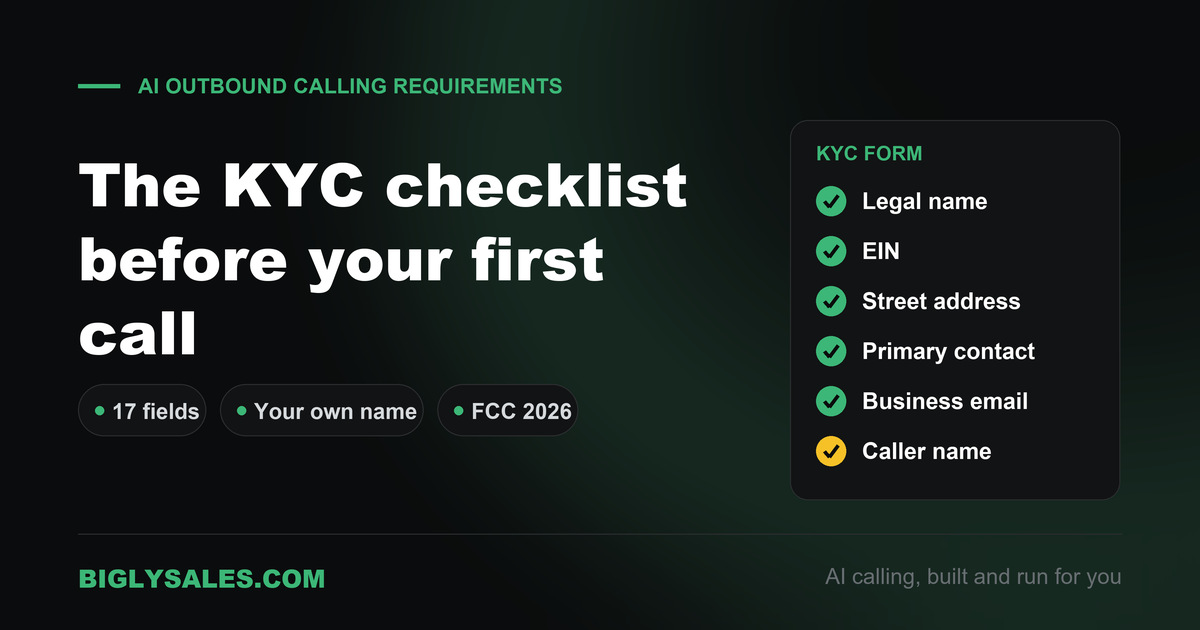


AI outbound calling requirements start before your first dial. Your carrier has to know who you are.
That step is called KYC, short for know your customer. Skip it, or fill it in wrong, and your calls get blocked, labeled Spam Likely or never leave the network.
Here is the exact checklist our team uses to get outbound accounts live. Every field, why it is asked and where teams trip up. Plus the new FCC proposal that could make it stricter.
TL;DR
KYC for AI outbound calling is the identity check a phone provider runs on the business behind the calls. Expect about 17 fields, including legal name, EIN, street address, a primary contact and a caller name of up to 15 characters. Those same details feed STIR/SHAKEN, CNAM, the Free Caller Registry and 10DLC, so one mismatch can break all of them. The FCC proposed tougher KYC rules on April 30, 2026, including a $2,500 per call base fine for providers. KYC proves who is calling but does not replace TCPA consent.
Key Takeaways
- KYC comes before every other outbound calling requirement.
- The standard form is about 17 fields and takes 15 minutes if your details are ready.
- Your legal name has to match your EIN records everywhere.
- Register numbers under your own company and business email, never your vendor’s.
- CNAM names max out at 15 characters on most providers.
- FCC 26-27 proposes ID checks and per call fines. It is still a proposal.
- KYC is not consent. TCPA rules still apply to every AI call.
Table of contents
- What KYC for outbound calling is
- Why carriers ask for it before your first call
- The 17 field KYC checklist
- Register numbers under your own company
- Where your KYC details go
- Why KYC and caller ID registrations get rejected
- How long it takes
- The 2026 FCC KYC proposal
- When a number has to be retired
- The rest of the AI outbound calling requirements
- Who this is wrong for
- AI outbound calling requirements FAQ
- The bottom line
What KYC for outbound calling is
KYC for outbound calling is the check a phone provider runs to confirm the real business behind a set of numbers before those numbers can call the public.
It is a short form. Company name, tax ID, address, a contact person and the name you want on caller ID.
If you have opened a business bank account, you have done this before. Same idea. Different industry.
For AI calling it matters even more. An AI agent can dial thousands of people in an afternoon. Carriers know that. So the first question is always the same. Who is this, and can we find them if something goes wrong?
If you are new to the category, start with our guide on what AI outbound calling is. This post is the paperwork side.
Why carriers ask for it before your first call
Because the law already makes them.
FCC rule 47 CFR 64.1200(n)(4) says originating providers must take “affirmative, effective measures” to stop new and renewing customers from making illegal calls. The FCC reads that as two duties. Know your customers. And exercise due diligence.
So when a provider asks for your EIN, it is not being difficult. It is covering itself.
It also protects you. Weak outbound calling compliance on one account can drag down the reputation of the numbers around it.
Our CEO Tom Ryan has watched bad actors try to slip onto calling and messaging platforms for years. His answer has not changed. “The biggest one is just KYC, just know your customer. Actually get on a phone call with them and meet them before doing outbound.”
The 17 field KYC checklist
This is the form Tom read out, field by field, in our Monday team meeting on November 2, 2026. It is the same list carriers and caller ID services keep asking for.
His summary. “This is not hard information to get.”
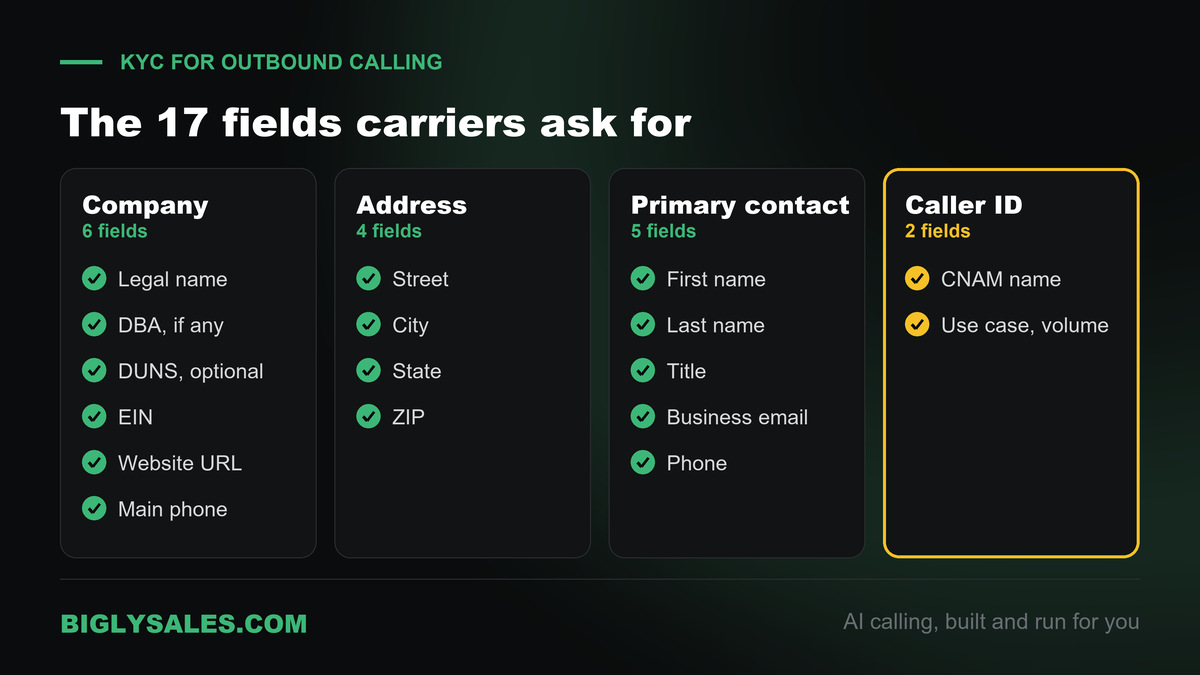
| Field | Why it is asked | Where to find it | Common mistake |
|---|---|---|---|
| 1. Legal company name | Ties the numbers to a real entity | Articles of incorporation, IRS EIN letter | Using the brand name instead of the legal name |
| 2. DBA, if any | Explains a trade name that differs from the legal one | State or county DBA filing | Showing a DBA on caller ID with no filing behind it |
| 3. DUNS number, optional | Extra business identity check | Dun & Bradstreet lookup | Leaving out a DUNS you already have |
| 4. EIN | The anchor for every registration | IRS letter CP 575 or 147C | A legal name that does not match the IRS record |
| 5. Corporate website URL | Proves a public business presence | Your live site | A site that is down or shows a different company name |
| 6. Main business phone | A callback line for the business | Your main line | Listing one of the outbound numbers |
| 7 to 10. Street, city, state, ZIP | Physical location of the business | Same as the EIN record | PO boxes and old addresses |
| 11 to 13. Contact first name, last name, title | A real person who answers for the calls | An owner or manager | Naming the vendor’s rep |
| 14. Contact email | Verification and notices | Your own domain | Gmail, Yahoo or the vendor’s domain |
| 15. Contact phone | Direct line to that person | Their mobile or desk | The main line again |
| 16. CNAM, the caller name | The name people see on caller ID | Your legal name or DBA, shortened | Over 15 characters or not matching records |
| 17. Additional details | Use case and expected volume | Your campaign plan | Leaving it blank |
Have these ready in one document before you sign with any calling platform. You will paste them more than once.
Register numbers under your own company
This is the mistake we see most.
A team buys a calling platform. The platform buys numbers. And the numbers get registered under the platform’s name and email.
Then the AI agent says “Hi, this is Sarah from Acme Roofing” from a number registered to some software company. That mismatch is exactly what spam filters look for.
Our engineers put it simply in that same meeting. The numbers have to be registered with the business email of the business. A biglysales.com email “is not going to fly.”
The Free Caller Registry agrees. Before it accepts a submission, it makes you confirm you are not registering numbers for another business.
Where your KYC details go
You fill in the form once. Your details then travel to five different places. One typo and it breaks in all five.
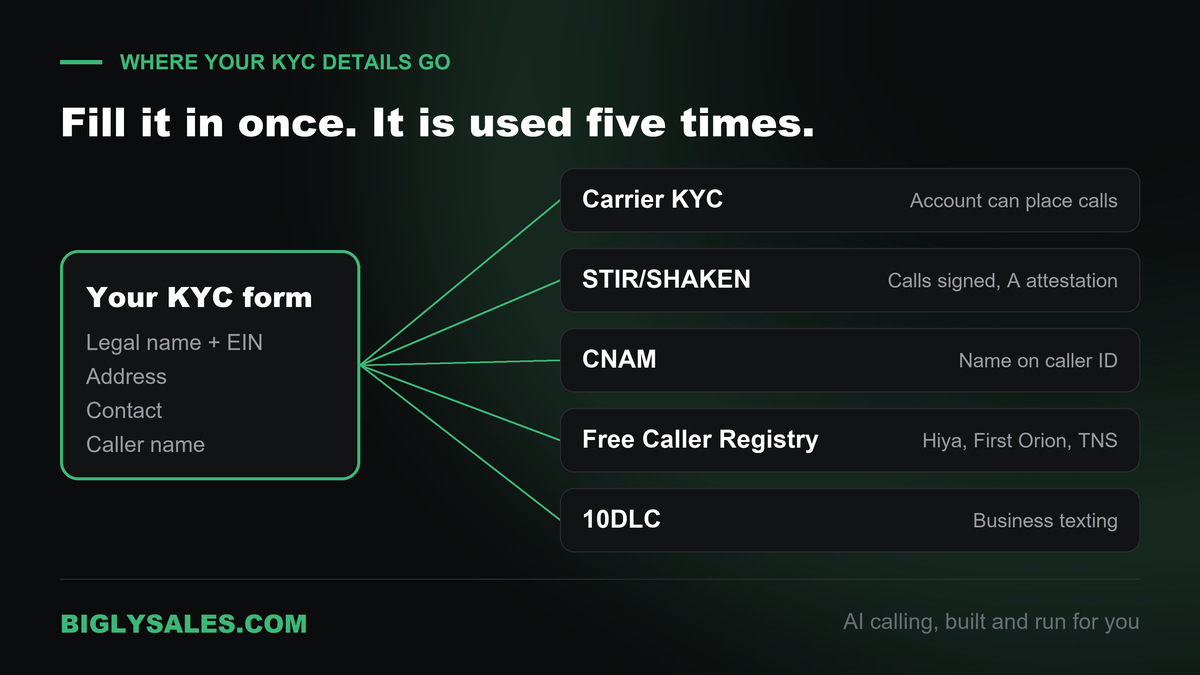
| Destination | What it does | Who runs it | What it uses |
|---|---|---|---|
| Carrier or platform KYC | Lets the account place outbound calls | Your originating provider | All 17 fields |
| STIR/SHAKEN business profile | Signs calls so carriers trust the caller ID | Your carrier | Legal name, EIN, address, contact |
| CNAM registration | Sets the name shown on caller ID | Carrier CNAM databases | Caller name, legal name, EIN |
| Free Caller Registry | Tells spam labeling engines the numbers are a real business | Hiya, First Orion and TNS | Business details, contact, call purpose, volume, numbers |
| 10DLC, for texting | Registers your brand for business texts | The Campaign Registry, via your provider | Legal name, EIN, website, contact |
Each one has its own deep dive on our blog. STIR/SHAKEN attestation levels explains why an A rating matters. Our guide to 10DLC registration covers the texting side.
KYC done with you
Go live without the paperwork guesswork
Our team walks through the KYC form with you, registers your numbers under your company and handles whitelisting. Most teams are live within 24 hours.
Why KYC and caller ID registrations get rejected
Most rejections are boring. That is good news, because boring is fixable.
- Name mismatch. The legal name on the form does not match the IRS record for the EIN. One vendor warns the address has to match the EIN listing exactly too.
- A personal email. Gmail and Yahoo addresses look like throwaway accounts.
- CNAM too long. Most providers cap the caller name at 15 characters, including spaces.
- CNAM does not match the business. If the display name differs from the legal name, expect to explain why, sometimes with a DBA filing.
- Dead or mismatched website. The URL should load and show the same company.
- Vendor details in your form. The contact, email or company belongs to the platform instead of you.
Fix the record before you resubmit. Resubmitting the same bad data just adds a second rejection.
How long it takes
The form is the fast part. About 15 minutes if you have your EIN letter open.
The approvals are slower. Phone vendors report five to ten business days for a CNAM name to show at carriers. Free Caller Registry sends an acknowledgment from each of its three providers after you submit.
Our rule of thumb is one to two weeks before a brand new number has its full reputation. Bigly Sales keeps 200+ whitelisted lines, which is how most teams still go live within 24 hours.
The 2026 FCC KYC proposal
KYC is about to get stricter. Possibly a lot stricter.
On April 30, 2026 the FCC adopted a proposal called Enhancing Know-Your-Customer Requirements, document FCC 26-27. It was published in the Federal Register on May 26, 2026. Comments closed June 25 and replies July 27.
Here is what the FCC asked about.
- Every new and renewing customer gives a name, physical address, government issued ID number and an alternate phone number.
- Providers verify identity with records such as a copy of a government ID.
- High volume customers, including businesses, also state their intended use and the IP address calls come from.
- A $2,500 per call base fine for providers that break the KYC rule.
- Whether AI or accredited third party ID checks should count as a safe harbor.
Look at that fine again. Per call. An AI dialer can make thousands of calls a day.
That is why providers will push harder on KYC, not softer. As of November 3, 2026 this is still a proposal, not a final rule. We will update this post when that changes.
When a number has to be retired
KYC gets a number clean. It does not keep it clean.
Tom ran the math in that same meeting. Say your numbers normally get answered 15% of the time. What are the odds a healthy number misses 40 calls in a row by plain bad luck?
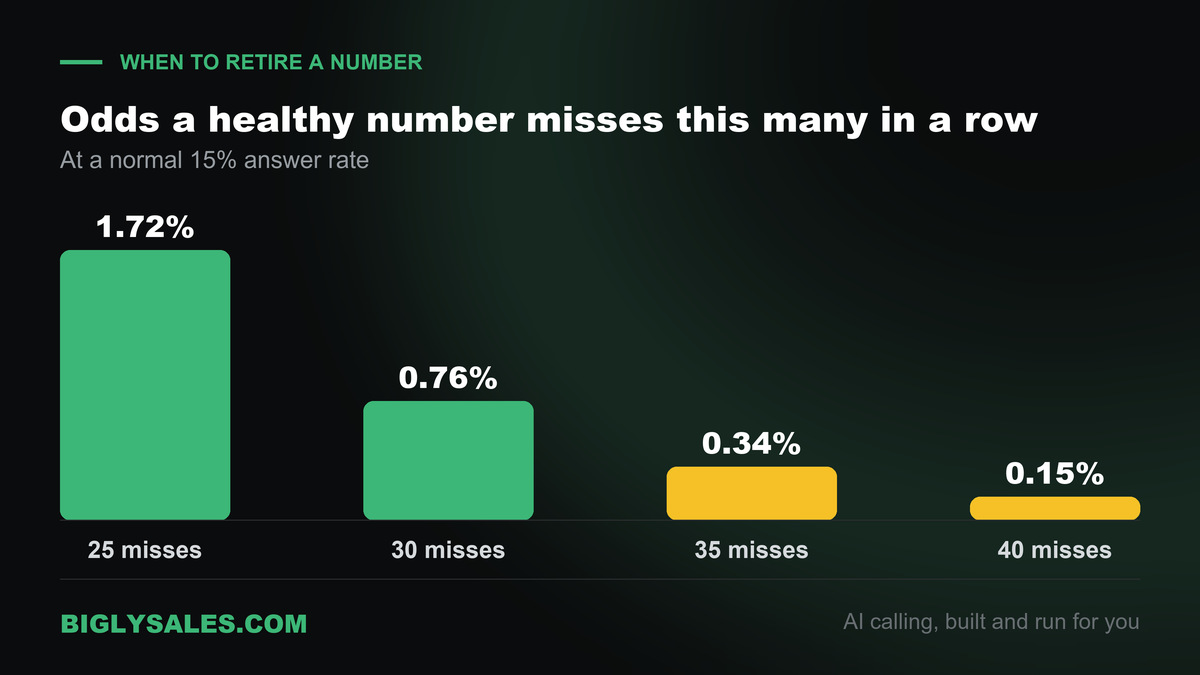
| Missed calls in a row | Odds it is just bad luck | What it suggests |
|---|---|---|
| 25 | About 1.7% | Watch it |
| 30 | About 0.8% | Probably flagged |
| 35 | About 0.3% | Almost surely flagged |
| 40 | About 0.15% | Retire or remediate |
Tom’s conclusion. 35 or 40 straight misses is the point to stop calling from that number. At that line you are about 99.85% sure something is wrong, and you still catch it fast.
From there you either fix the label or rotate the number out. Our guides on number health and fixing Spam Likely walk through both.
The rest of the AI outbound calling requirements
KYC gets you on the network. These rules decide what you can do once you are there. We cover each one in depth elsewhere, so here is the short version.
| Requirement | The short rule | Deep dive |
|---|---|---|
| Consent | AI voice marketing calls need prior express written consent under the TCPA | TCPA consent for AI calls |
| AI disclosure | Several states require the caller to say it is AI, and doing it on every call is the safe default | AI disclosure laws |
| Calling hours | Federal rules allow 8 a.m. to 9 p.m. in the recipient’s local time, and some states are tighter | calling rules by state |
| Do Not Call | Scrub against the national and internal Do Not Call lists before every campaign | TCPA consent for AI calls |
| Call authentication | STIR/SHAKEN signs your calls, aim for A attestation | STIR/SHAKEN explained |
| Testing | Run test calls before real leads ever hear the agent | how to test an AI voice agent |
Putting it all together into a launch plan? Our outbound AI campaign guide lays out the eight steps in order.
Who this is wrong for
We sell AI calling, and some teams should wait.
- Teams without consent records. Clean KYC does not save a list nobody agreed to be called from.
- Teams that need to dial today. Registration takes days. Rushing it with half filled forms makes it slower.
- Companies with no US entity. Tom’s first question on any new account is whether it is a US company. Without an EIN, expect a longer, different verification path.
- Anyone who wants to stay anonymous. If you will not put your legal name on your numbers, outbound calling is the wrong channel.
AI outbound calling requirements FAQ
What are the requirements for AI outbound calling?
There are two layers. The first is identity. Your carrier or calling platform has to know who you are, so you hand over a KYC form with your legal name, EIN, address, contact and caller name. The second is the call itself. That covers consent under the TCPA, AI disclosure, calling hours, Do Not Call scrubbing and opt-outs. Skip either layer and calls get blocked or labeled.
What is KYC in outbound calling?
KYC stands for know your customer. In outbound calling it means the phone provider verifies the business behind the calls before it lets them out onto the network. Under FCC rule 47 CFR 64.1200(n)(4), originating providers have to know their customers and use due diligence to stop illegal calls. In practice that means a short form about your company.
What information do I need for KYC before outbound calls?
Plan on about 17 fields. Legal company name, DBA if you have one, DUNS number if you have one, EIN, website, main phone and full street address. Then a primary contact with first and last name, title, business email and phone. Finally the caller name you want shown, plus any notes about your calls and volume.
Do I need an EIN to make AI outbound calls?
For US business calling, yes in practice. Carriers, STIR/SHAKEN business profiles and 10DLC texting registration all key off the EIN, and the legal name on the form has to match it. The IRS issues an EIN for free. A foreign company without a US entity will usually need a different verification path, so ask your provider first.
What is CNAM registration?
CNAM is the caller name database. Registering CNAM tells carriers which business name to show next to your number on caller ID. Most providers cap the name at 15 characters, including spaces, and the name has to match your business records. Display depends on the receiving carrier and the phone, so CNAM helps but does not promise the name appears.
What is the Free Caller Registry?
The Free Caller Registry is a free website run by the call analytics companies Hiya, First Orion and TNS. You register your business details, contact, call purpose, monthly volume and up to 20 numbers at once. Those three companies feed the spam labels that major carriers show, so registering tells them the numbers belong to a real business.
How long does KYC and number registration take?
The KYC form itself takes about 15 minutes if your details are ready. Approvals take longer. Vendors report five to ten business days for CNAM to show at carriers. Free Caller Registry sends an acknowledgment from each provider after you submit. Plan on one to two weeks before a brand new number reaches full reputation.
Can my calling vendor register numbers under its own name?
It should not. The numbers need to be registered with your legal business name and a business email on your own domain. Free Caller Registry makes you confirm you are not registering numbers for another business. If the registered name does not match the company the caller says on the call, the mismatch itself can hurt your reputation.
Is the FCC changing KYC rules for voice providers?
It has proposed to. In FCC 26-27, adopted April 30, 2026, the FCC asked whether providers should collect a name, physical address, government issued ID number and an alternate phone number before service. High volume callers could also be asked for their intended use and IP address. As of November 3, 2026 it is still a proposal.
Does KYC make my AI calls TCPA compliant?
No. KYC proves who is calling. The TCPA governs whether you may call that person at all. AI voice marketing calls still need prior express written consent, a clear way to opt out and calls inside legal hours. Treat KYC as the entry ticket and consent as the rules of the game. This is general information, not legal advice.
The bottom line
AI outbound calling requirements start with one boring form. Seventeen fields, all of them about your own company, all of them matching your EIN record.
Get it right once and it carries you through STIR/SHAKEN, CNAM, the Free Caller Registry and 10DLC. Get it wrong and every one of them fails. With the FCC proposing $2,500 per call fines for providers, expect the checks to get tighter, not looser.
Free setup session
Hand us the form, get your numbers registered
Send us your 17 KYC details and we register your numbers under your company, set up your agent and test it with you. Plans start at $99 a month, and setup is free.