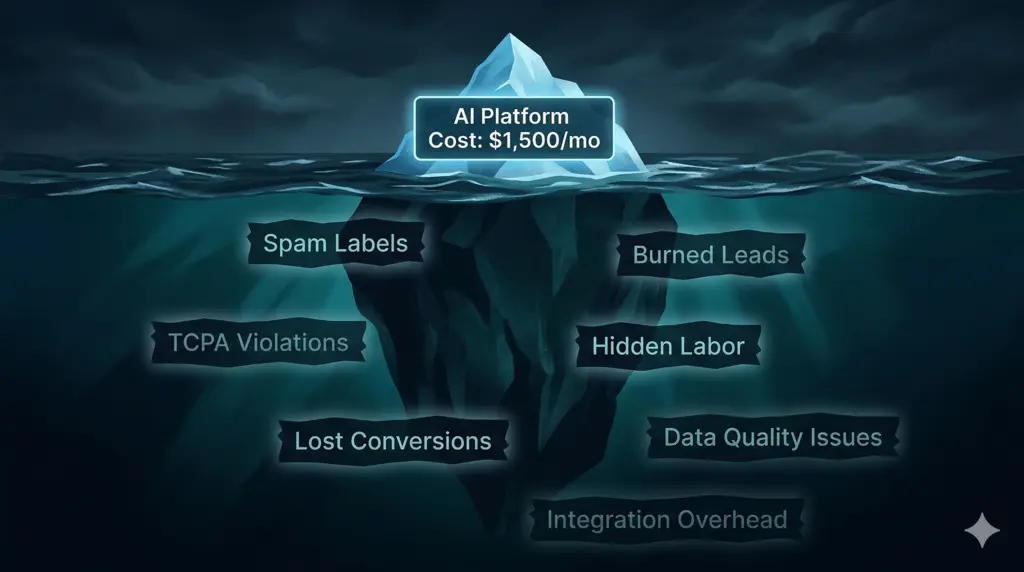


Ghost costs are the expenses of AI outbound calling that never appear on an invoice and still decide whether the program makes money. They are the answered calls you never got because your number was labeled, the leads you burned by dialing at the wrong hour, the compliance exposure you accrued per dial, and the hours your managers spent babysitting a platform that was sold as self managing.
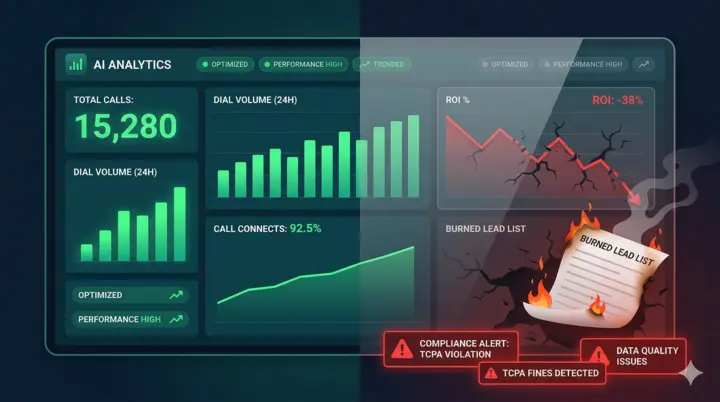
You watched the demo, saw the cost per call number, and signed up. Six months later your dial volume is up, your cost per seat is down, and your revenue is flat. That gap between what the dashboard reports and what the business actually banks is where ghost costs live.
What follows is a breakdown of the seven places those costs hide in AI outbound calling, an honest comparison of cheap, managed, and in house approaches, and a self audit you can run this week on your own numbers.
TL;DR
Cheap AI outbound calling looks affordable per dial and often costs three times more per conversation. The single biggest driver is carrier spam labeling, which cuts answer rates by roughly 50 to 80 percent, so a 10,000 dial month at a 20 percent answer rate delivers the output of 2,000 calls at the price of 10,000. Add TCPA statutory damages of 500 to 1,500 dollars per violating call, burned leads that cost 50 to 200 dollars each to acquire, and the manager hours nobody logs.
Managed infrastructure is not the answer for everyone. If you place a few hundred low stakes calls a week in a non regulated category, a self serve tool is the correct spend and the ghost costs stay small in absolute dollars.
Key takeaways
- Cost per dial is a vanity price. Cost per real conversation is the number that decides ROI.
- Spam labeled numbers drop answer rates 50 to 80 percent, and shared number pools put that reputation outside your control.
- TCPA statutory damages run 500 to 1,500 dollars per call, and liability sits with your business, not the software vendor.
- A burned lead in mortgage, insurance, or debt relief can represent 500 to 5,000 dollars of lost revenue that no dashboard reports.
- Unmanaged platforms hand configuration, compliance, and optimization work to sales managers who are not telephony specialists.
- Run an answer rate, lead burn, compliance, CRM completeness, and labor audit before you renew any contract.
- Low volume, low risk outbound calling genuinely does not need managed infrastructure.
Table of contents
- What ghost costs in AI outbound calling are
- Ghost cost 1: Spam labels erode your answer rate
- Ghost cost 2: Lead burn destroys inventory you already paid for
- Ghost cost 3: TCPA exposure that compounds per call
- Ghost cost 4: The hidden labor tax on your managers
- Ghost cost 5: The conversion quality gap
- Ghost cost 6: CRM data that never arrives
- Ghost cost 7: The optimization vacuum
- What managed AI outbound calling actually includes
- Cheap, managed, or build it yourself
- Which industries pay the highest ghost cost
- The good enough trap
- How to audit your AI outbound calling costs
- Who should not buy managed AI outbound calling
- AI outbound calling FAQ
- The bottom line
What ghost costs in AI outbound calling are
A ghost cost is an expense that never appears as a line item and shows up everywhere in your outcomes, including lost revenue, wasted leads, regulatory penalties, brand damage, and the labor of running a system that was sold as hands off.
In traditional outbound sales, these costs were visible. A rep who underperformed, a script that did not convert, a shift with too many missed calls. You could watch the inefficiency happen and fix it.
With unmanaged AI outbound calling, the same costs hide behind impressive dashboards. Your report shows thousands of calls placed. It does not show how many were answered by a human, how many were flagged as spam before anyone picked up, how many broke a state dialing rule, or how many burned a good lead permanently.
That distance between reported activity and delivered revenue is the whole problem. Everything below is a specific place where the distance widens.
Ghost cost 1: Spam labels erode your answer rate
Your number may already be flagged before you place a single call.
Carriers score phone numbers on call behavior, including how many calls are placed per hour, how many are answered, and how many recipients report the call as unwanted. When a number accumulates a poor behavioral profile it gets labeled, and depending on the carrier and handset the recipient sees Spam Risk, Likely Spam, or Scam Likely.
Answer rates then collapse. Labeled numbers commonly see answer rates fall by 50 to 80 percent compared with clean, registered numbers.
Apply that to a bill. If you pay for 10,000 outbound calls a month and 20 percent get answered because your numbers are labeled, you are paying for 10,000 calls and receiving the output of 2,000. Your cost per conversation, which is the only unit that maps to revenue, is five times the price on the rate sheet.
Shared number pools multiply the risk
Many low cost platforms rotate customers through shared number pools. Several businesses call from the same numbers and inherit a reputation none of them controls individually. One aggressive dialer on that pool can flatten answer rates for everyone else on it.
Unmanaged AI outbound calling does not solve this. It does not buy dedicated numbers on your behalf, register and whitelist them with carriers, monitor them daily for flagging, or retire them the moment a label appears. It sells the dialing capability and leaves number reputation to chance. Fixing the problem takes a registration and whitelisting strategy, not a fresh batch of numbers every few weeks.
Ghost cost 2: Lead burn destroys inventory you already paid for
A lead is not a renewable resource. Every record in your database is a person who expressed some interest by filling out a form, clicking an ad, or answering an email. That interest has a shelf life and it can be destroyed permanently.
When AI outbound calling reaches a lead at 8:00 AM on a Sunday, three times in one day, or from a spam labeled number, one of two things happens.
They do not answer, the lead goes cold, and you have spent a contact attempt for nothing. Or they answer and they are angry. The timing is bad, they did not expect the call, the assistant stumbles on their name, and they hang up committed to never hearing from your company again. That lead is now hostile, and if they leave reviews or report numbers, the damage spreads.
Burned leads almost never appear in ROI analyses because it is hard to price a lead that would have converted and now never will. The cost is still real. In mortgage, insurance, debt relief, and solar, a converted lead can be worth 500 to 5,000 dollars. A platform that burns even 20 percent of your list through bad timing, bad call behavior, or labeled numbers carries a hidden cost that scales with your volume.
Ghost cost 3: TCPA exposure that compounds per call
The Telephone Consumer Protection Act is the most consequential law governing outbound calling in the United States, and the arithmetic is unforgiving. The statute itself is published on govinfo.gov, and the Federal Trade Commission maintains the parallel telemarketing rules at ftc.gov.
Calls placed with automated technology, including AI outbound calling, without proper prior express written consent can carry statutory damages of 500 to 1,500 dollars per call. Not per campaign. Per call.
Place 5,000 calls a day, have 1 percent of them fall outside the rules through a wrong time dial, an unconsented contact, or a missed suppression, and that is 50 potential violations a day. At the 500 dollar minimum that is 25,000 dollars of daily exposure and roughly 750,000 dollars over a month. Plaintiff firms are good at finding these patterns in call records.
State rules sit on top of the federal floor
- Several states prohibit calls before 9 AM or after 8 PM in the recipient’s local time.
- Several cap how many times you may call the same number in a day or a week.
- States with emergency declarations or observed holidays add further restrictions.
- California, Florida, and others layer their own consent and disclosure requirements on top of federal rules.
Unmanaged platforms enforce the federal floor at best. They do not build state by state logic into the dialer, detect a dial crossing into a restricted time zone, pause for a state holiday, or verify that the consent record attached to a lead was captured properly. That enforcement lands on you, and when a violation occurs the business carries the liability, not the vendor.
Two rules people get wrong right now
The one to one consent rule that many vendor decks still cite as binding law was vacated by a federal appeals court in January 2025 and never took effect. Prior express written consent under the TCPA remains the operative standard. Collecting consent on a one to one basis is still worth adopting as internal policy, because it narrows the argument a plaintiff can make about what a consumer agreed to.
The requirement that is genuinely arriving is revocation of consent across channels. When a consumer says stop on any channel, that opt out has to propagate everywhere you contact them, with the full cross channel obligation phasing in through 2026. Systems that treat voice and SMS suppression as separate lists are the ones that will fail this. For the wider set of obligations, see our guide to TCPA compliance.
Ghost cost 4: The hidden labor tax on your managers
The pitch for cheap AI outbound calling is that it removes the need for human oversight. Set it up, let it run, watch leads arrive. That is almost never how unmanaged platforms behave in practice.
Someone writes the prompts. Someone tests them. Someone works out why calls are not converting and decides what to change. Someone watches number reputation. Someone checks compliance. Someone connects the platform to your CRM and repairs the connection when it breaks. Someone builds qualification logic and interprets the reports.
With self serve tools all of that lands on your team, and your team is a group of sales managers, not prompt engineers, telephony compliance specialists, and integration developers. A manager spending 15 hours a week configuring and troubleshooting instead of coaching reps and working pipeline is a cost that never appears on the platform invoice.
Neither does the cost of mistakes made by non specialists operating a system with real regulatory consequences. A misconfigured dialing window. A skipped suppression check. A consent validation step dropped to launch faster. Those are liabilities, not inefficiencies.
Ghost cost 5: The conversion quality gap
Not all AI converts equally, and the gap between a strong system and a cheap one is about conversation structure more than voice quality.
Cheap platforms give you a voice that reads a script. When the lead says something unexpected the assistant stumbles, falls back on a generic line, or ends the call. The interaction feels transactional. In high consideration purchases such as insurance, mortgage, and debt relief, that produces low trust, low conversion, and a pile of call me back responses that never materialize.
Stronger systems are built around conversational handling rather than script playback. They work through objections, pivot on what the lead says, capture structured qualification data, adjust tone by segment, and build enough trust to earn the next step. Response speed matters just as much, which is why speed to lead is usually the first thing to fix before anything else.
The conversion difference between the two approaches is often large. A platform converting at 2 percent looks cheaper than one converting at 8 percent right up until you calculate cost per converted lead, at which point the cheaper option usually is not.
Cost per conversation
Find out what your dialer is really costing
We will walk your answer rates, number reputation, and compliance gaps with you and show the real cost per conversation. It takes about 30 minutes.
Ghost cost 6: CRM data that never arrives
An AI outbound calling platform is only as useful as what happens to the data after the call, and in most unmanaged systems what happens is not enough.
You get a call log, maybe a recording, possibly a transcript. What you often do not get is structured, actionable data pushed automatically into your CRM, meaning the disposition, the qualification answers, the specific outcome, and the next step it should trigger.
Without that, one of two things happens. Your team reviews calls and logs data by hand, which is slow, expensive, and inconsistent. Or nothing gets logged and you make campaign decisions on partial information.
The cost is twofold. There is the raw labor of manual review, and there is the more expensive cost of decisions made on bad data. If you cannot see that 40 percent of calls end at the same point in the conversation, you cannot fix the script. If you cannot see which lead sources convert and which burn, you cannot move budget. Every blind decision is a ghost cost.
Ghost cost 7: The optimization vacuum
AI outbound calling is not a set and forget operation. The campaigns that improve do so through continuous work, including testing openers, refining qualification questions, adjusting call timing, changing transfer logic, and rewriting scripts from real call data.
Unmanaged platforms give you the tools to make changes. They do not make the changes, and they do not tell you which changes matter. You receive raw data and are expected to derive the insight, prioritize the test, and ship the improvement yourself.
For teams without an analyst, that means campaigns run untouched for months. The mediocre script from day one is still running on day ninety. The objection that ends 30 percent of calls in the first minute has never been addressed because nobody spotted the pattern.
The cost of an unoptimized campaign is not the cost of the calls you ran. It is the value of the conversions you would have earned at the campaign’s real potential, and it compounds every month the program runs unchanged.
What managed AI outbound calling actually includes
The difference between cheap and effective is mostly what happens around the call rather than during it. A managed program covers the following.
- Number acquisition and reputation management. Dedicated numbers bought, registered with carriers, whitelisted, monitored in near real time, and retired the moment they show spam signals.
- Local presence dialing. Calls display an area code matching the recipient’s geography, which alone lifts answer rates in most markets.
- Automated compliance. Federal rules, state by state dialing windows, velocity caps, holiday restrictions, and emergency state rules enforced at the system level rather than by manual oversight, with opt out detection and suppression applied across voice and SMS together.
- Consent validation. Integration with consent verification services so each call is defensible before it is placed.
- CRM automation. Transcripts, recordings, dispositions, qualification answers, and conversion events pushed into your CRM after every call, with no manual logging.
- Continuous optimization. Prompt design, testing, qualification logic, and transfer logic maintained by specialists rather than by your sales team between meetings.
- A named accountability owner. Someone responsible for campaign performance rather than for your subscription.
If any of those terms are unfamiliar, the AI calling glossary defines them in plain language.
Cheap, managed, or build it yourself
Companies evaluating AI outbound calling usually face three options. Here is the honest comparison, including where each one genuinely wins.
| Factor | Cheap self serve | Fully managed | Build in house |
|---|---|---|---|
| Number reputation | Shared pools, no monitoring | Dedicated, registered, monitored daily | Yours to buy and police |
| Compliance coverage | Federal basics at best | Federal plus state rules enforced in the dialer | Depends entirely on your legal and engineering teams |
| Who does the work | Your sales managers | The vendor’s specialists | Dedicated internal headcount |
| Time to first campaign | Days | One to three weeks | Six months or more |
| Best fit | Low volume, low risk, non regulated | High volume in regulated categories | Large enterprises with telephony engineers |
| Main risk | Ghost costs exceed the savings | Paying for capability you do not use yet | Cost and timeline overruns |
Building your own works for companies with deep engineering resources, telephony experience, and an in house compliance function. For everyone else the development, maintenance, number management, carrier relationship, and monitoring costs are far larger than they look at the whiteboard.
Which industries pay the highest ghost cost
Exposure is not evenly distributed. The worst combination is high call volume, expensive leads, strict regulation, and high conversion value. You can see how the same program changes shape by industry.
- Mortgage and lending. Leads cost 50 to 200 dollars each, regulatory exposure is severe, and a burned lead in a long consideration cycle is gone for good.
- Insurance. Health, life, final expense, property, and casualty all combine heavy regulation, expensive lead competition, and conversions worth hundreds to thousands in annual premium.
- Debt relief and credit. One of the most litigated spaces in outbound calling, where a single configuration gap generates dozens of violations at once.
- Solar and home services. Answer rates have fallen category wide because of high volume dialing, so number infrastructure decides whether you reach anyone.
- Staffing and recruiting. Timing is everything, and a low answer rate means a candidate accepted another offer before your call connected.
In each of these, ghost costs are not a marginal inefficiency. They decide whether the campaign produces positive ROI or destroys it quietly while reporting healthy dial volume.
The good enough trap
There is one more ghost cost worth naming, which is the cost of staying with a mediocre setup because the visible numbers look acceptable.
Your platform reports 9,000 calls last month and 47 conversions. That does not look like a disaster, so nothing changes. The problem is that you have no reference point. You do not know whether a managed program would have produced 180 conversions from the same list. You do not know that 15 percent of your leads are permanently burned, that three of your numbers were labeled six weeks ago, or that your complaint rate is approaching the threshold that attracts attention.
The cost of good enough is the whole gap between current and potential performance, multiplied by every month you stay in it.
How to audit your AI outbound calling costs
If you already run a program, whether in house, self serve, or partially managed, this is the sequence for finding what it is really costing you.
- Answer rate analysis. Pull human answer rate, not dials or attempts. Below 50 percent suggests a number reputation problem. Below 40 percent almost always means labeled numbers.
- Lead burn audit. Segment 90 days of contacted leads into converted, not reached, and reached but not converted. Listen to a sample of the third group. Early hang ups and irritation are burn signals.
- Compliance gap review. Map your actual dialing behavior against state rules for every state you call into. It is tedious and it is where violations are found.
- CRM completeness. What share of calls have structured outcome data in the CRM within an hour? Under 90 percent is a data gap and every decision made on it is a ghost cost.
- Conversion trend. Are conversion rates improving month over month? Flat or falling rates at steady volume mean nobody is optimizing.
- Labor accounting. Log every hour your team spends on platform management for two weeks and multiply by fully loaded hourly cost.
Run those six and you will have a defensible cost per conversation instead of a cost per dial. That is the number to compare vendors on.
Who should not buy managed AI outbound calling
Managed infrastructure is the wrong purchase for a real set of businesses, and it is worth saying so plainly.
If you place a few hundred calls a week for appointment reminders or simple follow up in a category with light regulation, a self serve tool is the right spend. The ghost costs described here are still present, but they are small in absolute dollars and the premium for managed infrastructure will not earn itself back.
The same applies if your outbound motion is not yet defined. If you do not know your offer, your list quality, or your qualification criteria, no amount of infrastructure will fix that. Sort the fundamentals with a small pilot first, then scale onto managed rails once you know the campaign works.
AI outbound calling FAQ
What are ghost costs in AI outbound calling?
Ghost costs are expenses that never appear on your platform invoice but reduce revenue anyway. They include collapsed answer rates from spam labeled numbers, leads burned by poor call timing, regulatory exposure accrued per dial, manager hours spent configuring and troubleshooting the platform, and conversions lost to campaigns that nobody optimizes. Together they often make a cheap platform more expensive per conversation than a managed one.
Why did my answer rate drop after switching to a cheap platform?
The most common cause is carrier spam labeling. Carriers score numbers on dialing velocity, answer rate, and consumer complaints, and a poor score triggers a Spam Risk or Scam Likely display on the recipient’s handset. Cheap platforms often rotate customers through shared number pools, so another business dialing aggressively on your pool can drag your answer rate down with theirs.
How much can a TCPA violation cost?
Statutory damages under the TCPA run from 500 to 1,500 dollars per violating call, and the count is per call rather than per campaign. At meaningful volume the exposure compounds quickly, and the larger risk is a class action rather than any single violation. Liability sits with the business placing the calls, not with the software vendor that supplied the dialer.
Is the FCC one to one consent rule in effect?
No. That rule was vacated by a federal appeals court in January 2025 and never took effect. Prior express written consent under the TCPA remains the operative legal standard. Many teams still choose to collect consent on a one to one basis as internal policy, because it makes the record of what a consumer agreed to much harder to dispute later.
What is changing for consent in 2026?
The meaningful change is revocation of consent across channels. When a consumer opts out on any channel, that request has to be honored everywhere you contact them, with the full cross channel obligation phasing in through 2026. Programs that keep separate voice and SMS suppression lists are the ones most likely to miss it, so consolidate suppression before the deadline arrives.
How do I calculate my real cost per conversation?
Take total monthly platform spend, add the fully loaded cost of the internal hours spent managing it, then divide by the number of calls where a human actually engaged in conversation. Compare that with your cost per dial. The difference between the two figures is the size of your answer rate problem, and it is usually the fastest ghost cost to fix.
Does local presence dialing actually improve answer rates?
Yes, in most markets. Recipients answer familiar area codes more often than unfamiliar ones, so matching the outbound caller ID to the recipient’s region lifts pickup. It is not a substitute for number registration and reputation monitoring though. A local number with a bad behavioral profile still gets labeled and still shows a warning on the handset.
Can AI outbound calling replace my sales team?
No, and vendors that claim otherwise are overselling. AI handles the repetitive top of funnel work well, including dialing, qualifying, and routing interested prospects to a person. Closing high consideration purchases such as mortgage, insurance, or debt relief still needs a human. The realistic outcome is that your reps spend their time on live qualified conversations rather than on dialing.
How long does it take to move to a managed program?
Typically one to three weeks, most of which goes to number acquisition and carrier registration rather than to software setup. Number reputation cannot be rushed, because carriers score behavior over time. If a vendor promises a same day launch on brand new numbers at high volume, treat that as a warning sign rather than a feature.
Do I need managed infrastructure for low call volume?
Usually not. If you place a few hundred calls a week in a lightly regulated category, a self serve platform is the appropriate spend and the ghost costs stay small in absolute terms. The math shifts once volume grows, lead costs rise, or you start calling into regulated categories where a single compliance gap can generate dozens of violations at once.
The bottom line
The AI outbound calling market competes on price, and much of the technology on offer is genuinely good. The problem is that price per dial hides everything that determines whether the program earns money, which is number reputation, compliance enforcement, data capture, and someone accountable for improving the campaign.
Cheap AI is not actually cheap. It defers the bill to your answer rate, your lead list, and your legal exposure. Work out your cost per conversation, run the six part audit above, and make the decision on that number rather than on the rate sheet.
Managed outbound
Stop paying for dials nobody answers
See a live campaign with registered numbers, enforced compliance, and CRM data flowing after every call. Bring your current numbers and we will compare them.