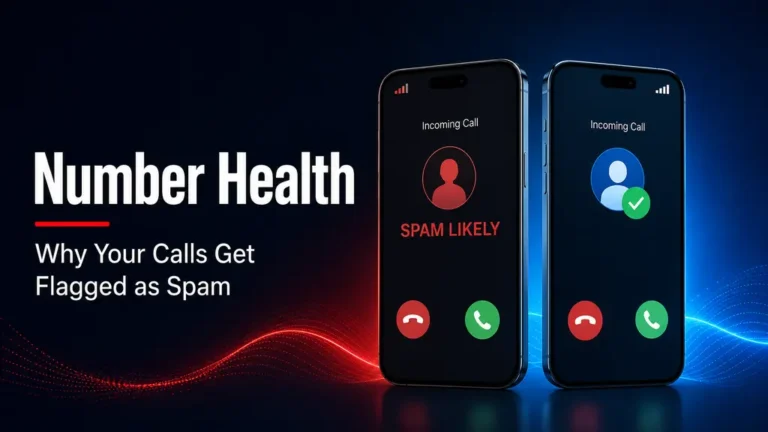



Spam likely calls are outbound calls that a carrier or analytics provider has already judged to be probably unwanted, so the recipient sees a warning label on the screen instead of your business name. The label is applied at the network level, before the phone finishes ringing and before anyone speaks.
Most outbound teams respond to falling answer rates by rewriting the opener, retraining reps, and testing a new pitch. The numbers stay flat because the script was never the problem. The call lost trust at the delivery layer, where the number reputation lives.
This guide covers what spam likely calls actually are, what they cost your pipeline in real dollars, why an AI voice agent cannot fix the problem on its own, and the seven deliverability moves that recover answer rates.
TL;DR
Spam likely calls happen when carrier analytics score your number as risky based on dialing velocity, complaint signals, registration status, and history. A labeled number typically loses 50 to 80 percent of its answer rate, which means a team dialing 10,000 times a month can be paying for 10,000 attempts while getting the reach of about 2,000. Fixing it takes number registration, carrier coordination, pacing, monitoring, and fast retirement of weak lines, not a better script.
If you dial a few hundred times a week from one or two long held numbers, this is probably not your bottleneck. Look at list quality and follow up speed first.
Key takeaways
- Spam likely calls are a delivery problem before they are a script problem, and the decision is made before the person answers.
- Labeled numbers commonly lose 50 to 80 percent of their answer rate compared with clean registered numbers.
- Answer rates collapse when volume scales faster than number infrastructure, especially on new or unregistered lines.
- STIR SHAKEN attestation helps carriers verify caller ID, but clean attestation alone does not prevent a spam label.
- An AI voice agent only performs as well as the numbers, registration, monitoring, and carrier reputation behind it.
- Deliverability is continuous operations work, not a one time setup task.
- Buying a fresh batch of numbers every time one degrades repeats the cycle instead of fixing it.
Table of contents
- What spam likely calls are
- Why outbound numbers get flagged
- What spam likely calls cost your pipeline
- How answer rates collapse at scale
- Why an AI voice agent cannot fix deliverability alone
- Seven moves that reclaim answer rates
- Number strategies compared
- How deliverability connects to compliance
- When spam labeling is not your real problem
- Spam likely calls FAQ
- The bottom line
What spam likely calls are
Spam likely calls are calls that arrive on a handset carrying a carrier or app generated warning such as Spam Risk, Likely Spam, or Scam Likely in place of a recognizable caller identity. The label comes from the carrier’s analytics partner, not from the person you are calling, and it is attached to the originating number rather than to the content of the conversation.
Three separate systems can produce that label. Carrier analytics engines score number behavior. Device manufacturers and dialer apps apply their own filters. Crowd sourced complaint databases feed both. A number can be clean on one carrier and labeled on another, which is why teams often see the problem show up unevenly across their list.
The important point is timing. The evaluation happens before the call connects. By the time the phone rings, the decision about how your call is displayed has already been made, and no amount of conversational skill recovers a call that was never answered.
Why outbound numbers get flagged
Spam likely calls are not random. Labels come from a combination of caller ID authentication, dialing behavior, complaint patterns, number history, and third party reputation databases.
Dialing behavior carriers watch
- Attempts per hour from a single number, especially sudden spikes on a new line.
- Short duration calls, which read as unanswered or immediately rejected.
- A low answer to attempt ratio sustained over days.
- Repeat attempts to the same number in a short window.
- Consumer complaints filed through carrier apps and reporting tools.
What STIR SHAKEN does and does not do
STIR SHAKEN is the framework voice providers use to sign and verify caller ID information. Calls receive an attestation level based on what the originating provider can confirm about the caller and their right to use the number. Full attestation supports trust. Partial or gateway attestation makes a call harder to validate downstream.
Attestation is necessary and it is not sufficient. A properly signed call can still be labeled if the number behind it shows aggressive pacing, a volume spike, high complaint signals, or a poor reputation history. Teams that assume clean attestation guarantees clean delivery are usually the ones surprised when spam likely calls appear across a campaign that authenticated correctly.
What spam likely calls cost your pipeline
This is the part that rarely reaches a report. Spam likely calls do not show up as a line item. They show up as a pipeline that is quietly smaller than it should be.
Work the arithmetic on a mid sized outbound team. Say you place 10,000 attempts a month and a clean program would answer at 25 percent, giving 2,500 conversations. Once numbers are labeled and the answer rate falls to 8 percent, you get 800 conversations from the same spend and the same list. You did not lose 1,700 calls. You lost every downstream stage those calls would have fed.
The compounding effect down the funnel
If 1 in 10 conversations becomes a qualified opportunity and 1 in 4 opportunities closes, those 1,700 lost conversations were roughly 170 opportunities and roughly 42 closed deals. In categories where a closed deal is worth 1,500 dollars or more, that is a six figure annual gap produced entirely by a display label.
There is a second cost that hurts longer. Every attempt against a labeled number consumes a contact attempt from a lead you already paid to acquire. Lead costs of 50 to 200 dollars each are normal in mortgage, insurance, and solar. Burning through three attempts on a labeled line does not just fail to connect, it retires that lead from your reachable inventory while the acquisition cost stays on the books.
The third cost is decision quality. When answer rates fall for delivery reasons, teams usually diagnose it as a messaging or list problem. They rewrite scripts, swap lead vendors, and change targeting. Months go by while the actual cause sits untouched in the number pool.
How answer rates collapse at scale
A small test campaign usually performs well on a fresh number. The trouble starts when that same number begins carrying thousands of attempts in a short period. Carrier analytics read the spike as suspicious, particularly on a line that is new, unregistered, or already accumulating unanswered calls.
The cycle repeats in the same order almost every time.
- A fresh number starts dialing at high volume.
- Carrier and analytics systems detect the spike against a thin reputation history.
- The number begins producing spam likely calls or simply performs worse on certain carriers.
- Answer rates fall, and the team keeps dialing the weakened number because the dashboard still shows activity.
- The reputation deteriorates further and becomes harder to remediate.
- The team buys another number and starts the cycle again.
This is why some campaigns show strong results for a week and then decline. The AI calling software did not stop working. The delivery layer underneath it broke, and buying replacement numbers treats the symptom while the operating pattern that caused the labeling stays in place.
Why an AI voice agent cannot fix deliverability alone
An AI cold calling bot can improve every second after pickup. It cannot repair a weak caller reputation, because that reputation is decided upstream of the conversation.
It helps to separate the two layers.
The voice layer
This is what buyers evaluate during a demo. The voice quality, the script, objection handling, qualification logic, and transfer flow. It determines what happens on an answered call.
The delivery layer
This decides whether a call is answered at all. It covers number registration, carrier reputation, attestation alignment, local presence, call velocity, spam monitoring, and rotation policy. A strong voice layer sitting on a weak delivery layer produces a polished assistant talking to voicemail.
That is the trap in most self serve tools. Teams compare voices, dashboards, and launch speed, all of which matter, and none of which address caller reputation. The best software still needs clean numbers, sensible pacing, local presence, monitoring, and someone doing deliverability operations. Without that, the campaign generates more activity and fewer real conversations. The same logic applies to how fast you follow up, which is why speed to lead and deliverability usually need fixing together.
Answer rate check
Find out if your numbers are the bottleneck
We will review your current numbers, registration status, and pacing and show you where answer rate is leaking. It takes about 30 minutes.
Seven moves that reclaim answer rates
Reclaiming answer rates means rebuilding the delivery layer. These are the seven moves that produce most of the recovery, in the order they should be done.
- Register every number. Registration gives carriers context about who is calling and why. Unregistered lines are the easiest to flag once volume rises, and registration is the cheapest single improvement available.
- Coordinate with carriers and reputation providers. Carrier trust is built deliberately through vetting and consistent behavior. It does not accumulate on its own.
- Pace the dial. Warm new numbers up gradually rather than launching them at full campaign volume. Most spam likely calls trace back to a velocity spike on a line with no history.
- Use local presence responsibly. People answer familiar area codes more often. Local presence should reflect a genuine regional operation, not create misleading patterns that generate complaints.
- Monitor number health continuously. Numbers degrade as they collect labels, complaints, and poor answer behavior. You need visibility before one line drags down a whole campaign.
- Retire weak lines fast. A flagged number should be paused and reviewed, not left dialing until the damage spreads across the pool.
- Fix the behavior that caused the flag. Replacing numbers without changing pacing, list hygiene, or attempt limits simply resets the clock on the same outcome.
None of these is a one time task. Deliverability is a running operation, and there is always a number to monitor, a pattern to adjust, or a flagged line to investigate. That is precisely the work self serve platforms leave with the customer.
Number strategies compared
Outbound teams generally handle numbers in one of four ways. The honest comparison looks like this.
| Approach | Answer rate outlook | Work on your team | Best fit |
|---|---|---|---|
| Shared pool from a self serve tool | Unpredictable, reputation is outside your control | Low until answer rates fall | Very low volume testing |
| Buy and burn replacement numbers | Short spikes followed by repeated collapse | Constant reactive replacement | Almost nobody, it repeats the cycle |
| Dedicated numbers you manage yourself | Good if someone genuinely owns monitoring | High, needs telephony knowledge | Teams with in house telecom skills |
| Managed deliverability with the calling platform | Most consistent, degradation caught early | Low, the vendor runs it | Regulated categories at real volume |
Bigly does not sell dialers or number pools on their own. Deliverability operations come bundled with the AI calling service, which is a different approach from buying software and running number health yourself. For the wider system, see our AI outbound calling guide.
How deliverability connects to compliance
Deliverability and compliance are separate problems that feed each other. Deliverability asks whether the call connects cleanly. Compliance asks whether the campaign follows the rules that apply to it. The same sloppy operating habits damage both.
Aggressive call velocity harms number reputation and increases regulatory risk at the same time. Weak consent records lead to outreach that generates complaints, and complaints are a direct input to spam labeling. Missing suppression checks cause repeat calls to people who asked not to be contacted, which is both a violation and a reliable way to get a number flagged.
Controls that belong in the workflow
Consent checks, do not call suppression, calling window enforcement, attempt frequency caps, opt out handling, disposition tracking, and records that survive internal review all belong in front of the dialer rather than in a cleanup pass afterward. The Federal Trade Commission publishes the telemarketing rules that govern much of this at ftc.gov, and the underlying statute is available on govinfo.gov.
One rule is worth calling out because it is often misstated. The one to one consent requirement that many vendor decks still present as binding law was vacated by a federal appeals court in January 2025 and never took effect. Prior express written consent under the TCPA remains the operative standard. Collecting consent on a one to one basis is still a sound internal policy because it reduces the room for dispute about what a consumer agreed to.
The obligation that is genuinely arriving is cross channel revocation of consent. When someone opts out on any channel, that request has to be honored everywhere you contact them, with the full requirement phasing in through 2026. Programs running separate voice and SMS suppression lists are the ones most likely to miss it. Our TCPA compliance guide covers the rest of the controls in detail.
When spam labeling is not your real problem
It is worth saying plainly that spam likely calls are not every team’s bottleneck, and treating deliverability as the universal explanation wastes money.
If you place a few hundred calls a week from one or two numbers you have held for years, and your answer rate is in a normal range for your category, your number reputation is probably fine. Look at list quality, timing, and the gap between form submission and first dial before you invest in deliverability infrastructure.
The same applies if you are reaching people and failing to convert them. That is a messaging, offer, or qualification problem, and better numbers will only deliver more of the same conversations. Deliverability work is worth doing when the evidence points at delivery, meaning answer rates below roughly 40 percent, uneven performance across carriers, or a measurable drop that started when volume increased.
Spam likely calls FAQ
What does a spam likely label actually mean?
It means a carrier, device, or analytics provider has scored the incoming number as probably unwanted and told the handset to display a warning. The evaluation typically uses caller ID authentication, number reputation, dialing behavior, complaint signals, and third party databases. It is applied to the number, not to the content of the call, and it happens before the recipient decides whether to answer.
Why are my outbound calls showing as spam likely?
The usual causes are an unregistered or brand new number, a sudden jump in dialing volume, repeated attempts to the same contacts, a long run of unanswered short calls, or complaints filed by recipients. Shared number pools add another cause, because another business dialing aggressively on the same numbers can pull your reputation down with theirs.
Can I remove a spam likely label from my number?
Sometimes. Remediation requests can be filed with analytics providers and are occasionally successful, but recovery is slower and less reliable than prevention. The stronger approach is to monitor number health continuously, pause weak lines early, and correct the pacing or list behavior that caused the flag. A number retired quickly is easier to rehabilitate than one dialed to exhaustion.
How much do spam likely calls reduce answer rates?
Labeled numbers commonly lose 50 to 80 percent of their answer rate compared with clean, registered lines. The exact drop varies by carrier, handset, and how the label is displayed. The practical effect is that your cost per real conversation rises by several multiples while your cost per dial stays exactly where it was on the invoice.
Does an AI cold calling bot get flagged more often than human reps?
Not because it is AI. Numbers get flagged for dialing behavior, reputation, registration status, volume, and complaints. An AI system can trigger those conditions faster simply because it dials faster, so poor infrastructure shows up sooner. Run with registered numbers, sensible pacing, and monitoring, and an AI campaign is not inherently more likely to be labeled.
Does STIR SHAKEN stop spam likely calls?
No. STIR SHAKEN lets providers sign and verify caller ID so downstream carriers can judge whether the identity is trustworthy. It raises the floor, and it does not override behavioral scoring. A fully attested call from a number with a poor reputation history can still be labeled, which is why attestation is one input among several rather than a solution.
Does local presence dialing help?
Yes, in most markets. Recipients answer numbers that look local more often than unfamiliar area codes, so matching caller ID to the recipient’s region lifts pickup. It works only alongside registration and monitoring though. A local number with a damaged behavioral profile still shows a warning, and local presence used deceptively generates the complaints that cause labeling.
Is outbound deliverability a one time setup project?
No. Number reputation, spam labels, answer behavior, carrier analytics, and complaint signals all shift while campaigns run. A number that performs well this month can degrade next month if volume, list quality, or attempt patterns change. Monitoring and remediation have to run continuously, which is the part most self serve platforms leave to the customer.
How long does it take to recover answer rates?
Plan on two to four weeks. Number acquisition and registration take days, and building a clean behavioral history with carriers takes longer because scoring is based on sustained patterns rather than a single change. Any vendor promising an immediate recovery on high volume from brand new numbers is describing the exact behavior that causes labeling in the first place.
Should low volume teams worry about this?
Usually not. A few hundred calls a week from established numbers rarely triggers carrier scoring, and the investment in deliverability infrastructure will not pay for itself. The math changes as volume grows, as lead acquisition costs rise, and as you begin calling into regulated categories where complaint rates and attempt patterns are watched more closely.
The bottom line
Spam likely calls are a pipeline problem wearing a dialer costume. The label is decided by carrier analytics before your call connects, it removes most of your answer rate, and it compounds through every stage of the funnel behind it. No script rewrite reaches a phone that was never picked up.
Check the delivery layer first. Pull your true human answer rate, check whether your numbers are registered, look at how fast new lines were pushed to full volume, and see whether anyone owns monitoring. If those answers are unclear, that is where your missing conversations went.
Managed deliverability
Get your outbound calls answered again
Registered numbers, monitored reputation, and paced dialing run for you alongside the AI voice agents. Bring your current answer rates and we will compare them live.