


The call center hiring cycle of doom is the repeating pattern where a sales floor recruits a large cohort of entry-level reps, loses most of them within a few months, and restarts the same expensive process again. It is not a people problem and it is not a management problem. It is a math problem baked into how call center hiring works on high-volume outbound floors.
For most sales leaders the worst moment of the week is Friday afternoon, when the newest rising star hands in notice after three weeks. The seat empties, the requisition reopens, and the cost meter starts over.
By 2026 the combination of labor costs and SDR market volatility has made purely human outbound floors difficult to scale profitably. This piece breaks down the arithmetic, what a replacement actually costs, where AI agents genuinely substitute for headcount, and where they do not.
TL;DR
Call center hiring on high-volume floors follows a rough 60-40-20 pattern. Screen 60 candidates, get 40 through a two-week onboarding, and keep about 20 producing past the 90-day mark. Industry estimates put the cost of a failed sales hire at 30 to 150 percent of that rep’s base salary once recruitment, ramp time and manager hours are counted.
Managed AI voice agents remove the churn from the first-contact layer, because software does not quit, and they hold the same call quality on dial 10,000 as on dial one. The caveat is that AI does not replace closers, does not fix a bad offer or a bad list, and does not eliminate management work. If your problem is conversion rather than capacity, hiring is not what is broken.
Key takeaways
- Call center hiring fails on arithmetic, not effort. Cohorts shrink at every stage and the survivors subsidize everyone who left.
- The expensive parts of call center hiring never show on a profit and loss statement: sunk recruiting spend, manager hours, and the unearned ramp period.
- A human rep needs roughly four to eight weeks to reach break-even output, so anyone who leaves near month three was never profitable.
- Agentic AI differs from a scripted bot because it reasons through an unexpected reply instead of falling off the decision tree.
- AI agents hold consistent performance across volume, which removes the week-long conversion dips caused by burnout and off-days.
- Compliance controls are easier to enforce in software than across a rotating call center hiring pipeline of new reps chasing activity quotas.
- Wrong fit if your close rate is the bottleneck, if your list quality is poor, or if you expect to remove management entirely.
Table of contents
- What the call center hiring cycle of doom is
- The 60-40-20 rule of call center hiring
- The invisible cost of a bad hire
- Agentic AI compared with scripted bots and human seats
- What AI does not fix
- How to run the transition without gutting your floor
- Compliance across a rotating floor
- Where Bigly fits
- Call center hiring FAQ
- The bottom line
What the call center hiring cycle of doom is
The call center hiring cycle of doom is a self-repeating staffing loop in which a company hires entry-level sales development reps in bulk, loses a large share of them before they reach productivity, and returns to the job boards to replace them at full cost. Each turn of the loop consumes recruiting budget, onboarding time and management attention without adding permanent capacity.
The loop persists because it looks like progress from the inside. Requisitions get filled. Training classes run. Headcount on the org chart holds steady. What does not hold steady is the number of people who have been on the phone long enough to be good at it.
Sales leaders usually notice the symptoms of broken call center hiring before they name the cause. Connect rates stay flat while payroll rises. Managers spend Monday morning re-teaching the same three objections. The senior reps carry an unfair share of the number and start looking elsewhere themselves.
The 60-40-20 rule of call center hiring
Many high-volume floors plan call center hiring around an informal 60-40-20 pattern. It is a planning heuristic rather than a published statistic, but it matches what most outbound managers see, and it explains where the money goes.
The top-of-funnel investment
A hiring sprint starts with sourcing roughly 60 candidates. Between job board spend, recruiter commissions and the hours your internal team spends screening, the upfront cost lands before anyone has touched a phone. You are paying in full for a group you already know will not survive intact.
The training room shrinkage
By the end of a standard two-week paid onboarding, the cohort is usually closer to 40. This is the first real leak. You have funded fourteen days of salary, benefits and management time for people who will never place a live call or generate revenue.
The 90-day survival rate
Across the first three months of production the group thins again. Rejection, quota pressure and better offers elsewhere reduce the class until roughly 20 productive reps remain. Leadership is now paying full overhead against a workforce that is effectively a third as productive as the headcount implies.
What the pattern costs in practice
Run the numbers on your own floor before you accept these ratios. Pull last year’s requisitions, count how many of those hires are still on the phone today, and divide total recruiting and onboarding spend by that survivor count. The resulting cost per productive rep is the honest number, and it is usually two to three times the figure in the staffing plan.
The invisible cost of a bad hire
The real cost of a failed hire rarely appears as a line item in the call center hiring budget. Industry estimates commonly place it between 30 and 150 percent of the rep’s base salary once every downstream effect is counted.
Sunk recruitment spend
Every rep who quits before the 90-day mark takes the recruiter commission, the background check and the equipment provisioning with them. None of it is refundable and none of it returns.
Managerial drag
The most expensive component is stolen leadership time. Every hour a senior manager spends walking a new hire through the same basic objections is an hour not spent on large accounts, coaching top performers, or fixing the offer. Multiply that across a class of 40 and the drag becomes the largest hidden expense in the department.
The unearned ramp
A human rep needs at least four to eight weeks to reach break-even, the point where output covers the cost of employment. A rep who resigns shortly after that milestone means the company funded a multi-week internship. You paid for the learning curve and never collected on the earning curve.
Pipeline damage
There is a fourth cost that almost never gets measured. New reps practice on real leads. Records worked badly by someone in week two are frequently unworkable later, because the prospect now associates your brand with a clumsy call. That is paid media burned during training.
Run the numbers
See what your empty seats actually cost
Bring your headcount plan and connect rates and we will model the same volume through managed AI agents. Thirty minutes, no obligation.
Agentic AI compared with scripted bots and human seats
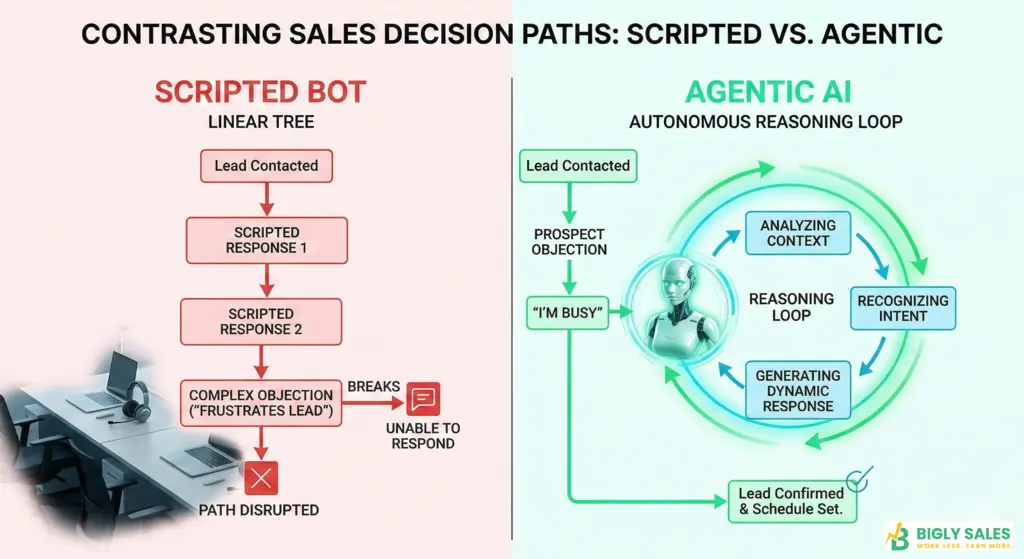
The robocalls and scripted phone trees of the past deserve their reputation. They follow a decision tree and break the moment a prospect asks something the tree does not anticipate. Agentic AI behaves differently, and the difference matters more than the voice quality.
Reasoning through the unexpected reply
If a prospect says they are interested but their partner handles the finances, a scripted bot has no branch for that. An agentic system understands the context, asks for the partner’s name, and offers a time when both can join. That is the behavior of a strong human closer, applied consistently.
No off-days
Human reps get tired, discouraged and distracted. An off week from three reps can move a whole month’s conversion rate. Software holds a flat line. The ten thousandth call of the month is delivered the same way as the first, which makes forecasting considerably easier.
| Factor | Human SDR seat | Scripted bot | Managed AI agent |
|---|---|---|---|
| Time to productivity | 4 to 8 weeks | Days | Days after setup and registration |
| Handles an unscripted reply | Yes, once trained | No | Yes, within set boundaries |
| Performance consistency | Varies by day and rep | Constant but rigid | Constant and adaptive |
| Cost behavior | Fixed salary plus churn | Low per message | Program fee plus talk minutes |
| Compliance enforcement | Depends on training | Limited | Enforced in the workflow |
| Best used for | Closing and complex deals | Reminders and notifications | First contact and qualification |
What AI does not fix
Anyone selling you AI as a cure for every staffing problem is overselling. Three limits are worth stating plainly before you budget for a switch.
AI does not replace closers. The technology is strong at first contact, qualification and booking. Complex negotiation, trust building and multi-stakeholder deals still belong to experienced people, and a floor that fires its senior reps to fund software will regret it inside a quarter.
AI does not fix a bad list or a weak offer. If your leads are stale or your pricing is uncompetitive, faster and more consistent calling simply surfaces that fact sooner. Automation applied to a broken funnel produces more evidence, not more revenue.
AI does not remove management. Someone still owns script logic, qualification criteria, routing rules and quality review. The work changes from supervising people to supervising a system, and the second job is smaller but it is not zero.
How to run the transition without gutting your floor
The teams that get this right treat it as a staged reallocation rather than a layoff, and they change call center hiring plans before they change headcount. A workable sequence looks like this.
- Freeze net-new entry-level requisitions rather than cutting current staff, then let normal attrition create the space.
- Move first contact and speed-to-lead calling to AI agents first, since those are the highest-volume and lowest-judgment tasks. Our speed to lead guide covers why response time dominates that stage.
- Keep senior reps on live transfers and closing, and rewrite their comp plan around booked conversations rather than dials.
- Instrument everything before you compare. You cannot judge the switch without a clean baseline for connect rate, qualified rate and cost per booked appointment.
- Review call recordings weekly for the first month, exactly as you would with a new hire, and tune the qualification logic from what you hear.
Expect the first four weeks to look worse than the plan. Registration timelines, script tuning and CRM mapping all take longer than the demo suggests. Budget for that instead of pretending it will not happen. If the vocabulary is unfamiliar, our AI calling glossary defines the terms without jargon.
Compliance across a rotating floor
Constant turnover is a compliance liability as much as a financial one. Rules learned in week one of onboarding get applied unevenly by week six, particularly by reps under pressure to hit an activity quota before their probation review.
Federal telemarketing rules restrict calls to the window between 8 a.m. and 9 p.m. in the recipient’s local time, require accurate caller identification, and require companies to honor do-not-call requests promptly. The FTC publishes a plain-English Telemarketing Sales Rule compliance guide, and the underlying TCPA statute at 47 U.S.C. 227 is available on govinfo.gov. Several states add their own call frequency caps and calling windows on top.
Software enforces those rules the same way on every call. A time zone check does not get skipped because someone is three dials from quota. That is a real advantage of moving first contact off a high-churn call center hiring pipeline, though it never removes the need for legal review of your specific program. Our legal and compliance overview covers what we do and do not take responsibility for.
Where Bigly fits
A common mistake is treating AI calling as another software login for an already stretched team to manage. Bigly Sales runs it as managed infrastructure instead.
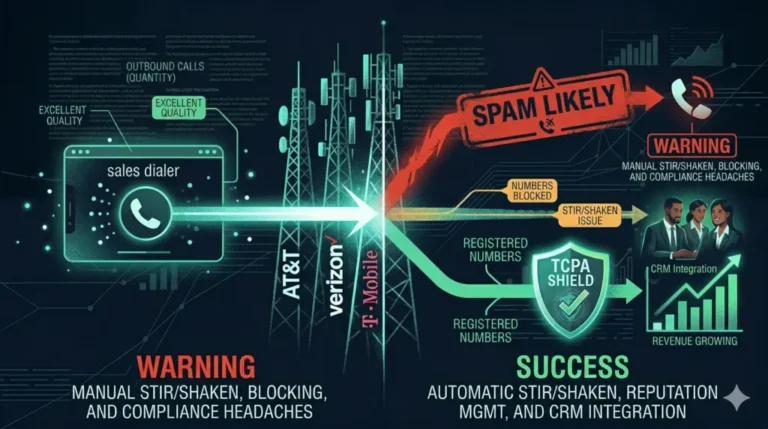
That includes carrier coordination and A2P 10DLC registration, number purchasing and reputation monitoring, local presence, script and qualification design, CRM integration, transcripts and dispositions, and live transfer routing into your existing floor. Number reputation with the major carriers is monitored on an ongoing basis, because unmanaged high-volume dialing is the fastest way to get an entire number pool labeled as spam.
Compliance controls sit in the architecture rather than in a training deck. State-level call velocity limits, calling windows and holiday blocking are applied before a call is placed.
The honest caveat is cost and timeline. A managed program carries a higher monthly commitment than a self-serve dialer seat and takes longer to launch, because registration and vetting run on carrier timelines nobody controls. Teams looking to test one script against a few hundred records this week should start somewhere cheaper. Our pricing page shows how programs are typically scoped.
Watch
The hardest seat to keep filled
Tom Ryan on the one role that empties fastest, why replacing it costs more than the salary, and what actually breaks the cycle.
Call center hiring FAQ
What is the call center hiring cycle of doom?
It is the repeating staffing loop where a sales floor recruits a large class of entry-level reps, loses most of them before they reach productivity, and restarts the same expensive recruiting process. Each cycle burns recruiting spend, onboarding salary and manager hours without permanently increasing capacity. The pattern hides inside a healthy-looking org chart, because seats stay filled even though tenure never accumulates.
How does the 60-40-20 rule affect the bottom line?
It is a diagnostic for call center hiring efficiency. If you screen 60 candidates to end up with 20 long-term producers, you have not simply lost 40 people, you have lost every dollar spent acquiring and training them. The effective cost per productive hour rises sharply, because the surviving reps are absorbing the cost of everyone who left. Run the calculation against your own last twelve months before accepting the ratio.
What does it cost to replace one sales rep?
Estimates vary widely by role and market, and the commonly cited range for a failed sales hire is 30 to 150 percent of base salary. That figure includes recruiter fees, onboarding salary, benefits, equipment, manager time and the revenue that never arrived during the ramp period. For an entry-level outbound seat, most floors land in the low end of that range, and the number climbs quickly for experienced roles.
Can AI handle objections better than a new human hire?
In the first 30 days, usually yes, because a new rep is still tied to the script and freezes when a prospect deviates from it. An agentic system reasons about the reply and responds inside approved boundaries. Against an experienced rep on a complex deal, no. The realistic comparison is AI against a brand-new hire on first contact, not AI against your best closer on a negotiation.
How fast can AI agents start producing compared with a new hire?
A human rep typically needs four to eight weeks to reach break-even output. A managed AI program can reach production in days once the script logic, qualification rules and CRM mapping are finalized, but the calendar is usually set by carrier registration rather than by configuration. Ask any vendor for a written timeline with the number registration step called out separately, since that stage sits outside their control.
Does switching to AI mean firing the sales team?
No, and the teams that do it that way generally regret it. The workable model puts AI on the high-churn entry-level layer of cold outreach and qualification, and moves human reps to live transfers and closing. Removing repetitive dialing from your best people tends to improve their retention, which addresses turnover at the top of the org chart as well as the bottom.
How does AI calling avoid carrier spam labels?
Human teams often burn through phone numbers with unmanaged high-volume attempts that trigger carrier blocks. Managed infrastructure handles number registration and caller authentication protocols at the architecture level, monitors number reputation over time, and retires numbers showing risk signals before they damage the campaign. No provider can guarantee delivery, but active monitoring is the difference between a number pool that lasts and one that dies in a month.
Is AI outbound calling compliant with the TCPA?
Compliance depends on how the program is run, not on the technology alone. The FCC confirmed in February 2024 that TCPA restrictions on artificial or prerecorded voice calls extend to AI-generated voices. That means consent appropriate to the call type, accurate caller identification, calls placed inside legal local-time windows, honored do-not-call requests and immediate opt-out suppression. Review your specific campaigns with qualified legal counsel.
What should we measure to know if the switch worked?
Cost per qualified conversation is the metric that matters, not cost per dial or cost per minute. Track connect rate, qualified rate, booked appointment rate and show rate for both channels against the same lead sources over the same period. Compare at least a full month, because early weeks reflect tuning rather than steady-state performance.
When is AI the wrong answer to a staffing problem?
When capacity is not the constraint. If your close rate is low, your leads are old, or your offer is not competitive, adding call volume of any kind makes the underlying problem more visible without solving it. AI is also a poor fit for low-volume consultative selling, where every account justifies a researched human first touch and the economics of automation never arrive.
The bottom line
Moving first contact off human seats lets leadership stop functioning as a hiring department and start functioning as a revenue department. Every dollar reclaimed from the recruiting loop can go into media, product or market expansion instead of another training class that will be half empty by spring.
The caveat stands. This changes what your call center hiring plan needs to cover, and it does not change whether your offer is any good. Fix the funnel first, then remove the churn from the layer that never needed a human in the first place.
Stop the loop
Fill the seats you cannot keep filled
We take over first contact and qualification so your closers stay on the phone with buyers. Bring your current ramp time and cost per hire to the call.