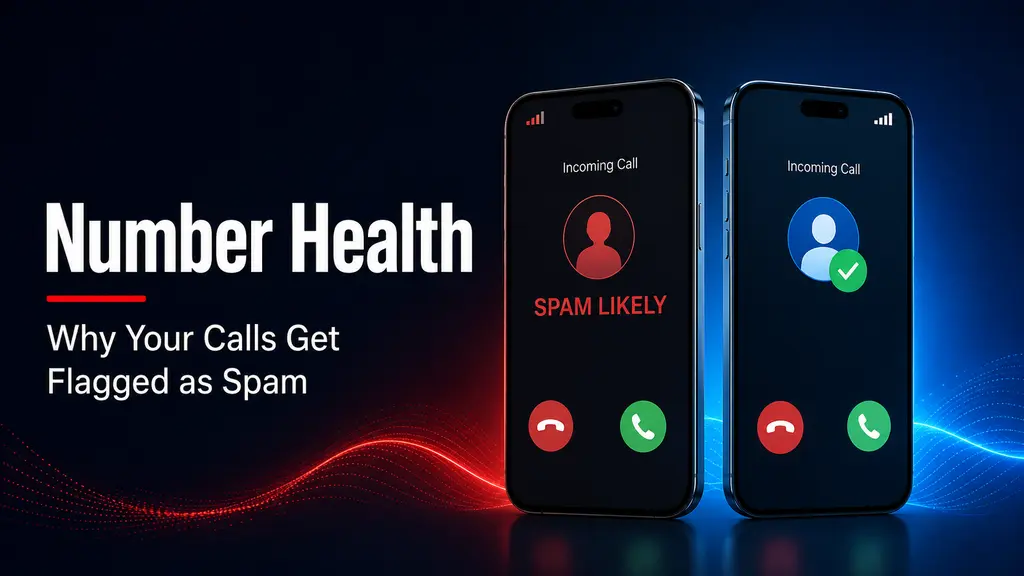


Number health is the reputation carriers and call-analytics providers attach to each phone number you dial from, and it decides whether your call arrives as a normal business call or as a “Spam Likely” warning. It is a property of the number itself, not of the script you run or the list you bought. Two teams can run the identical campaign to the identical list and see completely different results because one team is dialing from clean numbers and the other is not.
Most outbound teams never look at number health until their connect rate has already collapsed. The campaign works in week one, sags in week three, and by week five the reps are convinced the list is dead. The list is usually fine. The numbers are the problem.
This page explains what number health is, the specific signals that get a number flagged, what a flagged number actually costs you, and the operational routine that keeps a dialing pool clean at volume.
TL;DR
Number health is the carrier and analytics-provider reputation score attached to every phone number you make outbound calls from. Numbers get flagged for call velocity, short-duration answered calls, consumer complaints, weak STIR/SHAKEN attestation, and inherited history from a previous owner. A practical working ceiling for cold outbound is roughly 100 to 200 calls per number per day, spread across a rotating pool rather than concentrated on a handful of lines.
Fixing number health is operational work, not a one-time purchase. Register your numbers, warm new ones up over one to two weeks, monitor flag status weekly, and retire flagged lines fast. If you place only a few dozen calls a week from one office line, none of this applies to you and you do not need a managed calling platform to solve it.
Key takeaways
- Number health is the reputation score carriers and analytics databases assign to each of your outbound numbers.
- Flagging is driven by patterns such as call velocity, short-call rate, and complaints, not by whether your calls are legally compliant.
- Three separate layers label calls independently: carriers, analytics providers, and crowdsourced reporting apps.
- Local presence dialing matches your caller ID area code to the prospect’s area code and reliably lifts answer rates.
- Whitelisting registers your numbers as verified business callers and reduces, but does not eliminate, automated flagging.
- Full A-level STIR/SHAKEN attestation is worth confirming with your telephony provider because many default to B or C.
- Number health degrades continuously, so monitoring and retirement have to be a weekly routine rather than a launch task.
Table of contents
- What number health is
- Why outbound calls get flagged as spam
- How carriers decide what gets labeled
- The real cost of a flagged number
- Local presence dialing and answer rates
- Caller ID, CNAM, and what the recipient sees
- Phone number whitelisting, step by step
- Three ways teams manage number health
- How to improve call answer rates
- What to avoid
- What a good AI calling app does differently
- Number health FAQ
- The bottom line
What number health is
Number health is the reputation status of a phone number used for outbound calling, expressed as a set of signals that carriers and third-party analytics providers use to decide how to present your call. Every number your operation dials from carries one. That status determines whether the recipient sees a plain number, a verified business name, a “Spam Likely” label, or nothing at all because the call was blocked upstream.
The closest analogy is sender reputation in email. An IP address that sends too much volume too quickly, generates complaints, or hits dead addresses gets blacklisted, and its mail stops reaching inboxes. Phone numbers work the same way. A number that produces complaints, burns through a high share of very short calls, or fails authentication checks gets flagged, and its calls stop reaching people at full answer rates.
There is one difference that makes phone reputation harsher than email reputation. Email filtering happens quietly behind the scenes. A degraded phone number announces itself on the recipient’s screen before they decide whether to pick up. Most people do not answer a call marked as spam, and that judgment is made in under a second.
Why outbound calls get flagged as spam
Numbers get flagged for pattern reasons, and most of them have nothing to do with whether your calling is lawful. A fully consented, fully compliant campaign can wreck its own number health inside two weeks if the dialing pattern looks wrong.
Call velocity on a single number
If one number places several hundred calls in an hour, carrier algorithms match that against known robocall behavior and act on the pattern. The number gets flagged whether or not the calls were compliant. Volume alone is enough to trigger the filter, which is why concentrating a campaign on two or three lines is the fastest way to destroy them.
High short-call rate
When a large share of answered calls end within five to ten seconds because the recipient hung up, filters read that as unwanted calling. A real sales conversation runs minutes. A stream of two-second connections signals a machine working through a list.
Consumer complaints
Recipients can report a number as spam inside carrier apps such as AT and T Call Protect, T-Mobile Scam Shield, or Verizon Call Filter, and through public reporting databases. Complaints aggregate quickly. A small cluster of them can flag a new number that has almost no calling history to offset them.
Third-party analytics databases
Hiya, First Orion, and Transaction Network Services maintain their own number-reputation databases, and those databases feed the spam labels shown on most phones. A number flagged in any one of them can appear as spam on millions of devices no matter what your carrier thinks.
STIR/SHAKEN attestation failure
STIR/SHAKEN is the call authentication framework mandated by the FCC for the major voice networks. Calls signed at full attestation can display a verified indicator on compatible handsets. Calls that fail or arrive with weak attestation get more suspicion from both filters and people. The mechanics are covered in more depth in our guide to how STIR/SHAKEN affects outbound answer rates.
Inherited history from number recycling
Phone numbers get reassigned after they are released. A number previously used by a high-volume spam operation carries that history forward. The new owner starts dialing with a compromised asset and often has no idea until the connect rate comes in low from day one.
How carriers decide what gets labeled
There is no single authority deciding your label. Three independent layers each make their own call, and the recipient’s screen shows whichever one their device happens to trust.
The carrier layer
AT and T, T-Mobile, and Verizon each run their own spam detection. They analyze traffic patterns in near real time, cross-reference complaint data, and factor in attestation level when deciding how to present a call.
The analytics provider layer
Hiya, First Orion, and Transaction Network Services license their reputation data to handset makers, carriers, and app developers. This is why a number can pass one carrier’s filter and still show as spam on a large share of the phones you dial.
The crowdsourced layer
Apps that let users tag numbers as spam accumulate reports in databases anyone can query. A number carrying dozens of user reports is effectively poisoned for serious outbound work, and cleaning it up takes disputes filed with each source.
The practical implication is that number health is a portfolio problem across three layers. Clearing your reputation with one carrier does nothing for the other two layers, and most teams only discover this after they dispute a flag, get it removed, and find the label still showing.
The real cost of a flagged number
The obvious cost is a lower answer rate on the affected number. The less obvious costs compound underneath it.
Connect rate collapse. Operators commonly report clean, well-targeted campaigns connecting in the mid-tens to low-fifties as a percentage, and the same campaign on flagged numbers dropping into single digits or low teens. Exact figures vary widely by vertical, list source, and time of day, so treat those ranges as directional rather than as a benchmark to hold yourself to.
Wasted list exposure. Every dial from a flagged number burns a contact. That person saw a spam label attached to your outreach and formed an impression. Calling them again from a clean number risks a fresh complaint from someone already primed to file one.
Wasted rep capacity. For teams running humans alongside automation, connections that end in an immediate hang-up still consume the rep’s attention and reset their rhythm. The cost shows up as lower talk time per hour rather than as a line item.
Compliance exposure. Repeated dialing to someone who has already flagged your number, absent a clear do-not-call request, makes a harassment argument easier to build even when your volume sits inside legal limits. Number health and TCPA-compliant calling practice overlap more than most teams assume.
Local presence dialing and answer rates
Local presence dialing means displaying a caller ID whose area code matches the geography of the person you are calling. A prospect in Phoenix seeing a 602 number is more likely to answer than the same prospect seeing a South Florida number. The familiar area code creates enough ambiguity that answering feels reasonable.
Local presence does not mean the call physically originates in Phoenix. The platform keeps a pool of numbers registered across regions, looks up the destination area code before each dial, and selects a matching number to place the call from. Most enterprise dialers and AI calling platforms include this as a standard capability.
The size of the lift varies. Vendors often cite three to five times the answer rate of out-of-area numbers, and independent verification of that figure is thin, so the honest version is that the direction is consistent and the magnitude depends on your vertical and list. Run it as a split test on your own data before you build a forecast on someone else’s multiple.
One caveat matters. Local presence is a tool for improving answer rates on legitimate outbound calling, not for obscuring who is calling. The recipient still learns the actual company when the call connects. Using a local number to disguise a non-compliant operation adds legal risk rather than removing it.
Caller ID, CNAM, and what the recipient sees
Local caller ID refers to the full display the recipient gets when your call arrives, which is the number plus, where supported, the business name registered to it. “Bigly Sales, 561-XXX-XXXX” is a different proposition than “Spam Likely, 561-XXX-XXXX”. The first earns a look. The second ends the interaction before it starts.
Getting a business name to display requires registering your numbers with the major analytics providers and with the CNAM databases carriers query. That registration is separate from buying or porting the number, and nothing about the purchase triggers it automatically.
Managed platforms handle this during onboarding. A team running its own numbers through a self-service dialer has to file CNAM and analytics registrations manually, keep track of which numbers are covered, and redo the work as the pool changes. It is not difficult work. It is just easy to skip, and skipping it is one of the most common causes of poor number health in otherwise well-run operations.
Phone number whitelisting, step by step
Phone number whitelisting is the process of registering your outbound numbers with carriers, analytics providers, and reputation databases so they are recognized as verified business callers rather than unknown traffic. Whitelisting does not make a number immune. It establishes a baseline of legitimacy that lowers your exposure to automated flagging and gives you standing to dispute an incorrect flag.
Register through the Free Caller Registry
The Free Caller Registry is a joint intake run by Hiya, First Orion, and Transaction Network Services. Submitting your numbers there marks them as registered business callers across the major analytics databases at once, which is the highest-leverage single action available.
Register with each carrier’s business caller program
The major carriers each maintain their own process for verifying business identity and calling intent. Registered numbers get more favorable handling inside their detection systems.
Confirm A-level STIR/SHAKEN attestation
Ask your telephony provider directly what attestation level your traffic is signed at. A-level means the provider has verified both your identity and your right to use the number. B-level verifies the customer but not the number. C-level is gateway attestation with neither. Many providers default to B or C and will not upgrade you unless you ask.
Re-check registration monthly
Whitelisting is not permanent. Numbers can lose registered status, especially after a burst of consumer flags. A monthly re-check and re-submission cycle keeps the pool current.
Stop losing dials
Get your numbers answered again
We will walk through your current number pool, attestation level, and flag status on a live call. Twenty minutes is enough to tell whether number health is what is holding your connect rate down.
Three ways teams manage number health
Almost every outbound operation lands in one of three models. The right one depends on your call volume and how much operational attention you can spare each week.
| Model | Best suited to | Weekly effort | Main failure mode |
|---|---|---|---|
| Single number or tiny fixed pool | Under roughly 100 dials a day, one market | Near zero | Velocity flags the pool and there is no fallback |
| Self-managed rotation on a dialer | Mid-volume teams with an ops owner | Two to five hours | Monitoring slips and flagged lines stay live for days |
| Managed platform with automated rotation | High-volume or multi-market outbound | Minimal | Less direct control and you depend on the vendor’s pool |
The middle option is where most teams get hurt. They know rotation matters, they set it up once, and then nobody owns the weekly check. Six weeks later half the pool is flagged and the campaign data looks like a list quality problem.
How to improve call answer rates
Answer rate is the most upstream metric in outbound. Qualification rate, conversion rate, and cost per outcome are all capped by it, which is why number health work returns more than script work at the margin. Work this list in order.
- Audit your current pool first. Check the reputation status of every active number before changing anything else. Free lookup tools from the major reputation providers will tell you what a recipient sees. Retire anything already marked as spam.
- Spread volume across a larger pool. Do not concentrate dials on a small set of lines. Keeping cold outbound near 100 to 200 calls per number per day is a widely used working ceiling, not a published carrier threshold.
- Register every active number. Submit the full pool to the Free Caller Registry and to carrier verification programs before the numbers carry campaign volume, not after they have accumulated history.
- Match area codes to your target markets. Use local presence numbers for each region on your list and measure the lift yourself rather than assuming a vendor multiple.
- Monitor weekly and retire fast. A number flagged on Monday that is still dialing on Friday has made thousands of calls under a broken reputation. Pull it the day you see it.
- Warm new numbers up gradually. Start new lines at 20 to 30 calls a day and build over one to two weeks. A brand-new number that immediately runs at full volume trips the same velocity pattern as an abused one.
- Confirm A-level attestation. Put the question to your provider in writing and get the answer in writing.
- Cut your short-call rate. Fix the opening line, the dial timing, and the list targeting. Fewer instant hang-ups protects the number as well as the pipeline, and faster follow-up on inbound interest through a real speed-to-lead process produces conversations that actually last.
What to avoid
Some common fixes make number health worse. These are the ones worth naming.
Churning through cheap numbers. Buying a fresh block every time the pool degrades treats the symptom and teaches you nothing. If the underlying pattern is unchanged, the new numbers burn on the same schedule.
Dialing the same contact repeatedly after no answer. Repeat attempts against non-answering numbers raise your short-call and complaint exposure at once. Cap attempts per contact and respect the cap.
Treating whitelisting as a one-time setup. Registration lapses. Pools change. A registry submission from last quarter tells you nothing about this quarter’s numbers.
Assuming a compliant campaign cannot be flagged. Flagging is pattern-based. Consent status is not an input to the model. Both matter, and one does not protect you from the other. The Federal Trade Commission’s public guidance on robocalls is worth reading for how consumer complaints enter the system in the first place.
What a good AI calling app does differently
A capable AI calling platform treats number health as infrastructure rather than as a setting. That distinction shows up in a short list of concrete behaviors you can ask any vendor to demonstrate.
- Automatic rotation across a managed pool, with volume distributed without manual configuration.
- Flag detection that rotates away from a degraded number without waiting for someone to notice.
- Pre-registered pools, where numbers are whitelisted before they carry campaign traffic.
- A-level STIR/SHAKEN attestation as the default rather than an upgrade.
- Geographic matching for every area code on your list, managed by the platform.
- Scheduled retirement and replacement of degraded numbers as an ongoing operation.
Bigly Sales runs these as part of its managed calling infrastructure, so clients are not configuring pools, watching flag status, or filing carrier registrations by hand. If you want the vocabulary behind any of the terms on this page, our AI calling glossary defines them in plain language.
Here is the honest caveat. If you place a few dozen calls a week from one number in one market, none of this infrastructure is worth buying. Register the number, keep the volume sane, and move on. Managed number health earns its cost at volume, across markets, or when a flagged pool would cost you more in a week than the platform costs in a month.
Number health FAQ
What is number health in outbound calling?
Number health is the reputation status carriers and analytics providers attach to a phone number used for outbound calling. A healthy number is recognized as a legitimate business caller and connects without a warning label. A degraded number is marked as spam or blocked before it reaches the recipient, which cuts answer rates sharply even when the campaign behind it is entirely compliant.
Why do my outbound calls say Spam Likely?
That label appears when a number trips spam detection. The usual causes are too many calls from one number in a short window, a high share of answered calls that end within seconds, consumer complaints filed through carrier apps, or weak call authentication. Third-party analytics providers apply their own labels independently, so a number can be clean with your carrier and still show a warning.
How do I check my number health?
Start with the free lookup tools published by the major reputation providers, which show how a given number is currently classified. Then place test calls to devices on each major carrier and note what the screen displays. Doing both matters because the carrier label and the analytics label can disagree, and your prospects see whichever one their handset trusts.
What is local presence dialing?
Local presence dialing displays a caller ID whose area code matches the location of the person being called. A prospect in Dallas sees a 214 number rather than an out-of-state one. Answer rates improve because a familiar area code reads as possibly relevant rather than obviously national, which is enough to make picking up feel worth the risk.
Does local presence dialing actually increase answer rates?
The direction is consistent across outbound operations, but the commonly repeated three-to-five-times figure comes from vendor material rather than independent research. Treat it as directional. The reliable way to size the lift for your business is to split a single list between matched and unmatched area codes, run both for a week, and compare connect rates on your own data.
What is phone number whitelisting?
Whitelisting is registering your outbound numbers with carriers and third-party analytics databases so they are recognized as verified business callers. The Free Caller Registry acts as a shared intake for the three major analytics providers, and individual carriers run their own verification programs. Registration lowers your exposure to automated flagging, though it does not make a number immune to it.
How do I stop my calls from being flagged as spam?
Audit the current pool and retire anything already flagged, register every active number with the Free Caller Registry and carrier programs, rotate volume across enough numbers to stay under roughly 100 to 200 dials per number per day, warm new numbers up over one to two weeks, confirm A-level attestation with your provider, and re-check flag status weekly rather than at launch only.
What is STIR/SHAKEN and why does it matter here?
STIR/SHAKEN is the call authentication framework mandated by the FCC for major voice networks. A-level attestation means your provider verified both your identity and your right to use the number, B-level verifies only the customer, and C-level verifies neither. Calls signed at A-level are treated more favorably by spam filters and can display a verification indicator on compatible handsets.
How many calls per day can one number handle?
No carrier publishes a threshold. Operational experience across cold outbound programs points to roughly 100 to 200 calls per number per day as a working ceiling, with lower numbers safer for brand-new lines. High-volume programs should distribute across a large rotating pool rather than pushing any single number toward the top of that range.
Can a flagged number recover?
Sometimes. Resting the number for 30 to 60 days, filing disputes with the carriers and analytics providers showing the flag, and resubmitting it to the registries can restore it. Numbers carrying many consumer complaints or a long history of high-velocity dialing are usually cheaper to replace than to rehabilitate, so set a limit on how long you will spend on any one line.
The bottom line
Number health is the quietest variable in outbound calling and one of the most decisive. It degrades gradually, it announces itself on the recipient’s screen rather than in your dashboard, and it gets misdiagnosed as a list problem or a script problem more often than it gets identified correctly. The fix is unglamorous. Register the numbers, spread the volume, warm up the new lines, watch the flags weekly, and pull anything degraded the same day.
If your team has the discipline to run that routine, you do not need to buy anything to solve this. If your volume has outgrown the attention you can give it, the work is worth handing to infrastructure that does it continuously.
Clean pools, live conversations
See what a managed number pool changes
Bring one campaign and we will show you the rotation, registration, and attestation setup behind it. You will leave knowing what your current connect rate should be.