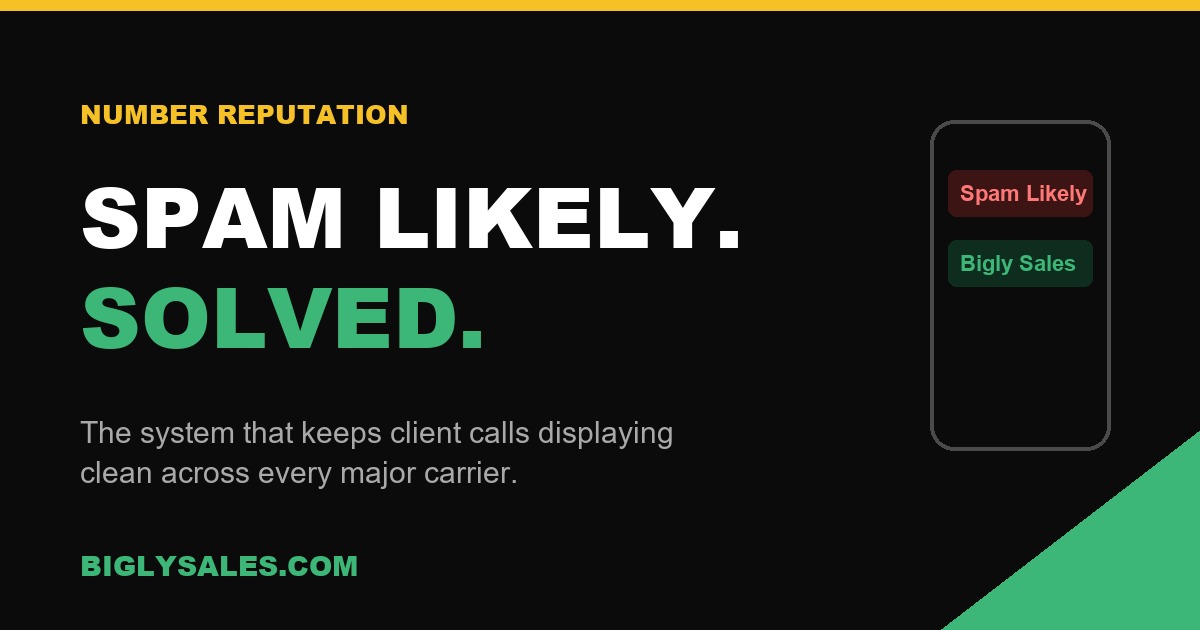


Spam likely is a warning label that phone carriers attach to your number before the call ever rings. It is not a glitch, it is a reputation score. Carrier analytics engines watch every outbound number in the country and grade each one on registration, calling patterns and complaints.
Most sales teams meet the label the expensive way. Connect rates slide for months, reps blame the lists, managers buy more leads, and the extra dialing makes the score worse. By the time someone calls their own number from a personal phone and sees the warning, a quarter of pipeline is already gone.
This post explains why the label exists, why most teams cannot stay ahead of it, and the system Bigly Sales runs so that client calls display clean.
TL;DR
Spam likely is a reputation score assigned to your number by carrier analytics engines, one per major US carrier, based on volume patterns, complaints and registration. Fixing it once is possible, but staying clean is permanent infrastructure work across three separate scoring systems. Bigly Sales runs that layer for its clients on whitelisted, registered lines with continuous monitoring, and enforces consent and Do Not Call scrubbing before any call connects, which removes the complaint signal at its source. The same bad habits that flag numbers also create TCPA exposure of $500 to $1,500 per illegal call. Teams dialing only a few hundred calls a week do not need managed infrastructure, and this service is not for them.
Key takeaways
- Spam likely is applied by the receiving carrier, so your dialer and CRM never see it coming.
- Three analytics engines score you independently, one per major carrier, which is why the label can appear on one network and not another.
- The strongest signals are volume patterns, short call durations, consumer complaints and missing registration.
- Swapping numbers does not work. New numbers inherit the behavior, and rotation is itself a spam signal.
- Staying clean is continuous work across registration, attestation, monitoring and remediation, which is why Bigly runs it as managed infrastructure.
- Complaint prevention beats complaint cleanup, which is why compliance runs before the call connects, not after.
Table of contents
- What spam likely is
- Why the label lands on legitimate businesses
- Why most teams cannot stay ahead of it
- The system Bigly Sales runs instead
- What changes for a client
- Who this is not for
- Check your own numbers today: a 20 minute audit
- Spam likely FAQ
- The bottom line
What spam likely is
Spam likely is a call label generated by carrier analytics engines that score the reputation of every originating phone number. T-Mobile, AT&T and Verizon each use a different engine, and each keeps an independent score. A number can display clean on one carrier and flagged on another, which is why checking from a single phone proves nothing.
The system exists because of the robocall epidemic. Regulators pushed carriers to protect subscribers, and the FTC’s guidance on robocalls explains the consumer side of that push. The industry answer was behavioral scoring on top of the STIR SHAKEN caller authentication framework. Every term in that sentence is defined in our AI calling glossary.
Why the label lands on legitimate businesses
The engines score statistics, not intent. A legitimate team dialing hard from too few numbers produces the same fingerprint as an illegal robocaller. High volume from a single number, short call durations, low answer rates and a handful of consumer complaints will flag an honest business as reliably as they flag a scam.
Registration gaps make it worse. A number with no verified business identity behind it starts from distrust, and a recycled number can arrive carrying the previous owner’s reputation. None of this is visible from inside the dialer, which is why the problem compounds quietly.
| Metric | Healthy number | Flagged number |
|---|---|---|
| What the prospect sees | Your business name or a clean local number | Spam Likely or Scam Likely warning |
| Answer behavior | Normal answer rates for cold and warm traffic | Sharply reduced answering, often screened to voicemail |
| Team response | Conversations and appointments | More dials per rep to hit the same targets |
| Downstream effect | Stable cost per contact | Rising cost per contact plus deeper flags from the extra volume |
There is also a legal shadow. The habits that flag numbers, like dialing purchased lists without consent, are the same habits that create TCPA exposure of $500 to $1,500 per illegal call under 47 U.S.C. 227. Reputation problems and compliance problems usually share a root cause.
Why most teams cannot stay ahead of it
Fixing a flagged number once is possible. Staying clean is the hard part, because the score is a moving target spread across three independent systems that reevaluate your traffic every week.
Doing it in house means owning carrier registrations and their renewals, attestation quality at the provider level, per number volume management, complaint monitoring, and a remediation process with each engine separately. It is a part time infrastructure job that most sales teams assign to nobody, which is how the label keeps coming back. The teams that manage it well treat number reputation the way they treat uptime, as something continuously watched rather than periodically rescued.
Number reputation
Find out what carriers think of your numbers
Book a demo and we will review where your current setup is losing you connects. Thirty minutes, and you keep the findings.
The system Bigly Sales runs instead
Bigly Sales treats number reputation as part of the platform, not as the client’s homework. Every plan runs on the same trust layer.
Whitelisted, registered lines from day one
Client campaigns run on numbers that are provisioned clean, registered to a verified business identity and signed at full attestation. Calls start from a position of trust instead of anonymity.
Compliance enforced before the call connects
Consent verification and Do Not Call scrubbing run on every call as a precondition of dialing, not as an after the fact audit. This is the part that kills the complaint signal at its source, because the people most likely to tap report junk are the people who never agreed to be called in the first place.
Continuous reputation monitoring
Every active number is watched on a schedule across the carrier ecosystems. A downgrade gets caught in days, while it is still cheap to fix, instead of surfacing a quarter later as a connect rate mystery.
Remediation handled by the same team
When a number does get scored down, the dispute and remediation work happens on our side, backed by the registration and traffic records that make those disputes succeed. The client finds out it happened, not that it is their problem.
Volume architecture that never trips the wire
Campaign volume is spread across an appropriately sized pool of registered numbers with sane per number limits, so the traffic pattern stays inside what the engines consider normal business behavior. What that architecture looks like in detail is part of the onboarding conversation rather than this post.
What changes for a client
The visible difference is that calls display clean and get answered, and connect rates stop being a mystery metric. The structural difference is that nobody on the client’s team owns carrier bureaucracy anymore. The same layer also powers our inbound side, where speed to lead only works if the callback line is trusted enough to be answered.
Who this is not for
A team dialing a few hundred calls a week does not need managed calling infrastructure, and buying it would be a waste. At low volume, careful list hygiene and basic registration are enough, and a disciplined operations person can handle them in house. Bigly plans start at a monthly commitment that only makes sense with real volume behind it, which is stated plainly on the pricing page.
Check your own numbers today: a 20 minute audit
You do not need a vendor to find out whether spam likely is already costing you deals. This 20 minute audit tells you where you stand before you change anything.
Call your own numbers from real phones
Borrow phones on Verizon, AT&T and T-Mobile and call your main outbound numbers from each. The label is applied by the receiving carrier, so the same number can display clean on one network and flagged as spam likely on another. Write down exactly what each screen shows. Teams are routinely shocked by this five minute test, and it is the single fastest way to see the problem the way your prospects do.
Look at your answer rate curve
Pull answer rates by number for the last 90 days. A healthy number holds a fairly steady rate. A flagged number shows a cliff, often within days of a volume increase. If a number fell off a cliff and never recovered, treat it as burned until proven otherwise, and stop routing your best leads through it while you investigate.
Check your registration status
The three carrier analytics providers all accept business registration, and unregistered numbers are scored on behavior alone. If your numbers have never been registered with the carrier ecosystem, that gap alone can explain a spam likely label on a perfectly compliant operation. Registration is not a silver bullet, but skipping it means the algorithms are guessing who you are.
Count calls per number per day
Divide yesterday’s total dials by the number of active caller IDs. If any single number carried more than a modest daily volume, the analytics engines almost certainly noticed. Sustainable volume per number is lower than most teams assume, and the fix is more registered numbers rotated responsibly, never one number pushed harder.
How long recovery takes
Set expectations before you start. Registration with the analytics providers typically processes within one to two weeks. A number with a light spam likely label on one carrier can recover within a few weeks of registration, disciplined volume and healthy answer rates. A number that spent months burned across all three carriers may never fully recover, and retiring it is usually cheaper than rehabilitating it. Plan in quarters, not days, and judge progress by answer rate trend rather than by whether the label has vanished on a single test call.
What not to do while you wait
Two mistakes make everything worse. Do not respond to a label by dialing harder, because falling answer rates on rising volume is exactly the signature the algorithms punish. And do not churn through cheap unregistered numbers, because carriers now score that pattern as snowshoeing, the classic spam tactic, and it can drag your whole account into deeper filtering. Steady volume on registered numbers with real conversations behind them is the only pattern that ages well.
One final habit separates teams that stay clean from teams that relapse. Assign the number reputation check to a named owner and put it on a weekly calendar slot. Ten minutes of monitoring catches a fresh label within days, while an unowned dashboard catches it after a quarter of quietly falling connect rates. Reputation is not a project you finish, it is a metric you watch, the same way you watch pipeline.
What the audit usually reveals
Most teams find the same three things. A number or two already flagged as spam likely on at least one carrier. No registration with the analytics providers. And per number volume far above what carrier algorithms tolerate. None of these are character flaws, they are the default state of any operation that grew fast without a number reputation strategy, and every one of them is fixable.
The difference is whether you spend the next quarter learning remediation by trial and error, or hand the whole layer to a system that manages registration, rotation, volume and monitoring as a matter of course. That layer is exactly what Bigly Sales runs for every client, which is why a spam likely label is an emergency for a DIY operation and a Tuesday for a managed one.
Spam likely FAQ
What does spam likely mean on a phone call?
It means the receiving carrier’s analytics engine scored the calling number as probable spam based on its behavior, registration and complaint history. The label is applied before the phone rings, and the caller usually has no idea it is happening.
Why is my business number suddenly marked as spam?
Something moved the score. Common causes are a volume spike, a new campaign with worse answer rates, a burst of complaints, or a registration lapse. Recycled numbers can also arrive flagged by a previous owner. Because each carrier scores independently, the flag may exist on only one network.
How do I check if my number is flagged?
Call your own number from phones on each major carrier and look at what displays. One phone on one carrier tells you almost nothing, because T-Mobile, AT&T and Verizon each use a different analytics engine with its own independent score.
Does changing my number fix spam likely?
Briefly, then it returns. A new number has no earned reputation, inherits the calling pattern that flagged the old one, and rapid rotation is itself a spam signal that engines detect across your whole pool. The pattern and the registration have to change, not the number.
Does STIR SHAKEN stop spam labeling?
No. STIR SHAKEN authenticates that you are entitled to use the number, which helps, but behavioral analytics run on top of it. A fully attested number that dials like a robocaller still gets flagged.
How does Bigly Sales keep numbers off spam lists?
By running reputation as infrastructure. Whitelisted registered lines, consent and Do Not Call enforcement before any call connects, continuous monitoring across the carrier ecosystems, and remediation handled by the same team that manages the campaigns. Preventing complaints does most of the work.
Is spam labeling a TCPA issue?
They are separate systems with a shared root cause. The label is a carrier reputation mechanism, while the TCPA is federal law with statutory damages of $500 to $1,500 per illegal call. Consent hygiene improves both at once.
Can a fully compliant business still get flagged?
Yes. The engines score statistics, not intent, so legal calling that looks statistically like abuse still gets labeled. Compliance keeps you lawful while reputation management keeps you connected, and a serious outbound operation needs both.
The bottom line
Spam likely is not a curse, it is a score, and scores respond to inputs.
The teams that keep their connect rates treat number reputation as permanent infrastructure across three carrier systems. The teams that treat it as a one time cleanup meet the label again within a quarter.
Bigly Sales exists for the teams that would rather buy that infrastructure than build it. The calls go out on trusted lines, the compliance runs before the dial, and the reputation work happens without the client ever opening a carrier portal.
Managed calling
Stop losing connect rate to a label
See how whitelisted, monitored lines perform against your current setup. A demo takes thirty minutes.