

There is no single FTC AI calling ruling that governs outbound sales. What actually controls AI calling in 2026 is a stack of rules from two federal agencies plus the states, and the most expensive mistakes come from treating it as one decision instead of several.
The two federal pieces that matter most are the FCC declaratory ruling from February 2024 confirming that AI generated voices count as artificial or prerecorded voices under the TCPA, and the FTC amendments to the Telemarketing Sales Rule that tightened recordkeeping and extended the ban on material misrepresentations to business to business calls.
This guide sets out what each agency actually did, what changed for one to one consent, what takes effect in 2026, and the controls to put in place before you scale a campaign.
TL;DR
AI calling is legal for outbound sales when the campaign meets the consent, disclosure, suppression, timing and recordkeeping rules that already applied to telemarketing. The FCC confirmed in February 2024 that AI generated voices are artificial or prerecorded voices under the TCPA, which for consumer telemarketing generally means prior express written consent before the dial.
The exposure is priced per call. TCPA statutory damages run $500 per violation and up to $1,500 for a willful or knowing one, and FTC maximum civil penalties for certain violations were adjusted to $53,088 in 2025. If your lead source cannot produce the exact consent language a buyer agreed to, do not put those records into an automated campaign at all.
Key takeaways
- There is no one FTC AI calling ruling. The rules come from the FCC, the FTC and state law together.
- February 2024, the FCC confirmed AI generated voices fall under the TCPA artificial or prerecorded voice rules.
- The FTC 2024 TSR amendments added records requirements and banned material misrepresentations in B2B calls.
- The FCC one to one consent rule was vacated in January 2025 and never took effect. Prior express written consent remains the standard.
- The revocation of consent requirement that applies a stop request across closely related messaging takes effect in January 2027.
- TCPA damages are $500 per violation and up to $1,500 for willful violations, with no aggregate cap.
- Buying a platform does not transfer liability. The seller still owns lead quality, consent records, scripts and claims.
Table of contents
- What the FTC AI calling ruling actually is
- Who regulates what
- The FCC ruling on AI generated voices
- The FTC 2024 Telemarketing Sales Rule update
- Where one to one consent stands now
- The Air AI case and AI sales claims
- Seven controls to fix before you launch
- What getting it wrong costs
- Why the vendor handles compliance is not enough
- What a managed platform should enforce
- When you should not run an AI campaign at all
- AI calling compliance FAQ
- The bottom line
What the FTC AI calling ruling actually is
The phrase FTC AI calling ruling is shorthand for a set of overlapping federal actions, not one decision. The FTC did not create a new AI calling law. It amended the Telemarketing Sales Rule in 2024 to require more records and to prohibit material misrepresentations and false or misleading statements in business to business telemarketing calls. The AI voice question was answered separately by the FCC.
That split matters because the two agencies control different things. The FCC governs how the TCPA applies to calls using an artificial or prerecorded voice, which is where AI generated speech now sits. The FTC governs telemarketing conduct, deception, required disclosures, recordkeeping and B2B misrepresentation under the TSR. State telemarketing statutes add registration requirements, tighter calling windows and in some cases private rights of action on top of both.
For an outbound team the practical reading is simple. AI calling can be legal, scalable and effective, but only where the controls sit in the system rather than in a rep’s memory. Bigly Sales was built around that problem, and the AI outbound calling features show how the controls are applied in a campaign.
Who regulates what
Four separate sources of risk apply to the same phone call. Teams get into trouble when they satisfy one and assume the others follow.
| Source | Governs | Key requirement | Who enforces |
|---|---|---|---|
| TCPA via the FCC | Artificial and prerecorded voice calls, including AI voices | Prior express written consent for consumer telemarketing | FCC, plus private plaintiffs |
| FTC Telemarketing Sales Rule | Telemarketing conduct, disclosures, records, B2B claims | No material misrepresentations, records retained | FTC and state attorneys general |
| State telemarketing law | Registration, calling windows, extra consent rules | Varies by state, often stricter than federal | State regulators and private suits |
| Private TCPA litigation | Any covered call to a consumer number | Proof of consent for each number called | Plaintiff firms, class actions |
The last row is the one that empties bank accounts. Regulators bring a limited number of actions each year. Plaintiff firms read call records at volume.
The FCC ruling on AI generated voices
In February 2024 the FCC issued a declaratory ruling confirming that AI generated voices, including voice cloning and similar human sounding speech synthesis, qualify as an artificial or prerecorded voice under the TCPA. The point of the ruling was to close an argument. A caller cannot escape TCPA restrictions merely because the voice was produced by a newer technology than a recorded message system.
For covered telemarketing calls to consumer numbers, that generally means prior express written consent before the call goes out. The consent record needs to tie the person to the specific number being dialed and show that they agreed to be contacted by this seller using this kind of technology.
Not every AI assisted phone interaction is treated identically. Inbound calls, service and support workflows, non telemarketing calls, business landlines and various industry specific exemptions can be analyzed differently. For outbound sales teams dialing consumer numbers with an AI voice, the safe assumption is that the full TCPA consent framework applies.
The FTC 2024 Telemarketing Sales Rule update
The FTC amended the Telemarketing Sales Rule in 2024. Two changes matter most for AI calling. The rule now requires additional telemarketing records, and it applies the prohibition on material misrepresentations and false or misleading statements to business to business telemarketing calls.
That second change narrowed a comfort zone. For years many teams treated B2B outreach as low risk because parts of the TSR exempted certain business calls. A B2B AI calling campaign can now create federal exposure when it makes unsupported claims. Real examples of the kind of language that creates it:
- This AI system will guarantee 10x revenue.
- You will make six figures in 90 days.
- Our platform is fully compliant in every state.
- You do not need consent if you use our software.
- We remove all TCPA liability.
- This campaign will book a fixed number of appointments.
Each of those is dangerous unless it is accurate, properly qualified and backed by evidence you could hand to a regulator. The FTC concern is not that a company uses AI. It is that AI lets a company scale an unsupportable claim faster than a human team ever could.
Where one to one consent stands now
This is the item most articles still get wrong, so read it carefully. The FCC one to one consent rule was vacated by the Eleventh Circuit in January 2025 and never took effect. The court held that the one to one consent and logically and topically related restrictions exceeded the agency’s statutory authority. Any content telling you that one to one consent became binding federal law in 2025 or 2026 is describing a rule that does not exist.
What remains operative is the existing standard. Prior express written consent under the TCPA is still what covered consumer telemarketing calls require, and that has not changed.
Adopt one to one consent anyway, as internal policy rather than as a legal citation. Seller specific consent is the cleanest defense you can build. When the consent record names the company actually placing the call, a plaintiff has far less to work with. If a lead came from an aggregator, verify that the consent language on the original form supports the specific call you are about to place, and store a copy of that language rather than a reference to it.
The genuinely new item on the 2026 calendar is different. The FCC revocation of consent rules require a revocation made through any reasonable means to be honored, and the provision applying a stop request across closely related messaging from the same seller takes effect in January 2027. If you have been tracking a date, that is the date, and it points at your suppression architecture rather than your consent forms. Our guide to TCPA compliance for AI outbound calling covers how that propagates across channels in practice.
Before you scale
Pressure test your calling controls
We will walk your consent flow, suppression logic and call timing rules against a live campaign setup. It takes about 20 minutes and you keep the notes.
The Air AI case and AI sales claims
The FTC action against Air AI is the clearest signal available on how the agency views AI sales claims. In March 2026 the FTC announced a settlement with the company and its owners, alleging deceptive claims about business growth, earnings potential, refund guarantees and service performance. The proposed order carried an $18 million monetary judgment, largely suspended based on inability to pay, and barred the operators from selling or marketing business opportunities.
Do not read that as the FTC banning AI calling. It did not. Read it as a statement about claims. If a company sells AI services, AI calling, AI agents or automated sales systems, the promises made about performance, earnings, ROI, refunds and compliance have to be supportable.
Three lessons transfer directly to buyers. First, the vendor’s own marketing claims are a risk signal. A provider making extreme promises without proof is creating exposure before your first campaign runs. Second, earnings and business opportunity claims sit in the highest risk category and need real substantiation. Third, vendor compliance is not campaign compliance. A platform can supply controls, but you still own lead sources, consent records, scripts, suppression settings and the claims your agent makes on the call.
Seven controls to fix before you launch
AI calling compliance is not one task. It is a system of controls, and a single failure can contaminate an entire campaign. Fix these seven before the first dial.
1. Consent that is documented, specific and verifiable
You should be able to prove who consented, when, what number they submitted, what language they saw, which seller was named, what communication type they authorized and where the consent was captured. A verbal yes is often not enough for consumer calls using an artificial or prerecorded voice. Neither is a vague lead form, a checkbox buried in general terms, or a third party source that cannot produce the exact language. The practical test is whether you can prove this person authorized this company to make this type of call to this number. If not, the record does not enter the campaign.
2. Do not call suppression enforced by the system
The National Do Not Call Registry remains central for covered campaigns, and the FTC treats interference with a consumer’s right to be on a do not call list as an abusive practice. Its do not call guidance for sellers and telemarketers sets out the obligations. Federal rules do not mandate a check at the exact instant of dialing in every situation, but high volume automated campaigns should move suppression as close to the dial as the system allows. Automation scales mistakes. A human team places a handful of bad calls before someone notices. A machine places thousands.
3. Opt out handling that is immediate in practice
Prospects say stop calling me, take me off your list, do not contact me again and remove my number, among many other phrasings. In a manual center, honoring that depends on the rep hearing it, choosing the right disposition, updating the right system and every other campaign respecting the result. That chain is too fragile for automated volume. The platform should detect opt out language in natural conversation, suppress the number immediately, timestamp the request, retain the transcript and update the CRM so no other active campaign dials it again.
4. Call timing set by the recipient’s location
Federal telemarketing rules generally prohibit calls before 8 a.m. or after 9 p.m. in the recipient’s local time, and the FTC identifies calls outside that window as an abusive practice. States can be stricter, adding evening limits, Sunday and holiday restrictions, registration requirements and industry specific rules. A national campaign should never default to the call center’s own time zone. The system needs to know where the recipient is and which window applies, and it should keep records proving the control was enforced.
5. Disclosures made clearly and early
Every outbound call should identify the seller and state the purpose early. For AI voice specifically, the FCC has proposed rules that would require disclosure at the start of a call that it uses AI generated technology. That sits in a notice of proposed rulemaking and is not binding today. Disclose anyway. An opening along the lines of an automated assistant calling on behalf of a named company about a recent inquiry reduces the chance a recipient feels misled, and it positions the campaign far better if anyone reviews the recordings later.
6. Performance claims that you can prove
Double your revenue, cut costs by 90 percent, guaranteed appointments, fully compliant, no TCPA risk. Every one of those creates exposure if it is not supportable, and the Air AI allegations show the agency will pursue them. The defensible version of the pitch describes mechanism rather than outcome. Faster response to new leads, automated repetitive outreach, more qualified conversations reaching closers, less manual dialing, and calling controls enforced at the workflow level. That framing is also more persuasive to buyers who have heard the other kind before.
7. Records and audit trails kept by default
The 2024 TSR amendment strengthened recordkeeping for telemarketing transactions, and compliance is as much about proving what happened as doing it right. Preserve consent records, lead source detail, call timestamps, recipient location logic, suppression checks, opt out events, recordings where legally permitted, transcripts, dispositions, CRM updates, campaign settings, script versions and disclosure language. When a demand letter arrives, nobody should be reconstructing a campaign from memory.
What getting it wrong costs
Outbound penalties are usually calculated per violation, per call or per affected consumer, which is why a small defect at scale becomes a balance sheet event.
| Exposure | Amount | Basis | Cap |
|---|---|---|---|
| TCPA statutory damages | $500 | Per violating call | None |
| TCPA willful or knowing | Up to $1,500 | Per violating call, at court discretion | None |
| FTC civil penalty | Up to $53,088 | Per violation of covered provisions, as adjusted in 2025 | Statutory maximum per violation |
Run the arithmetic on your own volume. A campaign with 100 problematic calls is a compliance issue. Ten thousand is litigation. A hundred thousand is a board conversation. That asymmetry is the reason AI calling should not be deployed as a loose API pointed at a lightly reviewed list.
Why the vendor handles compliance is not enough
Many teams assume that buying software moves the liability. Risk does not usually work that way. A vendor can supply infrastructure, checks, logs and suppression tooling. The company running the campaign still answers for lead quality, consent records, campaign purpose, scripts, claims, disclosures, opt outs, customer data and state specific requirements.
The useful question is not whether the vendor is compliant. It is what the vendor enforces before the call is placed. That is the line between a tool and a managed workflow.
An open calling API lets a technical team build almost anything, which is genuinely valuable if you have engineers who will own it. It also leaves consequential compliance decisions with people who are not reviewing every campaign through a legal lens. Neither model removes liability, and no responsible provider will tell you otherwise. The realistic goal is to stop compliance from depending on a person remembering every rule on call number 150. Our overview of compliant AI calling platforms compares how the two models handle that.
What a managed platform should enforce
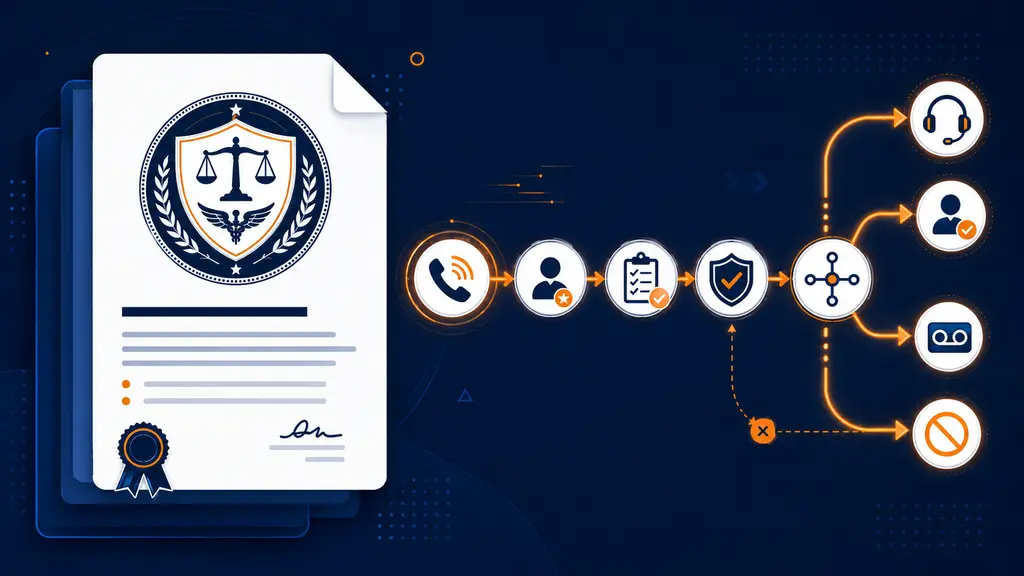
Controls belong at three points in the AI calling lifecycle.
Before the call, the platform should determine whether the lead is eligible at all, which means reviewing the consent record, checking internal suppression, applying registry logic, enforcing campaign rules and blocking numbers that should not be dialed.
During the call, it should hold the approved script, identify the seller and purpose, avoid unsupported claims, respect the recipient’s calling window, detect opt out language in natural speech and route qualified prospects to a human closer.
After the call, it should store the outcome, transcript, recording where permitted, disposition, opt out status and CRM update, and preserve an audit trail showing what happened and when. That is the point at which outbound stops being a dialing system and becomes a controlled revenue workflow. This matters most in debt relief, insurance, mortgage, solar and home services, where volume and regulation arrive together.
When you should not run an AI campaign at all
Some situations call for stopping AI calling plans rather than optimizing them, and a vendor that will not say so is not being straight with you.
Do not launch if your lead source cannot produce the exact consent language a buyer agreed to. Aggregated lists with missing provenance are the single most common cause of TCPA exposure, and automation converts that from a slow problem into a fast one.
Do not launch into a state whose registration or calling requirements you have not checked, particularly if you sell in a category with its own rules. Do not run an AI voice on emotionally sensitive calls, including hardship collections and health related outreach, whatever the regulations technically permit. And if your volume is genuinely low, a small named account list worked by a rep who knows the accounts is both safer and more effective than any automated motion.
None of this is legal advice. Have counsel review your consent flow, disclosures and state coverage before you scale.
AI calling compliance FAQ
Is there really no single FTC AI calling ruling?
Correct. The FTC did not issue one ruling that governs AI calling. It amended the Telemarketing Sales Rule in 2024 to add recordkeeping requirements and to prohibit material misrepresentations in business to business telemarketing. The AI voice question was answered by the FCC in a separate February 2024 declaratory ruling under the TCPA. State telemarketing law adds a third layer, and private TCPA litigation is a fourth source of risk.
Can you legally use AI calling for outbound sales in 2026?
Yes, when the campaign satisfies the applicable consent, disclosure, do not call, opt out, timing, recordkeeping and state law requirements. For covered consumer telemarketing calls using an AI generated or prerecorded voice, the caller must meet the TCPA consent standard before dialing. The campaign also needs to identify the seller and purpose, avoid misleading claims, honor opt outs promptly and preserve records that prove each of those things happened.
Is one to one consent still required?
No. The Eleventh Circuit vacated the FCC one to one consent rule in January 2025 and it never took effect, so it should not be described as a federal requirement. Prior express written consent under the TCPA remains the operative standard for covered consumer telemarketing calls. Seller specific consent is still worth adopting as internal policy, because a consent record that names the company placing the call is much easier to defend.
What takes effect in 2026?
The revocation of consent provisions are the live 2026 item. A revocation made through any reasonable means has to be honored, and the requirement that a stop request apply across closely related messaging from the same seller takes effect in January 2027. Practically, that is a suppression architecture question rather than a consent form question. Your systems need one opt out to propagate everywhere, not just to the campaign that received it.
What did the FCC say about AI generated voices?
In February 2024 the FCC confirmed that AI generated voices fall within the TCPA restriction on artificial or prerecorded voice calls, addressing voice cloning and similar human sounding synthesis directly. For outbound teams that means an AI voice cannot be treated as legally different from a prerecorded message simply because it responds dynamically or sounds more natural. The same consent framework applies to both.
Does the FTC rule apply to B2B outbound calls made with AI?
Yes, more than it used to. The 2024 TSR amendment applied the prohibition on material misrepresentations and false or misleading statements to business to business telemarketing, narrowing an exemption many teams relied on. B2B campaigns now create federal risk when sellers exaggerate results, misstate what an AI system does or make unsupported ROI claims. Some do not call and consent rules still treat business calls differently, but B2B is not outside federal scrutiny.
Does an AI voice agent have to disclose that it is AI?
Not yet as a binding federal rule. The FCC has proposed requiring callers using AI generated voices to disclose that at the start of the call, but that language sits in a notice of proposed rulemaking. Several states have moved separately on artificial voice disclosure. Disclose regardless. It reduces the chance a recipient feels deceived, and a recording where the agent identified itself is a much better exhibit than one where it did not.
What counts as a strong consent record?
One that shows who consented, the phone number submitted, the date and time, the exact consent language displayed, the seller named, the source page or form, and the communication types authorized. Store the language itself rather than a pointer to a page that may change. For AI outbound the record has to be clear enough to prove the recipient agreed to this type of call from this specific company at this specific number.
What happens if someone says stop calling me?
Suppress the number immediately across every active campaign. The safest operational standard is instant suppression rather than the maximum window the rules allow, because automated systems can place many more calls inside that window than a human team could. The platform should detect the opt out in natural language, log and timestamp it, update the CRM or suppression database, and block further attempts without anyone filing a ticket.
How expensive can AI calling mistakes get?
TCPA statutory damages are $500 per violating call, and courts may award up to $1,500 for willful or knowing violations, with no aggregate cap. FTC maximum civil penalties for certain violations were adjusted to $53,088 in 2025. Because outbound campaigns run in the thousands of calls, a defect that would be trivial once becomes serious exposure when repeated at volume, which is the whole reason to enforce controls before the dial.
The bottom line
The regulators are not saying you cannot use AI for outbound calling. They are saying the telemarketing rules that already existed still apply when software scales the voice. That reframes compliance from a training problem into an infrastructure problem, because training does not stop a bad lead entering a campaign, block a registered number, propagate an opt out or prove consent six months later.
Start with the consent records, because everything else fails downstream of a bad list. Then move suppression, timing and opt out detection into the system, keep the audit trail by default, and treat any vendor claim about removing your liability as a reason to walk. The teams that win in 2026 will not be the ones placing the most calls. They will be the ones who can prove every call they placed was one they were allowed to make.
Build the controls in
Scale outbound without scaling risk
See how consent validation, suppression, calling windows and opt out detection run inside a live campaign. Bring your own list structure and we will map it.