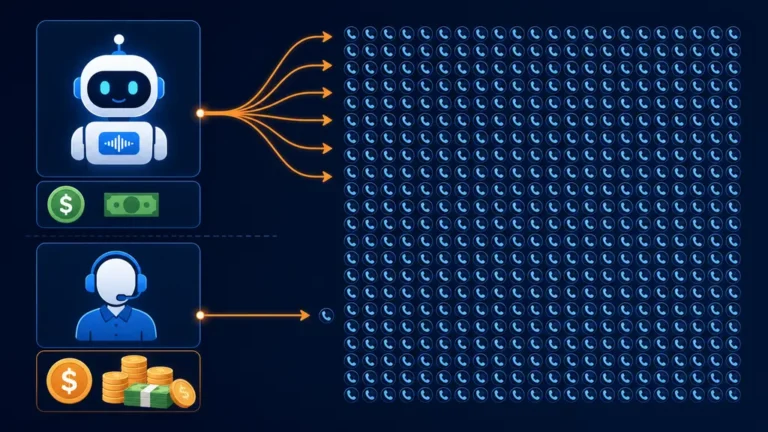



AI calling for mortgage and lending is the use of an AI voice agent to place or answer the first call on a borrower inquiry, confirm interest, ask approved intake questions, and book a loan officer. The AI handles the opening minutes. The licensed human handles the lending conversation.
Mortgage leads are perishable in a way that few other lead types are. A borrower who fills out a refinance form at 9 p.m. is usually filling out three of them. The lender who calls back first gets to frame the conversation, and everyone else inherits a borrower who already has a plan.
This guide covers how the workflow is built, what the AI may and may not say on a regulated lending call, what the compliance baseline actually is in 2026, and the seven setup steps that separate an AI calling campaign that books appointments from one that burns a lead list.
TL;DR
AI calling gives mortgage teams a first response measured in seconds instead of hours, which matters because borrowers shop several lenders in the same session. The AI confirms the inquiry, asks approved intake questions such as loan purpose, timeline, and broad property value range, then books the loan officer with a transcript and summary attached.
For covered consumer telemarketing calls that use an AI-generated, artificial, or prerecorded voice, prior express written consent is generally required before you dial, and calling lists must be scrubbed against the National Do Not Call Registry at least every 31 days. If your team cannot produce a consent record for each number, do not start here. Fix the intake forms first.
Key takeaways
- AI calling responds to a new borrower inquiry in under a minute, at 2 a.m. and on Sundays, without adding headcount.
- The AI performs intake only. It never states approval, quotes a rate, or implies eligibility.
- Prior express written consent is generally required before an AI voice call to a consumer, and it must be documented per number.
- The FCC one-to-one consent rule was vacated in January 2025 and never took effect, so prior express written consent remains the operative standard.
- Aged CRM reactivation is usually the fastest first win because the records are already owned and already consented.
- Calling windows follow the borrower’s local time, not your office time zone, and several states are stricter than the federal rule.
- Soft launch on a few hundred records before scaling, and read the transcripts yourself.
Table of contents
- What AI calling for mortgage teams is
- The mortgage lead problem nobody talks about
- How the workflow actually runs
- What the qualification conversation should cover
- What AI should never say on a mortgage call
- AI calling compared to dialers, services, and manual follow up
- TCPA and lending compliance in 2026
- What results look like in production
- Seven steps to set up a mortgage campaign
- Who should not buy this
- Why Bigly Sales fits mortgage and lending teams
- Mortgage AI calling FAQ
- The bottom line
What AI calling for mortgage teams is
AI calling for mortgage teams is an automated first-contact workflow in which an AI voice agent calls an eligible borrower inquiry, identifies the company, confirms the request, asks a fixed set of approved intake questions, and either books an appointment or routes the borrower into a follow-up sequence. Every call produces a transcript, a summary, a disposition, and a CRM record.
It is not a robo-dialer with a better voice. A dialer’s job is to connect a human to a live answer. An AI voice agent’s job is to have the first conversation on its own and hand a loan officer something better than a phone number, which is where most of the time savings come from.
It is also not a lending system. The AI does not underwrite, price, or advise. Think of it as structured intake that happens to work by phone, at the moment the borrower is most likely to answer.
The mortgage lead problem nobody talks about
When a borrower submits a refinance request, a rate quote inquiry, a purchase-loan form, or a calculator lead, they are rarely waiting on one lender. They may be comparing options, responding to several ads in the same evening, or working down a list. By the time a loan officer calls the next morning, another company has already framed the conversation.
The borrower is most engaged in the minutes right after submitting. They remember the form, they know why they filled it out, and they are more likely to answer a relevant call. Once that window closes, interest fades. The borrower gets busy, or someone else got there first.
Most mortgage teams understand this. Few can execute against it consistently. Loan officers are already on calls, working files, talking to real estate agents, and clearing conditions. Leads arrive after hours, on weekends, and in large batches from paid campaigns and third-party sources, which is exactly when nobody is free to dial.
The result is a queue. Fresh leads sit next to two-week-old leads, and the loan officer works whichever record is on top. Speed to lead stops being a strategy and becomes a lottery. AI calling exists to close that specific gap.
How the workflow actually runs
An AI calling workflow for mortgage and home lending begins when an inquiry enters the system from a website form, a refinance calculator, a paid ad, a rate quote page, a CRM reactivation list, a referral, or a reviewed third-party provider.
Before any call is placed, the workflow checks the basics. Lead source, consent record, internal suppression status, the applicable calling window in the borrower’s time zone, state considerations, and routing rules. A record that fails any check does not get dialed.
Once the lead is eligible, the AI voice agent calls and identifies the company clearly. The opening should reference the recent inquiry and state that the purpose of the call is to confirm a few details before connecting the borrower with a loan officer. The AI never presents itself as a licensed loan officer.
From there the agent moves through the qualification flow for that campaign. A refinance campaign covers the current mortgage situation, loan purpose, property value range, cash-out interest, and timeline. A purchase campaign covers pre-approval status, target purchase range, down payment readiness, timeline, and whether the borrower already has an agent.
If the borrower clears the threshold, the AI books directly against the loan officer’s calendar or triggers a warm transfer. The loan officer gets the summary, the answers, the transcript, and the appointment before the meeting starts, so nobody opens the call cold.
Borrowers who are not ready move into a nurture or callback sequence. Borrowers who decline are dispositioned. Anyone who asks not to be contacted again is suppressed immediately, and that suppression has to propagate across every channel your company uses.
What the qualification conversation should cover
A mortgage intake script should gather enough to decide whether a loan officer conversation makes sense. It should not attempt to complete the lending process, make a credit decision, recommend a product, or discuss personalized terms. The line between intake and advice is the whole game here.
Refinance campaigns
Ask about the current mortgage situation and whether the borrower wants a lower payment, a cash-out refinance, a shorter term, debt consolidation, or a general options review. Broad ranges are safer than precise figures. Current payment range, estimated property value range, and a general credit range if compliance has approved that question.
Purchase campaigns
Ask whether this is a first home or a subsequent property, whether the borrower has been pre-approved elsewhere, the approximate purchase range, expected timeline, down payment readiness, and whether they want to speak with a loan officer. These prioritize conversations without touching eligibility.
Home equity and cash-out campaigns
Collect property ownership, estimated equity, intended use of funds, timeline, and appointment interest. The AI still must not imply that the borrower qualifies. It collects context and routes to a licensed professional.
The safest design treats the AI as a structured intake assistant. Approved questions, captured intent, booked next step. Lending guidance, rate discussion, underwriting judgment, and disclosures stay with licensed loan officers inside the lender’s approved process.
What AI should never say on a mortgage call
Lending is a regulated environment and the language matters more than it does in most verticals. The AI should never say or imply that a borrower is approved, pre-approved, guaranteed a rate, eligible for a specific product, or likely to receive certain terms.
Sentences to prohibit outright in the script include “You qualify for this refinance,” “We can definitely lower your payment,” “You are approved,” “Your rate will be,” and “This loan is the best option for you.” Those statements belong to licensed professionals, and even then they require disclosures, documentation, and context.
Safer intake phrasing sounds like this. “A loan officer can review your options.” “I can collect a few details before your appointment.” “I can note that for the loan officer.” “The loan officer can discuss rates, terms, and eligibility with you.”
This boundary also protects the borrower experience. Nobody needs an AI system making promises about their mortgage. They need a fast response, a clear next step, and access to someone qualified to discuss their situation.
AI calling compared to dialers, services, and manual follow up
Bigly Sales does not sell dialers or answering services, so treat this as a comparison of approaches rather than a shortlist. Plenty of mortgage teams are better served by one of the other three, and the right answer depends on lead volume and where your bottleneck actually sits.
| Approach | Who has the first conversation | Best fit | Main limitation |
|---|---|---|---|
| AI voice agent | The AI, then a booked loan officer | High inquiry volume, after-hours leads, aged CRM lists | Needs documented consent and a compliance-reviewed script before launch |
| Power or predictive dialer | A human rep on every connect | Teams with idle rep capacity and a list to burn through | Reps still absorb every voicemail, wrong number, and unqualified answer |
| Answering service | An outsourced human operator | Inbound overflow and after-hours message taking | Rarely qualifies to mortgage standards, and cost scales with volume |
| Manual loan officer follow up | The loan officer | Low volume, referral-driven, relationship pipelines | Response time collapses the moment the officer gets busy |
Most teams run two of these at once. AI calling on paid and aggregated leads, manual follow up on referrals, because a referral does not need a machine to open the conversation.
Mortgage teams
Answer every borrower inquiry in under a minute
We build the script, the compliance checks, and the calendar routing for your loan officers. A working demo takes about 20 minutes.
TCPA and lending compliance in 2026
AI calling for mortgage teams sits at the intersection of calling compliance and lending compliance, and you have to clear both. On the calling side that means the TCPA, the FTC Telemarketing Sales Rule, National Do Not Call obligations, internal suppression, consent revocation, calling windows, caller identity, and call records. On the lending side it means ECOA, Regulation B, RESPA, Regulation X, fair lending expectations, privacy obligations, and state licensing.
Consent
For covered consumer telemarketing calls using an AI-generated, artificial, or prerecorded voice, prior express written consent is generally required before dialing. That consent must be documented before the lead enters the workflow. You should be able to show who consented, what number they gave, what company was authorized to call, what disclosure language they saw, when it was captured, and whether it was later revoked.
The one-to-one consent rule that never took effect
You will still find blog posts and vendor decks claiming that an FCC one-to-one consent rule became binding law in January 2025 or January 2026. It did not. The Eleventh Circuit vacated that rule in January 2025 and it never took effect. Prior express written consent under the TCPA remains the operative standard for covered calls.
That said, one-to-one consent is worth adopting as internal policy anyway. If your lead forms name the specific companies a consumer is agreeing to hear from, your consent records get dramatically easier to defend when a plaintiff’s firm comes calling. Treat it as risk reduction rather than a legal requirement.
The item that genuinely lands in 2026 is the cross-channel revocation requirement. When a consumer revokes consent through any reasonable method, that revocation has to be honored across the channels your company uses, not just the one they said it on. If your opt-outs live in three disconnected systems, that is the project to fund this quarter.
DNC and calling windows
Covered sellers and telemarketers must synchronize calling lists with the National Do Not Call Registry at least every 31 days. Some managed workflows apply an additional suppression check closer to the moment of dialing as a stronger operational control, but do not let a vendor restate the federal baseline as scrubbing before every call unless they actually do it.
Calling windows follow the called party’s local time, and several states are stricter than the federal rule. A national mortgage campaign cannot run on your office time zone. The workflow needs to resolve recipient location before it dials.
Finally, have compliance review the qualification script itself for fair lending risk. The Consumer Financial Protection Bureau publishes guidance worth reading before you write the first prompt. None of this is legal advice, and every workflow described here should go past your own counsel before launch. Our legal and compliance overview covers the platform side in more detail.
What results look like in production
The first benefit of AI calling is faster first response. Fresh leads no longer wait for a loan officer to free up. When the record is eligible and the campaign is live, intake starts immediately, including during the hours when your team is fully booked.
The second is qualification consistency. Loan officers are human. Some ask every question carefully, some skip steps when rushed, some get optimistic about weak leads, and some spend forty minutes on a borrower who is eighteen months out. The AI runs the approved flow every time, which finally gives managers a clean way to compare lead sources.
The third is better use of loan officer time. Instead of dialing raw records and hoping, officers receive booked appointments, live transfers, and prioritized callbacks with context attached. More of the day goes to borrowers who have confirmed interest and answered basic questions.
The fourth is CRM reactivation, and for most teams this is the fastest first win. Mortgage companies sit on thousands of older records that were contacted once, worked badly, or went cold in a different rate environment. Those records can be re-engaged where the team has a valid basis and the list has been reviewed for consent, suppression, recency, and state law.
Results vary with lead source, market conditions, loan product, borrower intent, rate environment, script quality, compliance limits, and loan officer follow-through. Any vendor quoting you a fixed conversion rate should be asked for comparable campaign data broken out by channel, product, geography, and lead age. If they cannot produce it, the number is marketing.
Seven steps to set up a mortgage campaign
1. Pick one campaign goal
Decide whether this workflow serves refinance inquiries, purchase leads, home equity interest, rate quote requests, aged CRM reactivation, missed-call recovery, or third-party lead follow up. Each needs its own script, routing rule, compliance review, and success metric. Teams that try to serve all seven at once ship none of them well.
2. Audit the lead source
Verify the source, the consent record, whether your calling entity is covered by that consent, whether AI-generated outreach is supported by the disclosure language, and which records are already suppressed or revoked. This step matters most for aggregated and purchased leads, where the consent you inherit is only as good as the form the consumer actually saw.
3. Build the qualification framework
Write the questions before you write the script. Refinance flows need current situation, loan purpose, broad credit range, property value estimate, payment context, and timeline. Purchase flows need pre-approval status, target range, down payment readiness, timeline, and agent status.
4. Get the script approved
Compliance signs off on the AI calling opening, the questions, the prohibited phrases, the opt-out handling, and the disclosure language before a single call goes out. Keep a dated copy of the approved version, because you will want it later.
5. Wire the CRM and the calendar
AI calling loses most of its value when outcomes live in a separate dashboard. Appointments, qualification answers, summaries, dispositions, transcripts, and recordings where permitted should land inside the systems loan officers already open every morning.
6. Soft launch on a small batch
Run a few hundred records, then read the transcripts yourself. You are looking for call quality, borrower reactions, opt-out rate, appointment quality, CRM field mapping, and loan officer feedback. Fix what you find before you scale, not after.
7. Scale by lead source, not all at once
Increase volume one source at a time so you can attribute changes. A campaign that works on your own website leads may perform very differently on aggregated leads, and blending them hides the difference.
Who should not buy this
If your team closes under about thirty loans a year and runs entirely on referrals, AI calling is the wrong tool. Your bottleneck is lead volume, not response time, and an AI voice agent will not manufacture inquiries you do not have.
If you cannot produce a consent record for the numbers you want to call, do not start here either. Fix the intake forms, the disclosure language, and the suppression list first. AI calling makes an existing compliance problem faster and more visible, which is not what you want.
And if your loan officers do not show up to booked appointments, automating the booking will only produce more no-shows with your company’s name attached. That is a management problem, and no platform solves it. Other verticals face similar constraints, and our industries overview covers how the approach changes by market.
Why Bigly Sales fits mortgage and lending teams
Bigly Sales runs AI voice agents for teams that need faster first response, consistent qualification, and a cleaner handoff without hiring more dialers. For mortgage teams that means contacting eligible borrower inquiries, asking approved intake questions, booking loan officer appointments, transferring qualified prospects, and writing structured call records back to the CRM.
The useful part is not the AI calling automation by itself. It is that the workflow gets managed around how mortgage sales actually works. Speed-to-lead pressure, third-party lead risk, loan officer capacity, appointment quality, and compliance-aware execution are all campaign design decisions, not settings you toggle.
We support qualification scripts, appointment setting, live transfer, CRM-ready summaries, transcripts, recordings where permitted, disposition tracking, opt-out capture, suppression workflows, calling-window logic, and deliverability review. Standard campaigns can go live in a few business days when lead records, consent documentation, CRM access, calendar rules, and compliance approval are ready. Multi-state programs with heavier integration work take longer, and we would rather tell you that upfront.
Mortgage AI calling FAQ
How does AI calling work for mortgage and lending?
An AI voice agent contacts an eligible borrower inquiry, confirms interest, asks approved qualification questions such as loan purpose and timeline, and books an appointment with a loan officer. The officer receives the call summary, transcript, qualification answers, and appointment context before the meeting. The AI handles intake only and hands off every lending conversation to a licensed human.
Is AI calling legal for mortgage lead follow-up?
It can be, when the campaign follows applicable TCPA, FTC, Do Not Call, opt-out, calling-window, state telemarketing, privacy, and lending compliance requirements. For covered consumer telemarketing calls using an AI-generated, artificial, or prerecorded voice, prior express written consent is generally required before dialing. Review every workflow with your own compliance team and counsel before launch, because this is not legal advice.
Did the FCC one-to-one consent rule take effect?
No. The Eleventh Circuit vacated the rule in January 2025 and it never took effect, so prior express written consent under the TCPA remains the operative standard. Many lenders still adopt one-to-one consent as internal policy because naming the specific companies on a lead form makes consent records much easier to defend if a claim is filed later.
What can the AI qualify on a mortgage call?
Loan purpose, refinance or purchase intent, broad credit range, property type, estimated property value range, timeline, appointment interest, and whether the borrower should speak with a loan officer. The AI should not make lending decisions, state or imply approval, quote personalized rates, or provide financial advice. Those belong to a licensed loan officer inside the lender’s approved process.
Why do mortgage leads go cold so quickly?
Because borrowers usually contact several lenders in the same session. If one company responds in a minute and another waits until the next morning, the first has already framed the conversation, gathered the details, and set an appointment. Interest also fades on its own as the borrower gets busy, so the same record answers at a much lower rate two days later.
Can AI call mortgage leads after hours?
AI can support after-hours intake, missed-call recovery, and scheduled follow-up, but outbound calls must still respect consent, calling windows in the borrower’s local time zone, Do Not Call status, opt-outs, and state rules. For most mortgage teams the safer model is to capture after-hours inquiries immediately and place the outbound call as soon as the window opens.
How is this different from an auto-dialer?
A dialer connects a human rep to a live answer and the rep does all the talking. An AI voice agent has the first conversation itself, asks the qualification questions, books the appointment, and updates the CRM before a loan officer is involved. The dialer saves dialing time. The AI saves conversation time, which is the more expensive resource on a mortgage team.
Which CRM systems does this integrate with?
Workflows integrate with major CRMs and calendar tools depending on the platform and the setup. The requirement that matters for mortgage teams is that call summaries, transcripts, qualification answers, dispositions, and appointment details land in the system loan officers already use. If outcomes sit in a separate dashboard, adoption drops and the program stalls within a month.
How long does setup take?
Standard managed campaigns can launch in a few business days when lead records, consent documentation, CRM access, calendar routing, script approval, and compliance review are ready. Complex programs with multi-state footprints, heavy integration work, or unresolved lead-source questions take longer. The compliance review is almost always the step that determines the timeline, not the technology.
What does a good first campaign look like?
Aged CRM reactivation on records you already own and already have consent for, run against a few hundred contacts with one clear qualification threshold. It carries the lowest lead-source risk, needs no new ad spend, and produces enough transcripts in a week to judge script quality honestly before you point the workflow at paid leads.
The bottom line
The mortgage teams getting value from AI calling are not the ones chasing automation for its own sake. They are the ones who identified a specific gap, usually the hours between a borrower submitting a form and a loan officer becoming free, and closed it with a workflow that respects the compliance boundary.
Start with records you already own, keep the AI firmly on the intake side of the line, read the transcripts before you scale, and be honest with yourself about whether your bottleneck is response time or lead volume. If it is response time, this works. If it is not, spend the money somewhere else.
Ready to test it
Start with the leads already in your CRM
We will review one aged list, build the intake script, and run a soft launch batch. You see real transcripts before you commit to anything.