

Outbound call tracking is the practice of recording, logging and analyzing every call your team places, so you can see what happened on each one instead of guessing. It covers the basic counts such as dials and connects, and the harder part, which is what was actually said.
Most teams stop at the counts. They know how many calls went out last week and almost nothing about which ones moved a deal. That gap is why two reps with identical activity numbers can produce completely different pipelines.
This guide covers what outbound call tracking measures, what traditional systems miss, what AI transcription and scoring add, the seven metrics worth reviewing weekly, and the consent rules you need to get right before you record anything.

TL;DR
Counting dials tells you how busy a team is, not how good it is. Useful tracking pairs the activity numbers with a transcript and an outcome for every call, so you can trace a booked meeting back to what the rep said. Review seven metrics weekly rather than twenty monthly, and connect rate, talk to listen ratio and meetings held will carry most of the signal.
Two warnings. Recording law varies by state and several require every party to consent, so check before you switch anything on. And tracking never improves a number by itself. If nobody reviews the calls and changes the script, you have bought a very detailed archive of the same results.
Key takeaways
- Outbound call tracking records, transcribes and scores calls so activity numbers can be tied to outcomes.
- Activity counts alone cannot explain why one call converted and a similar one did not.
- Manual logging by reps is the least reliable data source in any sales stack.
- Transcription, sentiment scoring and keyword detection turn calls into reviewable evidence.
- Track seven metrics weekly, starting with connect rate, conversation rate and meetings held.
- Recording consent rules differ by state and some require all parties to agree.
- Tracking without a weekly coaching habit changes nothing except your storage bill.
Table of contents
- What outbound call tracking is
- Why outbound call tracking matters
- Where traditional call tracking stops
- What AI adds to outbound call tracking
- The seven metrics worth reviewing weekly
- How to run a weekly call review
- How to choose outbound call tracking software
- Recording consent and compliance
- Common mistakes to avoid
- Who uses call tracking besides sales
- Outbound call tracking FAQ
- The bottom line
What outbound call tracking is
Outbound call tracking is the process of capturing a record of every call your team places, including who was called, when, for how long, what the outcome was and, in modern systems, what was said. The record lives against the contact so anyone can reconstruct the history later.
There are two layers. The activity layer counts dials, connects, average handle time and disposition codes. The conversation layer captures the recording, the transcript and any scoring applied to it. Most teams have the first and not the second.
The distinction matters because the two answer different questions. Activity data answers whether the work is getting done. Conversation data answers whether the work is any good.
Why outbound call tracking matters
The phone still works for reaching decision makers, especially for considered purchases where a buyer wants to ask questions before committing time. That makes outbound a channel worth measuring properly rather than one worth defending with anecdotes.
Without tracking, a manager is working from memory and from whichever call they happened to overhear. Scripts get changed on a hunch. Coaching goes to whoever sits closest. Good reps get credit for volume and weak reps hide inside it.
With tracking, the questions get answerable. Which opening holds people past the first fifteen seconds. Which objection appears in most lost calls. Which hour of the day produces connects for this segment. Those answers are worth more than any single conversion tactic, because they compound across the whole team.
The reporting case and the coaching case
Reporting is the reason most teams buy tracking and coaching is where the return actually appears. Leadership wants a pipeline forecast. Frontline managers need clips they can play back to a rep on Friday. Buy for the second use and the first comes along for free.
Where traditional call tracking stops
Older tracking setups have three structural problems, and none of them are fixed by trying harder.
The first is that they only count. Knowing your team placed 500 calls last week tells you nothing about whether those calls were competent. Volume is a workload measure that got promoted into a performance measure.
The second is manual logging. When reps type their own dispositions, the data is late, incomplete and shaped by how the rep wants the week to look. Decisions then get made on a report that quietly disagrees with reality.
The third is isolation. A tracking tool that lives outside the CRM produces two versions of the customer history and an argument about which is correct. If call outcomes do not write back to the contact record automatically, assume the data will decay within a month.
There is a fourth, softer gap. Traditional systems cannot capture tone, pacing or whether the rep listened. Those are the things that decide most calls, and they are invisible in a disposition dropdown.
What AI adds to outbound call tracking
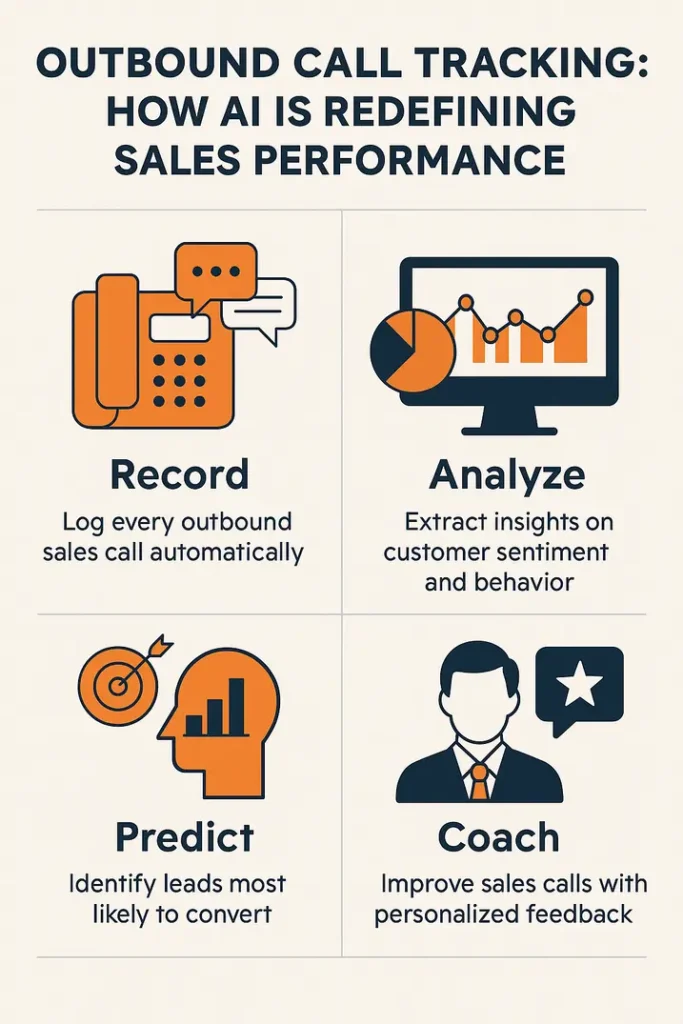
AI does not change what gets recorded. It changes how much of it a human can actually review. No manager listens to 500 calls a week, but a manager can read a summary of all of them and listen to the six that matter.
Transcription and search
Every call becomes text you can search. That single change turns your call archive into a research tool. You can find every conversation where a competitor was named, or where a specific objection appeared, and read them in an afternoon.
Sentiment and intent signals
Scoring flags calls where the prospect sounded frustrated, hesitant or engaged. Treat these as a filter for finding calls worth listening to rather than as a verdict. Automated sentiment is directionally useful and frequently wrong on sarcasm, accents and short calls.
Keyword and objection detection
The system counts which objections come up and how often. This is the most immediately actionable output, because a recurring objection is usually a messaging problem you can fix once for everyone rather than a rep problem you coach ten times.
Lead scoring and prioritization
Calls and their outcomes feed a score that ranks which contacts deserve another attempt. This works when the model is trained on your own closed deals. It works poorly on generic benchmarks from a different market. If a vendor cannot explain what their score is built from, discount it.
Coaching summaries
The system highlights talk ratio, interruptions, filler words and missed questions per call. Managers get a starting point instead of a blank page. The judgment about whether the recommendation was right still belongs to the human. Our AI calling glossary defines the terms vendors use for these features, which are not standardized.
See your data
Turn last week’s calls into a coaching plan
We will run transcription and scoring across a sample of your outbound calls and show you the patterns. About twenty minutes.
The seven metrics worth reviewing weekly

Most dashboards offer thirty metrics and get reviewed by nobody. Seven is enough to run a team on, and each one should have an owner and an action attached.
| Metric | What it tells you | Act when it moves |
|---|---|---|
| Connect rate | Whether you are reaching live people | Check number reputation, timing and list quality |
| Conversation rate | Connects that lasted past the opener | Rewrite the first fifteen seconds |
| Talk to listen ratio | Whether the rep is pitching or discovering | Coach questions, not volume |
| Meetings booked | Output of the calling motion | Look upstream at conversation rate first |
| Meetings held | Whether those bookings were real | Tighten qualification and confirmation |
| Objection frequency | Which concerns repeat across calls | Fix the message once for everyone |
| Time to first touch | Delay between a lead arriving and a call | Fix routing before anything else |
Time to first touch deserves special attention on inbound leads, because delay costs more than script quality does. Our notes on speed to lead response times cover how fast interest decays.
How to run a weekly call review
The habit matters more than the tooling. A simple review done every week beats an advanced platform reviewed quarterly.
Set a fixed time and a fixed shape. Pull the seven metrics for the team, then pick three calls per rep. One that went well, one that went badly, and one flagged by the system. Thirty minutes per rep is enough.
Give feedback on two things at a time and write them down. Reps who leave a review with six improvement areas make none of them. Check the same two next week before adding anything new.
What to keep
Keep clips. A twenty second clip of a rep’s own call teaches faster than a page of notes, and a shared library of good examples from your own team is worth more than any vendor training video.
How to choose outbound call tracking software
There are four common setups and they differ mostly in how much review effort they require from a manager.
| Setup | What you get | Manager effort | Best for |
|---|---|---|---|
| Manual logging in the CRM | Counts and dispositions, entered by reps | High and unreliable | Very small teams only |
| Dialer reporting | Accurate activity data, no conversation data | Moderate | Teams measuring throughput |
| Conversation analytics add on | Transcripts, scoring and search on top of calls | Low after setup | Teams that already have a dialer |
| AI calling platform | Placing, recording, transcribing and routing in one | Low | Teams replacing several tools |
Whichever you choose, check five things. Does it write outcomes and transcripts back to the CRM automatically. Can you search transcripts. Does it store recordings somewhere your security team approves of. Can it suppress recording by state. And can a manager get from a metric to the underlying calls in two clicks.
Bigly Sales covers placing, recording, transcribing and routing calls in one platform, with the outcome written back to the contact record. Current plan pricing is published if you want to compare the per minute cost against your existing stack.
Recording consent and compliance
Recording calls is regulated, and the rules depend on where the parties are. Some states require only one party to consent and several require every party on the line to agree. For a team calling across state lines, the safe operating rule is to disclose and get consent on every call.
Build the disclosure into the opener rather than treating it as a legal afterthought. A single clear sentence at the start costs nothing and removes the argument later.
The other obligations apply whether or not you record. Honor do not call requests immediately, keep to permitted calling hours in the recipient’s time zone, and do not misrepresent who is calling or why. The Federal Trade Commission publishes plain guidance on complying with the Telemarketing Sales Rule, which is the document to read before you write a script.
Storage is the part teams forget. Call recordings and transcripts contain personal information and sometimes payment or health details. Decide the retention period, restrict who can listen, and confirm where the audio is stored. This is a security review, not a sales tools decision.
Common mistakes to avoid
- Measuring dials as performance. Activity targets produce activity. Reps optimize for the number you display on the wall.
- Collecting without reviewing. An unreviewed archive is a cost, not an asset.
- Trusting sentiment scores literally. Use them to find calls worth hearing, not to grade a rep.
- Leaving data outside the CRM. Two histories of the same customer will disagree within weeks.
- Recording without disclosure. The legal risk is real and the reputational damage is worse.
- Changing five things at once. If the script, the list and the calling hours all change together, you learn nothing from the result.
Who uses call tracking besides sales
Sales gets the most obvious value, but the same recordings answer questions for three other teams.
Marketing can hear what prospects actually say when a campaign reaches them, which is usually a correction to the positioning written in a slide deck. Support and customer success can flag churn signals early, because the frustration shows up on a call long before it shows up in a renewal number. Product can search transcripts for feature requests and count them instead of relying on whoever escalated loudest.
Contact centers use tracking mostly for quality assurance at volume, where the practical question is which two percent of calls a supervisor should listen to today. That is exactly the problem automated scoring is good at.
Outbound call tracking FAQ
What is outbound call tracking software?
It is a tool that records, logs and analyzes the calls your team places. At minimum it captures who was called, when, for how long and what the outcome was, and writes that to the contact record. Modern tools add a recording, a searchable transcript and automated scoring for things like talk ratio and objections. The goal is to connect activity numbers to what was actually said.
How is call tracking different from call recording?
Recording captures the audio. Tracking is the wider system that ties each call to a contact, an outcome and a set of metrics you can report on. Recording without tracking gives you a pile of audio files nobody can find anything in. Tracking without recording gives you counts with no explanation behind them. Useful setups do both and make the transcripts searchable.
Is it legal to record outbound sales calls?
Yes, when you follow the consent rules that apply. Some states require only one party to consent and others require everyone on the call to agree, so a team calling across state lines should disclose and get consent on every call. Build a single clear sentence into the opener. Separately, honor do not call requests, keep to permitted calling hours and do not misrepresent the purpose of the call.
What metrics should I track in outbound calling?
Start with seven. Connect rate, conversation rate, talk to listen ratio, meetings booked, meetings held, objection frequency and time to first touch. Each should have an owner and a clear action when it moves. Reviewing seven metrics every week beats reviewing thirty every quarter, because the smaller set actually gets read and acted on.
Does AI actually improve outbound call tracking?
It improves coverage rather than accuracy of judgment. Transcription and automated scoring let a manager review signals from every call and listen closely to the few that matter, which is impossible manually at any real volume. Sentiment analysis is directionally useful and frequently wrong on sarcasm and short calls, so treat scores as a filter for finding calls, not as a grade.
How many calls should a manager review each week?
Three per rep is a workable target. Pick one strong call, one weak call and one the system flagged. Spend about thirty minutes per rep, give feedback on no more than two items, and check those same two the following week. More calls with vaguer feedback does not help. Consistency is what changes behavior.
Will call tracking upset my reps?
It depends entirely on how it is introduced. If recordings are used to find teachable moments and build a library of good examples, reps ask for them. If they are used to catch people out, the team learns to game dispositions and avoid difficult calls. Say plainly what the recordings will and will not be used for before you switch anything on.
Do I need a separate tool if my dialer already reports?
Not necessarily. Dialer reporting gives accurate activity data, which covers connect rates and volumes. What it usually lacks is the conversation layer, meaning transcripts, search and scoring. If your gap is understanding why calls fail rather than how many happened, add conversation analytics or move to a platform that includes it rather than buying a second reporting tool.
How long should we keep call recordings?
Set a defined retention period rather than keeping everything indefinitely. Recordings and transcripts contain personal information and sometimes payment or health details, so storage duration, access control and location are security decisions. Agree the period with whoever owns data protection at your company, document it, and make sure your vendor can actually enforce deletion on that schedule.
Can outbound call tracking work with an AI voice agent?
Yes, and the review process should be identical. An automated caller drifts the same way a human script does, so read a sample of its transcripts weekly and check the same metrics. The one addition is escalation quality, meaning how often the agent hands a caller to a person and whether the context travels with them. Track that as its own number.
The bottom line
Outbound call tracking earns its cost when it changes what reps say on Monday. Capture the calls, make them searchable, review seven metrics weekly and pull three calls per rep from the pile. That loop is simple and most teams still do not run it.
Be realistic about the tooling. Software will not tell you whether the recommendation on a call was the right one, and no dashboard fixes a weak offer or a bad list. Get consent right, keep the data inside your CRM, and treat the recordings as coaching material rather than surveillance.
Weekly review
Put every outbound call on the record
Bigly Sales places, records, transcribes and routes calls in one platform. We will map it to your CRM on a short call.