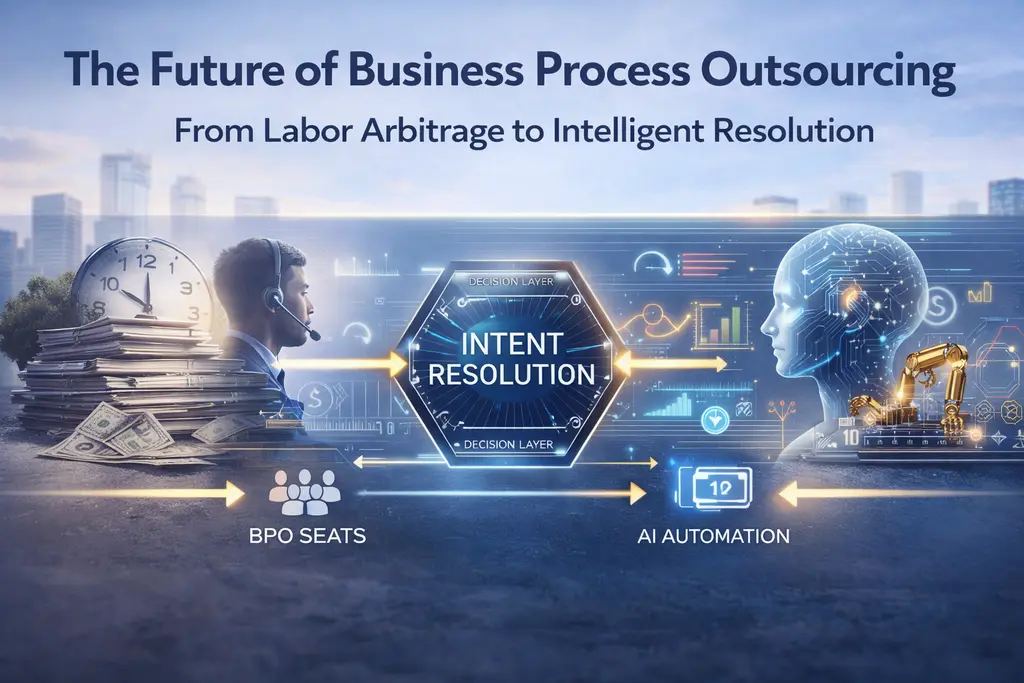


BPO automation is the practice of moving repeatable contact center work out of human headcount and into software that handles the conversation end to end. The buyer is no longer purchasing hours of labor in a cheaper country. They are purchasing resolved outcomes, priced per interaction.
For thirty years the business process outsourcing model ran on labor arbitrage. You moved transactional work to a region with lower wages and captured the spread. That trade still functions, but the spread has narrowed as wages rose in the major delivery hubs, and the thing enterprises now complain about is not cost per seat. It is the three minute hold, the fifth transfer, and the agent who has to ask for the account number again.
This article covers where the traditional BPO model actually breaks, what the cost math looks like with real ranges, which functions should stay human, how compliance changes when it lives in code, and the cases where automating your BPO would be a mistake.
TL;DR
Automated resolution replaces the transactional layer of a BPO contract while human agents keep escalation, negotiation and judgment work. The economics are the argument. Human contact center labor runs roughly $6 to $25 an hour depending on geography, with another 15 to 30 percent on top for management, training and turnover, while a voice AI interaction costs well under a dollar in most configurations. Gartner has projected that conversational AI in contact centers will reduce agent labor costs by $80 billion globally in 2026.
The catch is that this only works on volume that is genuinely repeatable. If your interactions are mostly novel, regulated in ways that require licensed judgment, or under about 2,000 a month, the automation will cost more to build and maintain than it saves. Compliance also does not disappear. It moves from a training problem to a configuration problem, and configuration mistakes scale faster than human ones.
Key takeaways
- Labor arbitrage is a discount on friction, not a fix for it, and the discount is shrinking.
- Average handle time hides the real cost, which is the latency between a customer signaling intent and someone resolving it.
- Automated systems scale in milliseconds, so surge capacity stops requiring a hiring cycle.
- Compliance enforced in code is auditable and consistent, but a bad rule now applies to every call at once.
- Roughly the top 5 to 20 percent of interactions by complexity should stay with humans, and those humans get better work.
- Fragmented opt-out handling across voice, SMS and email is the single largest litigation exposure in outsourced calling.
- Low volume operations and highly bespoke service lines should not attempt this yet.
Table of contents
- What BPO automation is
- Why labor arbitrage stopped working
- The latency tax your metrics do not show
- What automation handles and what humans own
- The cost math, with ranges you can check
- Compliance as a system control
- Data security in an automated operation
- What happens to the workforce
- How to evaluate a BPO automation partner
- A 90 day migration plan
- Who should not automate
- BPO automation FAQ
- The bottom line
What BPO automation is
BPO automation is the replacement of scripted, high-volume contact center tasks with software that understands natural speech, queries your systems, takes the action, and escalates to a person only when the interaction requires judgment. The unit you buy shifts from an agent seat to a resolved interaction.
That is different from the previous two waves of contact center technology. Interactive voice response moved work to the customer by making them navigate a menu. Robotic process automation moved work off the agent’s screen but left the conversation untouched. Automated resolution handles the conversation itself, which is where most of the cost and nearly all of the customer frustration lives.
It is also not a synonym for eliminating your BPO relationship. Plenty of providers now sell exactly this, and the sensible question is not whether to keep an outsourcing partner but what unit you are being billed in.
Why labor arbitrage stopped working
Three pressures converged on the traditional BPO contract, and all three are structural rather than cyclical.
The wage gap narrowed
Wages in the established delivery markets have risen steadily while connectivity costs fell everywhere, which compressed the spread that made offshoring attractive. Attrition in the sector remains high, and every point of attrition carries recruiting and training cost that never appears in the per-seat rate you negotiated.
Customer expectations moved faster than staffing models
Consumers now compare your response time to whatever their fastest vendor does, not to your industry peers. A staffing model that takes a quarter to add capacity cannot serve an expectation measured in seconds.
Regulation stopped being a training problem
Consent management, opt-out handling, call recording disclosure and time-of-day restrictions all now carry class action exposure. Enforcing those through agent training means enforcing them through the most variable component in your operation.
The latency tax your metrics do not show
Average handle time measures the part of the interaction you can see. It does not measure the queue before it, the wrap-up after it, the context lost at shift handoff, or the callback that never happened because the note was written badly. Add those together and you get the real number, which is the gap between a customer signaling intent and that intent being resolved.
That gap is expensive in any high velocity sector. In insurance, mortgage, solar and staffing, a lead that sits for an hour is worth a fraction of the same lead answered in a minute. The interesting part is that scaling a traditional operation to fix latency usually adds latency, because more people means more handoffs, more supervision layers, and more variance between the best and worst agent on the floor.
Automation attacks the gap directly. The system answers on the first ring at any volume, and it does not need a wrap-up period before taking the next call.
What automation handles and what humans own
The best run contact centers in 2026 are not choosing between people and software. They are drawing a deliberate line and defending it.
In a modern BPO arrangement, automation owns volume, consistency and speed. It handles the first layer of every inbound and outbound interaction, initial qualification, intent detection, suppression list checks, consent verification, data capture and opt-out enforcement. It does that without fatigue and without the variance that makes quality management so expensive in human teams.
Humans own complexity, judgment and trust. A customer transferred live to a person is continuing a conversation rather than starting one, because the agent receives the summary and the answers already gathered. For escalations, complaints and high value negotiation, human judgment is still the product.
| Function | Automated | Human | Why |
|---|---|---|---|
| Initial outreach and qualification | Yes | No | Repeatable and volume bound |
| Consent and DNC enforcement | Yes | No | Rule based, zero tolerance for variance |
| CRM capture and disposition | Yes | No | Removes handoff data loss |
| Opt-out detection and suppression | Yes | No | Must apply across every channel at once |
| Complex objection handling | No | Yes | Requires judgment and improvisation |
| Escalation and complaints | No | Yes | Trust repair is a human product |
| Live transfer | Hands off with context | Receives and closes | Continuity beats a cold restart |
| Campaign refinement | Supplies the data | Makes the calls | Optimization needs a human owner |
The operational result is not only lower cost. When repetitive volume moves off the floor, the remaining human work is harder and more interesting, which reduces burnout and improves retention in a sector that has struggled with both.
The cost math, with ranges you can check
Human BPO labor typically runs $6 to $25 an hour depending on geography and function, and management, training and turnover add roughly another 15 to 30 percent on top of the rate you were quoted. Gartner has projected that conversational AI deployments in contact centers will reduce agent labor costs by $80 billion globally in 2026, and the mechanism in that projection is automating the transactional majority of interactions rather than removing the workforce.
On a per-interaction basis, voice automation typically lands well under a dollar, against several dollars for a human handled call once you load in the overhead. We are giving ranges rather than a single figure because the delta swings hard with call length, and a vendor quoting you one precise number for every use case is selling rather than modeling.
| Model | Typical cost driver | Surge capacity | Best fit |
|---|---|---|---|
| In-house team | Fully loaded salary | Weeks to months | Complex, brand critical work |
| Offshore BPO | Per seat, per hour | Weeks | Large steady transactional volume |
| Automated resolution | Per minute or per conversation | Immediate | Repeatable, rule bound interactions |
| Hybrid | Blended, mostly per conversation | Immediate for tier one | Most operations above 2,000 interactions a month |
The honest caveat is that per-interaction pricing hides implementation effort. Budget for integration work, prompt design and a tuning period measured in weeks. If you compare a fully burdened BPO rate against a raw per-minute rate with no implementation line, you will get a number that flatters the automation and disappoints you in month three.
Run the numbers
See your cost per resolved call
Bring your current volume and handle time and we will model the split against a live campaign. It takes about twenty minutes.
Compliance as a system control
Relying on agent training to maintain compliance means relying on consistent execution under production pressure, which is the least controllable variable in any operation. One distracted agent who skips a suppression check can produce a claim that costs more than the year’s savings.
Moving those rules into code changes the failure mode. Consent is verified programmatically before the call connects, calling windows are enforced against the record’s own time zone, and an opt-out detected on any channel writes to a single suppression list that voice, SMS and email all read. The Telemarketing Sales Rule requirements published by the Federal Trade Commission are the baseline here, and for healthcare adjacent work the HHS privacy rule guidance sets the handling standard.
There is a real tradeoff worth stating plainly. A human error affects one call. A misconfigured rule affects every call until someone notices. Automated compliance is safer on average and more dangerous in the tail, which is why change control and a weekly audit of the suppression list matter more than they did with a human floor. Our compliance overview covers the specific checks to run.
Data security in an automated operation
Automated handling removes a category of risk and adds a different one. It removes the human factor in breaches, which covers social engineering, casual screenshotting, and deliberate exfiltration by an agent with list access. Data moves through a closed path, encrypted in transit and at rest, with no human eyes on the record unless an exception routes it to review.
What it adds is concentration. One integration credential now touches your entire customer base, so access control, key rotation and vendor security posture become first order questions rather than procurement checkboxes. Ask for the encryption standard, the data retention window, whether recordings are used for model training, and where the data physically sits. Our notes on platform security cover what we hold ourselves to.
What happens to the workforce
Automation in this sector does not end human value. It ends the use of humans as throughput units. The roles that disappear are the scripted call and the manual data entry seat. The roles that grow are workflow design, conversation quality analysis, exception handling and industry specialist work that requires actual domain knowledge.
That transition mirrors manufacturing more than it mirrors software. The floor gets smaller and the average skill level goes up. It is worth being honest with your team about that rather than pretending headcount is unaffected, because they will work it out from the volume charts regardless.
How to evaluate a BPO automation partner
Ask these before signing a BPO automation contract, and ask for evidence rather than assurance.
- Who owns carrier number registration and spam remediation when a number gets flagged.
- Does a detected opt-out suppress voice, SMS and email simultaneously, and can you inspect that list.
- Are calling windows enforced per record time zone or per account setting.
- What exactly is written back to your systems after each interaction, and is it structured.
- Who tunes conversation logic after launch, on what cadence, and at what cost.
- What is the escalation path when the system cannot resolve, and how fast does the transfer connect.
- Can you export recordings, transcripts and suppression data if you leave.
- What is the retention policy, and are your recordings used to train shared models.
A 90 day migration plan
Days 1 to 30, pick one interaction type with high volume and low complexity. Inbound intake or first touch outbound qualification are the usual starting points. Instrument your current baseline first, because without a before number you cannot prove anything later.
Days 31 to 60, run the automation in parallel with the existing team at low volume. Listen to recordings daily. Expect to rewrite the opening and the escalation trigger more than once. Confirm that write-back is landing correctly in every downstream system before you increase volume.
Days 61 to 90, shift the majority of that interaction type across, keep humans on escalation, and only then add the second interaction type. Moving three workflows at once guarantees you will not know which one is underperforming.
Who should not automate
Do not automate your BPO workload if your interaction volume is under roughly 2,000 a month, because implementation and tuning cost will exceed the savings. Do not do this if your calls are mostly novel rather than repeatable, since the value comes from pattern volume. Do not do this if your work requires licensed judgment on nearly every call, such as clinical advice or legal counsel, where the automation can only handle intake.
Also avoid two specific mistakes. Do not automate a broken process, because you will simply run the broken version faster and at greater scale. And do not remove human capacity before the automated path has held production volume for at least a full billing cycle.

BPO automation FAQ
Is BPO dead?
No, but the unit of sale is changing. Providers that bill for seats and hours are under real pressure, while providers that bill for resolved outcomes are growing. Most enterprises will keep an outsourcing partner and simply stop paying for headcount to handle work that does not require a person. The realistic outcome is a smaller human floor doing harder work, sitting on top of an automated first layer that handles the repeatable majority.
How is this different from the IVR systems we already have?
Interactive voice response is a decision tree that moves work onto the customer and fails the moment they say something off script. Conversational systems use natural language understanding, so the caller can describe their problem in their own words and the system determines intent from context. That difference shows up most clearly in multi-part requests, where an IVR forces two separate calls and a conversational system resolves both in one.
What is the difference between a chatbot and agentic AI?
A chatbot answers what it was explicitly programmed to answer. An agentic system is given a goal, such as qualify this lead and book an estimate, and can choose which tools to use, query your CRM, and adapt its path based on what the person says. The practical distinction is whether the software can take actions in your systems or only produce text. That capability is also why access control matters more with agentic deployments.
How does automation handle opt-outs across channels?
Correctly implemented, an opt-out detected on any channel writes immediately to one suppression list that voice, SMS and email all read before every send. Fragmented suppression is the most common serious defect in outsourced calling operations, because a customer who tells a voice agent to stop and then receives a text the next day has a clean claim. Ask any vendor to demonstrate this live rather than describe it.
Can we support multiple languages without offshoring?
Yes for common languages, with caveats. Current speech models handle major languages at usable fluency, which removes the historical reason to staff a foreign floor purely for language coverage. Quality varies considerably by language and accent, so test with recordings from your actual customer base rather than trusting a demo. Regional dialect and code switching remain the weak spots.
What volume do you need before automation pays back?
As a rough gate, around 2,000 interactions a month of a single repeatable type. Below that the implementation and tuning effort dominates and you are better served by improving routing or scripting with the team you have. The threshold drops if the interactions are high value, since a mortgage or insurance lead justifies more setup cost than a routine status check does.
Does automated calling create more compliance risk or less?
Less on average and more in the tail. Rules enforced in code apply consistently and produce an audit trail, which is a genuine improvement over training and hoping. The offsetting risk is that a misconfiguration applies to every call at once rather than one agent’s calls. Treat conversation and suppression logic as production code with change control, and audit the suppression list weekly.
What happens to our existing agents?
The transactional seats shrink and the specialist roles grow. Agents who move into escalation handling, quality analysis and workflow design typically report better work, because they stop reading the same script eighty times a day. Be direct with the team about the change rather than framing it as pure augmentation, since the volume reports will make the reality obvious within a quarter anyway.
How long does implementation actually take?
A single well scoped workflow can be live in days and tuned to production quality in four to six weeks. Full migration of a multi-workflow operation is a quarter or more, mostly because of integration work and change management rather than the conversation logic itself. Anyone promising a full contact center migration in two weeks is describing a pilot, not a migration.
Which industries see the fastest return?
High velocity sales and intake operations where speed directly changes conversion, including insurance, mortgage, solar, debt relief, staffing and home services. The common trait is a large volume of similar first conversations where minutes matter. You can see how the qualification logic differs by sector on our industries overview.
The bottom line
The BPO model is not dying because software got impressive. It is changing because the thing enterprises buy has changed from labor time to resolved outcomes, and per-seat pricing cannot express that. If your provider cannot quote you a price per resolution, you are still buying the old unit.
Start with one high volume workflow, measure the baseline before you touch anything, and keep humans on everything that requires judgment. The operations that get this right end up smaller, faster and considerably harder to compete with on price.
One workflow first
Pilot before you migrate anything
We will stand up a single campaign against your real volume so you can judge quality on recordings. No contact center rip and replace required.