


AI voice agents for outbound call centers are software that makes and answers phone calls, understands what the person on the other end is saying, and replies in natural spoken language. In an outbound call center, the agent handles the first layer of every call. Initial contact, qualification, appointment setting, and compliance checks, then it routes the conversations worth having to a human closer.
A call center running the same dialing operation it ran five years ago is falling behind. Speed of first response is now measured in seconds. Compliance is a per-call enforcement problem rather than a quarterly audit. Reps are asked to handle objections on leads they did not qualify, from lists nobody cleaned, on numbers carriers already flagged as spam.
This guide covers what these systems actually are, why outbound operations are adopting them now, the eight jobs they do in practice, and where the compliance line sits between a managed platform and a tool you configure yourself.
TL;DR
An AI voice agent holds a real phone conversation, running speech recognition, intent understanding, response generation, and speech synthesis in a loop that has to close in under one second to feel natural. In outbound call centers it takes the top of the funnel, contacting leads, qualifying them against your rules, booking appointments, and warm transferring the ones that qualify.
The real decision is not the voice technology, which is broadly similar across vendors. It is whether consent checks, calling windows, do-not-call suppression, and carrier number health are enforced by the platform or left to your team. If your outbound program is under a few thousand dials a month, or your calls need licensed advice, this is not the right purchase yet.
Key takeaways
- An AI voice agent is not an IVR, a chatbot, or a dialer. It holds a two-way conversation.
- The full speech loop has to complete in under a second or the call stops feeling human.
- A US-based outbound SDR costs $55,000 to $75,000 all in, which is the number automation is measured against.
- Prior express written consent under the TCPA is the operative standard for automated calls to wireless numbers.
- The FCC one-to-one consent rule was vacated in January 2025 and never took effect.
- Managed platforms enforce consent, calling windows, and number health at the infrastructure level. Self-serve tools do not.
- Do not automate licensed advice, complaint handling, or any conversation where a wrong answer creates liability.
Table of contents
- What an AI voice agent is
- How it works on a live call
- Why outbound call centers are adopting them now
- Eight jobs an AI voice agent does in outbound
- Managed platform against self-serve tool
- Consent, and the rule that never took effect
- Number health and spam labels
- Where an AI voice agent is the wrong choice
- What a managed deployment involves
- AI voice agent FAQ
- The bottom line
What an AI voice agent is
An AI voice agent is software that can hold a real phone conversation, dialing or answering calls, interpreting what the person says, and responding in natural spoken language without a human on its side of the line.
It is not an IVR. An IVR reads a menu and waits for a keypress. It is not a chatbot, which handles text in a browser. It is not a dialer, which connects a number to a human rep and does nothing else.
The closest comparison is a well-trained phone rep, with three operational differences.
- It never has an off day, and the tenth hour sounds like the first.
- It runs thousands of conversations at once without adding headcount.
- It follows the approved script on every call, with compliance checks built into the flow.
Building this in 2022 meant a development team and months of work. In 2026 a managed deployment goes live in days. The technology stopped being the hard part. What surrounds it did not.
How it works on a live call
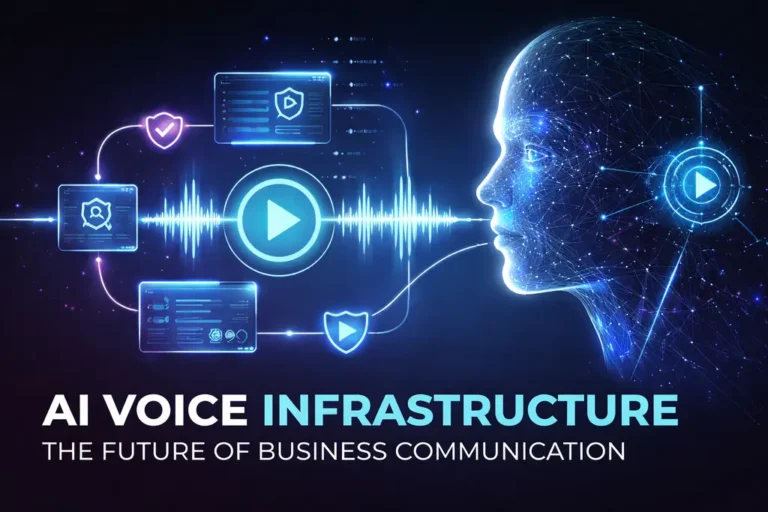
Four things happen on every call, continuously. The system converts speech to text in real time. It interprets what the caller meant rather than only what they said. It generates a response from your script and the caller’s answers. Then it speaks that response back in a human-sounding voice.
The whole loop has to close in under a second. That latency budget is the entire difference between a conversation that feels natural and one that feels like a machine. Vendors who are vague about latency are usually vague for a reason, so ask for the number and then listen to a live call rather than a demo recording.
Two other components decide whether the call is useful rather than merely smooth. The first is barge-in handling, meaning what happens when the caller interrupts. The second is the write-back, meaning what lands in your CRM when the call ends. A pleasant conversation that produces no structured record is not an operational improvement.
Why outbound call centers are adopting them now
Four pressures are driving the shift, and none of them are easing.
Labor economics
A US-based outbound SDR costs $55,000 to $75,000 all in once you add benefits, management overhead, training, and turnover. Offshore alternatives have become substantially more expensive over the past decade as wages and quality expectations both rose. An automated agent covering the same top-of-funnel volume costs a fraction of that per conversation.
Speed of first response
Widely cited industry research puts a sharp drop in lead conversion rates once first contact happens more than five minutes after the inquiry. Most human teams cannot hold that window consistently. A lead submitted at 7:43 PM on a Friday sits until Monday. An AI voice agent calls inside 30 seconds, including weekends and holidays. Our post on speed to lead in outbound calling covers the underlying data.
Compliance enforcement
The Telephone Consumer Protection Act, codified at 47 U.S.C. 227, carries statutory damages of $500 per violation and up to $1,500 per violation where the conduct was willful or knowing. On a campaign measured in thousands of dials, a systematic error is not a fine. It is a class action. Many state attorneys general also have information-sharing arrangements with federal regulators, and state dialing windows, disclosure language, and do-not-call rules still vary by jurisdiction.
Lead volume in specific verticals
Insurance carriers push agencies for faster quote turnaround. Mortgage lenders compete for refinance leads that go cold in hours. Solar companies pay $50 to $150 per lead and cannot let them sit. Debt relief operations sit on databases of 50,000 to 500,000 aged leads that no human team can work through at any sensible cost.
Eight jobs of AI voice agents for outbound call centers
The pattern across all eight is the same. The system takes volume, speed, and consistency. Your people take the close, the objection, and the trust-building conversation.
1. Automated prospect outreach
The agent works your list or CRM against your rules, including time zones, dialing windows, opt-out status, and prior contact history. A list of 20,000 leads gets worked in a day instead of a month.
2. Instant response on form fills
The moment a form arrives, the system dials within 30 seconds while the lead is still on your page. Two or three qualification questions later, a qualifying lead goes to a human who already has the context.
3. Qualification at scale
The first three to five questions decide whether a lead is worth a rep’s time. Not ready gets a booked callback. Not qualified gets a clean ending. Qualified gets a live transfer.
4. Appointment setting
The agent reads your calendar and books directly during the call, with confirmation by SMS or email before the call ends. No promise to call back and no missed follow-up.
5. Routing to the right closer
A commercial insurance lead goes to the commercial team. A residential refinance goes to mortgage closers. An in-state lead goes to the agent licensed in that state. Routing runs on your rules, during the call.
6. Personalization at volume
Every call is built from CRM fields, including name, prior history, product interest, geography, and referral source. One conversation still feels like one conversation when 500 are running at once.
7. Aged lead reactivation
Most centers hold thousands of cold leads no human team can economically revisit. The system can work all of them in a weekend on a single question about whether the person is still in the market. On 50,000 aged records, even a 2 percent response rate produces 1,000 live conversations.
8. Repetitive operational calls
Payment reminders, appointment confirmations, renewals, document collection, and post-service surveys. These are the calls your best closers should never be making. The agent handles them, logs the outcome, and escalates exceptions.
Live walkthrough
Hear an AI voice agent work your script
We will run your qualification questions on a live call and show you the CRM record it writes. The session takes about 30 minutes.
Managed platform against self-serve tool
The voice technology is broadly comparable across serious vendors. What differs is who owns the parts that get you sued or get your numbers blocked.
| Option | Who owns compliance | Time to live | Number health | Best fit |
|---|---|---|---|---|
| Managed AI voice agent platform | The vendor, enforced per call | Three to five business days | Monitored and rotated for you | Regulated verticals at real volume |
| Self-serve AI voice tool | Your team, in configuration | Hours to set up, weeks to make safe | Your responsibility | Low-risk internal or notification calls |
| In-house build on an API | Your engineers and counsel | Months | Your responsibility | Teams with a genuine product reason to build |
| Predictive dialer plus human reps | Your supervisors, manually | Weeks | Partly, depending on carrier setup | Complex consultative selling at low volume |
Read the compliance column first. For an outbound operation in a regulated vertical, that column is the product. Everything else is a feature comparison.
One caveat worth stating plainly. Bigly Sales does not sell dialers or CRM software, so the bottom row of that table is not a product we offer. We run the conversation layer on top of the systems you already have, which is a different approach rather than a cheaper version of the same thing.
Consent, and the rule that never took effect
This is the section most vendor material gets wrong, so it is worth being precise.
What the operative standard actually is
Automated calls to wireless numbers in commercial contexts require prior express written consent under the TCPA. That has been the standard for years and it remains the standard today. In February 2024 the FCC confirmed that AI-generated voices count as artificial or prerecorded voices for these purposes, which means an AI voice agent placing outbound marketing calls sits squarely inside those rules. Clear disclosure at the start of the call and a working opt-out are part of the same package.
The one-to-one consent rule was vacated
You will still find articles, including older posts on this site, describing a one-to-one consent requirement as binding law with a 2025 or 2026 effective date. That is not correct. The FCC rule that would have required consent to be given to one identified seller at a time was vacated by the Eleventh Circuit in January 2025 and never took effect. Buying a lead with broad multi-party consent language is not, by itself, a violation of a rule that does not exist.
That does not make it a good idea. One-to-one consent remains sound internal policy. Litigation risk in lead generation is driven by whether you can produce a clean, specific, time-stamped consent record for the number you dialed, and a single-seller record is far easier to defend than a list of eighty partner names in a footer. Treat it as a standard you hold your lead vendors to rather than as a rule someone is about to enforce.
The requirement that is actually landing
The change worth building for is revocation of consent. Consumers must be able to revoke consent through any reasonable method, and a revocation received on one channel has to be honored across the others, including calls and texts, within a short processing window. That is an operational problem more than a legal one. If your text platform, your dialer, and your CRM keep separate suppression lists, you will honor an opt-out in one place and violate it in another. Our TCPA compliance guide for managed AI calling covers how those suppression records are unified.
The controls that carry the weight
Consent status is checked on the number before the call is placed, and the call is blocked when consent is missing or revoked. Calls run only inside the 8 AM to 9 PM local calling window described in the Federal Trade Commission’s Telemarketing Sales Rule guidance, with state rules layered on top where they are stricter. Every call is recorded and transcribed, with retention matched to your jurisdiction. When a caller says stop calling, the agent recognizes the intent, writes the opt-out to the suppression list, and stops permanently across every campaign rather than only the current one.
Number health and spam labels
An AI voice agent is only as effective as the numbers it calls from. When carriers flag your numbers as spam, connect rates collapse and no amount of script quality recovers them.
Managed platforms monitor carrier reputation on every outbound number, rotate numbers before they are flagged rather than after, and maintain the registration and attestation that carriers require for calls to be signed properly. Self-serve platforms hand you the dashboard and leave the judgment to you.
This is also where volume discipline matters. Short-duration calls, high abandon rates, and heavy dialing from a small pool of numbers are the patterns that trigger labeling in the first place. Our breakdown of the spam likely problem in outbound calling goes through the specific behaviors that cause it.
Where an AI voice agent is the wrong choice
Do not automate conversations that require licensed advice. If an answer would amount to a recommendation only a licensed professional can make, the call belongs to a person.
Do not automate complaint handling, collections disputes, or anything with a safety dimension. A caller who is distressed needs judgment, and the reputational cost of getting that wrong is larger than the payroll it saves.
Do not deploy without a consent record you trust. Automation multiplies whatever your list quality already is. A dirty list dialed by hand produces complaints. The same list dialed automatically produces a pattern, and a pattern is what plaintiff firms look for.
And if your outbound program runs a few hundred dials a month, the configuration work will cost more than it returns. Fix your list hygiene and your follow-up discipline first.
What a managed deployment involves
Bigly Sales is a managed AI outbound calling platform built for high-volume call centers in regulated industries, including insurance, mortgage, solar, debt relief, real estate, and staffing. The deployment work is the service rather than your team’s homework.
That work covers number registration and attestation, script development against your existing call flow, CRM integration and field mapping, consent and suppression configuration, and the calling window rules for every state you operate in. Deployments typically go live in three to five business days.
After launch the account stays staffed. Connect rates get monitored, numbers get rotated before they are labeled, scripts get revised against what the transcripts show, and qualification rules get tuned as your close data comes back. Auto warranty campaigns run on the same mechanics, with the same consent handling and live transfer logic.
AI voice agent FAQ
What is an AI voice agent?
It is software that places and answers phone calls, understands spoken language in real time, and responds conversationally without a human on its side of the line. It differs from an IVR, which waits for keypresses, from a chatbot, which handles text, and from a dialer, which only connects numbers to reps. In outbound sales it typically handles contact, qualification, booking, and routing before a human joins.
Do AI voice agents really sound human?
The current generation largely does. On managed platforms using modern voice models, most callers do not identify the system as automated in the first half minute of a conversation. Voice quality is no longer the limiting factor. Latency and interruption handling are. Disclosure remains required in practice and is the right thing to do regardless of how convincing the voice is.
Is the FCC one-to-one consent rule in effect?
No. The rule was vacated by the Eleventh Circuit in January 2025 and never took effect, so it is not binding law. Prior express written consent under the TCPA remains the operative standard for automated calls to wireless numbers. One-to-one consent is still worth adopting as internal policy, because a specific single-seller consent record is much easier to defend if you are ever sued.
Are AI voice agents legal for outbound sales calls?
Yes, when operated compliantly. The FCC confirmed in February 2024 that AI-generated voices fall within the TCPA’s artificial and prerecorded voice provisions, which means prior express written consent is required for automated marketing calls to wireless numbers. Add clear disclosure at the start of the call, a working opt-out, calling only inside the permitted local window, and complete records, and the activity is lawful.
What happens when a prospect asks something outside the script?
A well-configured agent either answers from its trained knowledge base or escalates to a human in real time. The escalation should be a warm transfer carrying the full conversation context, not a promise of a callback. Ask any vendor to demonstrate an off-script moment during evaluation rather than accepting the claim, because handling of the unexpected is where deployments most often disappoint.
How long does deployment take?
On a managed platform, three to five business days is typical. That covers number registration and attestation, script development, CRM integration, consent and suppression configuration, and state calling rules. A self-serve tool can be switched on in an afternoon, but the compliance configuration, list hygiene, and number reputation work still have to happen and your team does all of it.
How does an AI voice agent handle opt-outs?
It should recognize the intent rather than only a keyword, so stop calling, take me off your list, and do not contact me again all register. The opt-out is written to a suppression record that applies across every campaign and every channel, not just the current one. Cross-channel revocation is the requirement most worth checking, because separate suppression lists in your dialer, texting tool, and CRM create violations.
Which industries use AI voice agents the most?
Insurance, mortgage, solar, debt relief, real estate, staffing, legal intake, and final expense. What those verticals share is high lead cost, high deal value, heavy regulation, and a qualification-heavy sales process. Those are exactly the conditions where taking repetitive top-of-funnel work off a human team produces the largest measurable lift in cost per acquisition.
Will an AI voice agent replace our human sales team?
It replaces work rather than people, specifically cold contact, first-pass qualification, appointment setting, and compliance checking. Closers still close. In practice the headcount effect shows up as slower hiring at the top of the funnel rather than reductions among experienced reps, because the qualified conversation volume reaching those reps goes up rather than down.
What should we measure in the first 30 days?
Connect rate, contact-to-qualified rate, transfer acceptance rate, appointment hold rate, and cost per qualified conversation. Track spam labeling on your outbound numbers weekly from the start, because reputation damage is slow to appear and slow to repair. Also sample transcripts by hand, since aggregate metrics will not show you a qualification rule that is quietly disqualifying good leads.
The bottom line
The question is not whether an AI voice agent can be compliant. It can. The question is whether the platform you choose enforces compliance automatically or hands you a tool and expects you to build that layer yourself. For a center running 10,000 calls a day, those two answers are the difference between a scaling operation and an incident waiting to be filed.
Judge vendors on the compliance column, the latency number, and the CRM write-back. Judge the deployment on connect rate and cost per qualified conversation after 30 days on your own leads. And keep a person on every conversation that needs judgment, because the operations getting the most out of this are the ones that were honest about where the line sits. You can see the full feature set on our AI outbound calling features page.
Regulated verticals
Put compliance in the infrastructure
We handle number registration, consent enforcement, and script work so your reps only speak to leads that qualify. Deployments go live in days.