


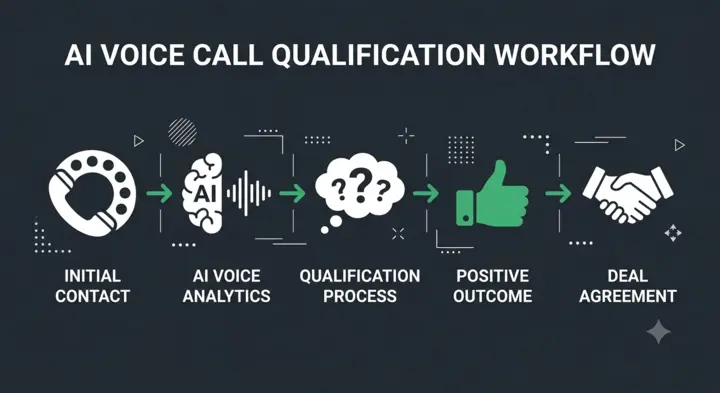
AI voice agents for sales teams are software agents that place and answer phone calls, hold a real qualification conversation with the person who picks up, and either book the meeting, log the outcome in your CRM or transfer the prospect live to a human rep. They sit between your lead list and your closers and do the first-touch work an SDR would otherwise do.
The reason sales teams care is arithmetic. Outbound without AI support means dialing hundreds of contacts to produce a handful of real conversations. AI voice agents now run full qualification calls at scale, ask the right questions, manage common objections and pass warm prospects to a rep while the prospect is still on the line.
This guide compares the ten AI voice agents sales teams shortlist most often in 2026, with pricing checked against each vendor’s public pricing page in September 2026. Bigly Sales is our platform. It is reviewed here alongside the alternatives, ranked first, and every competitor is described on the same facts a buyer would check: what it costs, what it includes and what work is left for your team.
TL;DR
AI voice agents for sales teams fall into three lanes. Managed platforms, where the vendor builds and runs the agent, the phone numbers and the compliance checks for you. That is Bigly Sales. No-code builders, where your own team assembles and operates the agent without engineers. That is Synthflow, Thoughtly, ElevenLabs Agents and Aloware. Developer APIs, where your engineers own everything. That is Retell AI, Bland AI and Vapi. Pick the lane before you pick the vendor.
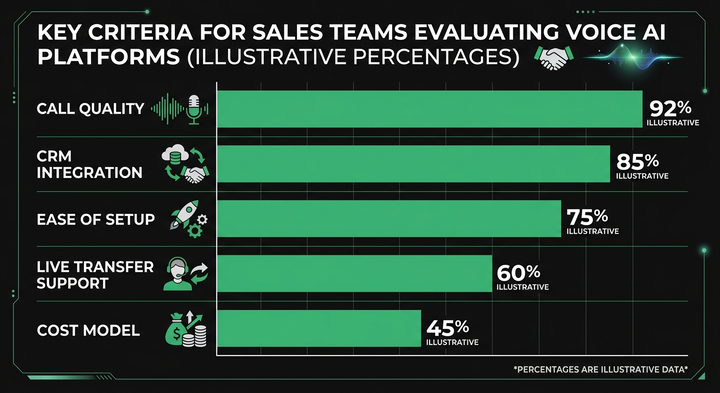
Judge any shortlist on five things. Conversation quality, compliance controls, setup effort, CRM write-back and live transfer. Then model per-minute and per-call pricing against 90 days of your own dial data, because the cheapest rate at 2,000 minutes a month is often the most expensive system at 20,000.
Key takeaways
- AI voice agents replace manual dialing by having an agent make and qualify calls without a human on each attempt.
- Managed platforms, no-code builders and developer APIs are three different purchases. Retell AI, Bland AI and Vapi need engineering work before anyone gets called.
- Compare vendors on five factors only. Conversation quality, compliance controls, setup effort, CRM write-back and live transfer.
- Live transfer is the highest-value feature because it hands a qualified prospect to a rep while the prospect is still on the call.
- Component pricing runs roughly $0.07 to $0.31 per minute before your engineering time. Managed plans start at $99 a month and include the build and compliance the other lanes leave to you.
- Compliance is the hidden cost. Only the managed lane screens litigators, Do Not Call lists and state quiet hours before the call is placed. Everywhere else it is your job.
- Run a four-week pilot on one narrow segment of your list before you roll anything out broadly.
Table of contents
- What an AI voice agent for sales is
- How we ranked the ten agents
- The ten agents at a glance
- The 10 best AI voice agents for sales teams
- How to choose the right agent for your team
- What to avoid when you shortlist AI voice agents
- Compliance basics before you dial
- Getting started with a pilot
- AI voice agents for sales teams FAQ
- The bottom line
What an AI voice agent for sales is
An AI voice agent is software that runs a live phone conversation, understands what the person says, responds in natural speech and follows a defined qualification path to a decision. The decision is usually one of three outcomes. Transfer the call to a human rep, book a meeting, or log a disposition and move on. Our guide to AI voice agents covers the technology in depth.
That is a narrower category than it sounds. A power dialer speeds up human dialing but still needs a rep on every call. A CRM stores the record but does not talk to anyone. None of the ten products below is a dialer or a CRM. AI voice agents are a different approach to the same problem, which is that first-touch conversations consume most of an SDR’s day and produce the least value per minute.
Under the hood, every option combines the same three parts. Speech recognition that turns the prospect’s words into text, a language model that decides what to say next, and speech synthesis that says it. The differences that matter to a sales team live above that layer, in how much of the sales operation the vendor has already built and how much is left for you to build, staff and keep compliant.
How we ranked the ten agents
Many AI voice agents are developer infrastructure aimed at engineers building custom applications. Others were designed for inbound support, not outbound prospecting. We scored every candidate on five things, and one disclosure applies throughout. Bigly Sales is our platform, so it is ranked first, and every other vendor is measured on the same five criteria with pricing read from its own site.
Conversation quality and latency
Prospects hang up on robots. Latency under about a second, clean interruption handling and a voice that does not drift matter more than any feature list, and the only way to judge them is to run calls against your own list, not the vendor’s demo line.
Compliance controls
Do Not Call scrubbing, consent capture, state calling rules and quiet hours, and litigator screening decide whether the agent creates pipeline or lawsuits. We note for each vendor whether those checks are built in or left to you. Our comparison of TCPA-compliant AI calling platforms goes deeper on the specific controls to ask about.
Setup effort
The honest gap between signing and placing your first production call. For a managed platform that is about a week. For a no-code builder it is days for the agent and weeks for the numbers and integrations around it. For a developer API it is an engineering project.
CRM integration and write-back
Call outcomes have to land in your records automatically or your reps will stop trusting the pipeline. We looked for native write-back rather than a webhook you still have to wire up.
Live transfer
Warm transfer of a qualified prospect to a rep, ideally with a summary of the conversation so far, is the feature that turns an AI conversation into revenue. Every vendor claims it. Few make it work without your engineers building the routing.
Cost model runs through all five. Per-minute rates look cheap in testing and grow quickly in production. Plan pricing looks expensive on day one and predictable at scale. Neither is better in the abstract, which is why the table below records the shape of each price, not a single number.
The ten agents at a glance
The table below summarizes how the ten options differ on lane, price and who carries the work. Pricing was read from each vendor’s public pricing page in September 2026 and will change, so treat it as a shape to model against your own volume rather than a quote.
| Agent | Lane | Pricing | Who does the work | Best fit |
|---|---|---|---|---|
| Bigly Sales (our platform) | Managed platform | $99 to $9,999 a month by volume, overage from $0.20 down to $0.08 per minute | Bigly builds and runs the agent, numbers and compliance, with a named account manager | Sales teams and call centers at thousands of calls a month, regulated industries |
| Retell AI | Developer API | About $0.07 to $0.31 per minute assembled, no platform fee, $10 free credit | Your engineers assemble and maintain the agent | Product and engineering teams embedding calling in their own software |
| Bland AI | Developer API | $0.14 per minute on Start, $299 a month plus $0.12 per minute on Build, Enterprise custom | Your engineers, with speech, model and voices bundled | Engineering teams running volume who want one per-minute rate |
| Vapi | Developer API | $0.05 per minute hosting plus models at cost, roughly $0.10 to $0.15 all in, Pro from $999 a month | Your engineers own every component | Teams building a voice product of their own |
| Synthflow | No-code builder | Enterprise from $30,000 a year at time of writing, confirm self-serve tiers directly | You build the flows, you run the operation | Small teams automating defined call flows without engineers |
| ElevenLabs Agents | No-code and API builder | $6 to $990 a month for 75 to 12,375 minutes, $0.08 per extra minute, models and telephony at cost | You build it and operate it | Teams where voice quality matters and someone will own the setup |
| Aloware | Contact center with AI agent | $30 to $85 per user a month, AloAi voice agent from $0.10 per minute | Your reps plus an AI layer, vendor hosts the stack | SMB teams on HubSpot, Salesforce, Pipedrive, Zoho or GoHighLevel |
| Thoughtly | Visual builder | Flex from $500 a month with unlimited minutes and 10 concurrent calls, Scale and Enterprise quoted | You design the flows, Thoughtly hosts | SMBs wanting voice, SMS and email in one builder |
| Air AI | Autonomous AI rep | License based, quote only | Vendor operated, terms vary | Buyers who test on their own list first and get terms in writing |
| PolyAI | Enterprise inbound assistant | Enterprise custom | Vendor delivered | Large contact centers handling inbound customer service at scale |
The 10 best AI voice agents for sales teams
These options range from a fully operated sales calling service to raw infrastructure. What fits depends on your technical resources, your call volume, your timeline and how much customization you genuinely need rather than how much you would enjoy having.
1. Bigly Sales: Best managed AI voice agent for sales teams
Bigly Sales is our platform, so read this section with that in mind. It is a fully managed AI voice agent service for outbound and inbound sales calling, founded in 2020 and headquartered in Miami, Florida, serving more than 30 industries including insurance, mortgage, debt relief, legal intake, home services and real estate. The difference from everything else on this list is who does the work. Bigly builds the agent around your offer, supplies more than 200 whitelisted phone lines with local presence, screens every number against known litigator lists and against state and federal calling rules and quiet hours before the call is placed, A/B tests scripts and voices, and assigns a dedicated account manager. When a prospect qualifies, the agent warm transfers to your rep with a summary of the conversation, and outcomes write back to your CRM. The same system powers speed to lead, calling new inbound leads back within seconds.
Pricing is published. Plans are $99 a month for 500 minutes, $500 for 3,000, $2,999 for 25,000, $4,999 for 50,000 and $9,999 for 125,000, covering outbound and inbound alike, with overage from $0.20 down to $0.08 per minute. Full details are on the pricing page.
Where Bigly fits. It is built for sales teams and call centers that run thousands of calls a month and want one vendor accountable for the agent, the numbers, the compliance and the transfers, rather than a toolkit to assemble and staff. For a side-by-side with the platforms buyers compare it against, see our Bigly Sales alternatives comparison and the head-to-head pages against Retell, Bland AI and Vapi.
2. Retell AI: Best developer API for teams that want to build
Retell AI is a voice agent API with contact center features built in, including batch outbound calling, warm transfer and post-call analysis. Engineering and product teams use it to embed calling into their own software, and the documentation is detailed enough to reach production. Pricing is pay as you go with no platform fee. A working agent lands at roughly $0.07 to $0.31 per minute, assembled from $0.055 for the voice infrastructure, $0.015 for platform text to speech, a language model charge that varies widely by model, and about $0.015 for US telephony. The first 20 concurrent calls are included, extra concurrency is $8 a month each, phone numbers are $2 a month and new accounts get $10 in credit.
The honest caveat is ownership. Retell gives you flexibility in exchange for a permanent maintenance job, and compliance screening, list hygiene and number reputation are all yours. If a RevOps or sales ops team is setting it up without developer help, the technical barrier will stall the project. It was not designed as a plug-and-play sales tool and does not pretend to be one.
3. Bland AI: Best for engineering teams running volume
Bland AI is an API-first platform for building and running voice agents at scale, known for low latency and conversational pathways. Its pricing is simpler to budget than most APIs because speech recognition, the language model and premium voices are all included in the per-minute rate. The Start plan is $0.14 per minute of talk time plus $0.05 per minute on transfers, with no platform fee, 10 concurrent calls and a cap of 100 calls a day. Build is $299 a month for $0.12 per minute, 50 concurrent calls and 2,000 calls a day. Enterprise is custom, with dedicated infrastructure, VPC options, a BAA and SSO. Our full Bland AI review goes deeper on pricing and support complaints.
The tradeoff is time to production and the daily caps on the lower tiers. Getting Bland tuned for one specific sales use case takes genuine engineering investment, and you own testing, telephony, list hygiene and TCPA exposure. Teams that need calls running in weeks rather than months will feel that as a hard barrier.
4. Vapi: Best for full-stack control
Vapi is an infrastructure layer for voice AI that lets you choose your own speech recognition, language model and voice, then assemble them into an agent. Hosting is $0.05 per minute and everything else is billed at cost. Transcription runs about $0.01 per minute, language models $0.008 to $0.045, text to speech $0.015 to $0.024 and telephony up to $0.014, so a production agent lands at roughly $0.10 to $0.15 per minute before your engineering time. New accounts get $5 in credit, the Pro tier carries a $999 a month minimum and Enterprise adds a 99.9 percent uptime SLA and a named support team.
That positioning is also the caveat. You cannot point Vapi at a prospect list and switch it on. Building the sales logic, the routing and the compliance above the infrastructure is a real engineering project, so evaluating Vapi for outbound sales is really evaluating whether you want to build and maintain a custom sales tool.
5. Synthflow: Best no-code builder for small teams
Synthflow lets a non-technical team assemble a voice agent visually from templates, connect a calendar and a CRM and run it without engineers, with native telephony and SIP options and a long integration list. It is the lowest-friction way to get a working agent for a defined call flow. At the time of writing its pricing page leads with an Enterprise plan from $30,000 a year, scoped on call volume, concurrency, telephony and integrations, so confirm directly whether a self-serve monthly tier is available at your volume.
The coding burden is gone but the operating burden is not. Phone numbers, number reputation, compliance screening and list hygiene stay on your desk, and complex branching conversations hit its ceiling. Treat it as a starting point rather than a destination.
See it live
Hear an AI voice agent qualify your own leads
We will run your script against a real call scenario and show you the warm transfer handoff end to end. Most demos take under 30 minutes.
6. ElevenLabs Agents: Best voices, bring your own operation
ElevenLabs Agents lets you build conversational voice agents on the voice quality ElevenLabs is known for, through a visual builder or an API. Plans are published and cheap to start. Free includes 15 minutes, Starter is $6 a month for 75 minutes, Creator $22 for 275, Pro $99 for 1,238, Scale $299 for 3,738 and Business $990 for 12,375 minutes, with extra agent minutes at $0.08. Language model and telephony costs are billed at cost on top of the subscription.
It is an agent-building product, not a sales system. Outbound dialing, phone numbers, CRM write-back and compliance are integration work that your team does. It fits teams where brand voice matters and somebody will own the setup. A sales leader who wants calls made this month is buying a build project.
7. Aloware: Best for SMB teams that want humans and AI in one contact center
Aloware is a contact center for small and mid-sized teams that live in HubSpot, Salesforce, Pipedrive, Zoho or GoHighLevel, with dialing, texting, cadences and an AI agent layer. Human seats run $30, $60 and $85 per user a month depending on tier, with unlimited US and Canada calling and one-to-one SMS included, and the AloAi voice agent starts at $0.10 per minute with an outcome-based option. Native CRM sync is the reason it ranks.
It covers a lot of ground rather than going deep on autonomous calling. Teams that want one tool for reps, calls, texts and workflows will like it more than teams chasing the best possible AI conversation, and the AI agent should be evaluated on your own calls, separately from the dialer.
8. Thoughtly: Best visual builder with unlimited minutes
Thoughtly is a visual conversation designer that covers voice, SMS and email in one builder. Its Flex plan starts at $500 a month with unlimited voice minutes and 10 concurrent calls. Scale, with 100 or more concurrent calls, and Enterprise, for a million or more minutes a month or regulated verticals, are quoted. There are no per-seat or per-channel fees, which makes it easy to model.
Concurrency is the real limit, not minutes. Ten simultaneous lines is a small outbound operation, and as with every builder the numbers, the compliance and the list hygiene are yours to run.
9. Air AI: The autonomous rep pitch, with a caution
Air AI markets a fully autonomous AI sales rep that holds long-form calls and closes on its own. Pricing is license based and quoted rather than published. In 2026 the company reached a settlement with the FTC, which we cover in our Air AI FTC settlement guide, and it is the reason our Air AI alternatives comparison exists.
Evaluate it the way you would evaluate any vendor making a large promise. Test on your own list before paying, confirm who owns the phone numbers and the account, and get refund and exit terms in writing.
10. PolyAI: Best for enterprise inbound at contact-center scale
PolyAI builds voice assistants for large contact centers, mainly inbound customer service in banking, hospitality, utilities and retail, with strong multilingual handling. Pricing is enterprise custom. It appears on sales-team lists because it can qualify and route inbound callers at very high volume with a polished voice.
It is not an outbound prospecting tool, and a mid-market sales team is not its buyer. Shortlist it if you are a large enterprise replacing an IVR, and skip it if your problem is getting more first conversations from a lead list.
How to choose the right agent for your team
Three questions narrow the field quickly.
Start with technical resources. Do you have developers who will own a custom integration for years, not just build it once? If yes, every option is open. If your team is sales, marketing and RevOps, you need a platform you can run without engineering involvement, and that removes Retell AI, Bland AI and Vapi from the list.
Next, identify the primary use case. High-volume outbound prospecting is a different problem from inbound call routing. Most of these options lean one way or the other, and the depth of the qualification logic and the maturity of live transfer vary enough to change your results by a wide margin. Our guide to choosing an AI voice agent platform has a longer checklist.
Finally, model cost against real usage. Pull dial data from the past 90 days, then price each structure at your current volume and at double it. The option that looks cheapest today is often the one that breaks your budget at scale. If you are also weighing tools further up the funnel, our list of the best AI cold calling software covers dialers and AI SDR products as well.
What to avoid when you shortlist AI voice agents
A few patterns waste more pilot budgets than any other. Watch for them before you sign anything.
Judging on demo recordings
Every vendor demo uses a cooperative caller and a clean line. Your list has hold music, background noise, gatekeepers and people who interrupt at word four. Insist on running your own numbers through the agent during evaluation.
Buying capability you will not staff
Unlimited customization is only a feature if somebody is paid to use it. If nobody on the team owns prompts, call flows and integration upkeep as part of their job description, a managed option removes that job and frees the time for list quality.
Skipping the write-back test
Ask to see a real disposition land in your CRM during the trial, not a screenshot of one. Integration gaps almost always surface at this exact step and they are much cheaper to find before the contract than after.
Ignoring where compliance runs
Ask each vendor a single question. Before the agent dials, what does the system check? If the answer is nothing, then Do Not Call scrubbing, state quiet hours, consent records and litigator screening are your job, and you should price that work into the comparison.
Launching against your whole list
A broad launch spends your best contacts on your worst script. Start narrow, tune, then widen.
Compliance basics before you dial
Outbound calling with an AI voice agent is legal in the United States, and it is governed by the same rules as any other telemarketing call. Prior express written consent under the TCPA remains the operative standard for calls and texts to mobile numbers in most sales scenarios, and the Telemarketing Sales Rule adds disclosure and record-keeping duties on top. The FTC guidance on complying with the Telemarketing Sales Rule is the plainest primary source to start from, and our TCPA compliance guide walks through the requirements.
One point causes repeated confusion. The one-to-one consent rule that would have required separate written consent for each individual seller was vacated by the Eleventh Circuit in January 2025 and never took effect. Prior express written consent under the existing standard still governs. Adopting one-to-one consent as internal policy is still worth doing, because it narrows your litigation exposure on shared or resold lead data even though no rule compels it.
The requirement that does bite is revocation. Consumers can revoke consent through any reasonable method, and a revocation received on one channel applies across your channels. Whatever agent you buy, confirm that an opt-out captured on a call propagates to your email and SMS suppression lists automatically.
Getting started with a pilot
Buy an AI voice agent the way you buy any other production system, with a defined pilot rather than a rollout. Pick one well-scoped segment of your list, set a single goal you can measure and give it at least four weeks before drawing conclusions. Meetings booked, qualified leads transferred and connect rate are clean metrics for this phase. Cost per booked meeting is the one to report upward.
During the pilot, have reps listen to recordings on a fixed schedule. Feedback from real calls improves the agent script faster than any analytics dashboard. Look for the exact moment prospects disengage and work backward from there, because the fix is almost always in the first two lines rather than in the objection handling.
Set an exit condition before you begin. If cost per booked meeting after four weeks is worse than your current SDR cost per booked meeting and the trend is flat, stop and reassess instead of extending the pilot on hope.
AI voice agents for sales teams FAQ
What is an AI voice agent for sales teams?
An AI voice agent for sales teams is software that places and answers phone calls for a sales team without a human on each attempt. The agent speaks with prospects, asks qualifying questions and handles common objections. When a prospect meets your criteria, it books the meeting, logs the outcome in your CRM or transfers the call live to a human rep. The category covers managed platforms, no-code builders and developer APIs, which are very different purchases.
Which AI voice agent is best for a sales team with no engineers?
If you run thousands of calls a month, a managed platform such as Bigly Sales is the only option on this list where the vendor builds and operates the agent, the phone numbers and the compliance checks for you. No-code builders such as Synthflow or Thoughtly can produce a working agent without engineers, but the phone numbers, compliance screening and CRM work stay with your team. Retell AI, Bland AI and Vapi all require engineering time before the first call.
How much do AI voice agents for sales teams cost in 2026?
Pricing follows three shapes. Component-priced developer APIs run roughly $0.07 to $0.31 per minute once you add the voice, model and telephony charges, with Vapi at $0.05 per minute for hosting plus models at cost. All-inclusive builders run about $0.08 to $0.14 per minute or a few hundred dollars a month for a bundle of minutes. Managed platforms are priced by plan, and Bigly Sales publishes plans from $99 to $9,999 a month with overage from $0.20 down to $0.08 per minute. Model every shape against 90 days of your real dial data before you sign.
Is it legal to use an AI voice agent for outbound sales calls?
Yes, with proper compliance in place. Outbound AI calling is legal in the United States and is governed by the same rules as any other telemarketing call. The TCPA requires prior express written consent for most sales calls to mobile numbers, the Telemarketing Sales Rule adds disclosure and record-keeping duties, and you should disclose that the caller is an AI when a prospect asks. Consent revocation must be honored across channels, so an opt-out captured on a call has to reach your email and SMS suppression lists too.
Did the FCC one-to-one consent rule take effect?
No. The one-to-one consent rule was vacated by the Eleventh Circuit in January 2025 and never took effect, so it is not binding law. Prior express written consent under the existing TCPA standard remains the operative requirement. Many teams still apply one-to-one consent as internal policy because it reduces litigation risk on shared or resold lead data, but no regulation currently forces that choice.
What is the difference between an AI voice agent and a power dialer?
A power dialer automates dialing but still needs a human rep on every call. An AI voice agent replaces the human for the first qualifying conversation and connects a rep only once the lead meets your criteria. The two solve different problems. A dialer increases the number of attempts a rep can make, while an AI voice agent removes the rep from attempts that were never going to convert.
How long does it take to launch an AI voice agent for sales?
A managed platform can have a pilot making its first calls within about a week, because the agent build, the numbers and the compliance checks are done by the vendor. No-code builders can produce a working agent in days, but connecting numbers, CRM and compliance usually takes longer than the agent itself. Developer APIs such as Retell AI, Bland AI and Vapi typically need several weeks of engineering before production traffic, depending on call flow complexity and how much engineering time is actually available.
Can an AI voice agent transfer a call to a human rep?
Yes. Live transfer is the highest-value feature in the category because it hands a qualified prospect to a rep while the prospect is still on the line. Managed platforms build it in. Bigly Sales warm transfers with a summary of the conversation so the rep knows what was said before picking up. Developer APIs support transfer at the API level, but your engineers build the routing, the rep availability logic and the fallback when nobody answers.
Can an AI voice agent qualify leads reliably?
Yes, within defined criteria. An agent can ask multi-step qualifying questions, handle common objections, confirm contact details and decide whether a prospect matches your rules. Quality depends almost entirely on how precisely your criteria and script are written. Vague criteria produce transfers your reps resent, so tighten the definition of a qualified lead before you blame the agent.
Does Bigly Sales integrate with major CRMs?
Bigly Sales connects with the CRM systems outbound teams commonly use and writes disposition codes, qualification outcomes and call data back to your records after each call. Coverage varies by CRM and by how your instance is configured, so confirm your specific setup with our team during a demo rather than assuming every field you care about syncs out of the box.
The bottom line
The category has matured enough that AI voice agents for sales teams run in production without daily supervision. The real decision is not which vendor has the best voice. It is whether you are buying an operated sales system, a builder you will run yourself or a set of building blocks, because that choice determines whether your first production call happens next week or next quarter, and who gets the call when a compliance check is missed.
Developer APIs give engineering teams total control in exchange for owning the build, the numbers and the compliance for the life of the contract. Builders remove the code and leave the operation. A managed platform removes both, which is what Bigly Sales is built for: one vendor accountable for the agent, the numbers, the compliance and the transfers. Whichever lane you pick, test with your own numbers before money changes hands.
Try it first
Hear your own script on a real call before you commit
We build a pilot on your real list and your real offer, and you listen to the calls. Most pilots make their first calls within a week, no engineering required.