


AI calling for personal loans is software that phones an applicant within seconds of form submission, runs a real qualifying conversation about income, employment, amount and purpose, and live transfers the qualified ones to a loan officer. It exists because personal loans are a commodity purchase and the applicant is almost never yours alone.
Someone who submits an inquiry for personal loans has usually submitted it to two or three other lenders in the same sitting. Whoever has the first real conversation gets the deal. Everyone else leaves voicemails.
This guide covers what AI calling does for a personal loans operation, what TCPA requires before you dial, how managed platforms differ from developer APIs, what to evaluate, and how to set a campaign up without creating exposure on day one.
TL;DR
Speed to lead is the dominant conversion variable in personal loans. Contact rates for a lead called inside five minutes are dramatically higher than for one called at thirty minutes, and AI calling closes that window to seconds at any hour without a representative on shift. A managed deployment typically runs three to five business days from contract to first live call.
The gate is consent. The FCC confirmed in February 2024 that AI-generated voices are artificial voices under the TCPA, so every AI call to a cell phone needs documented prior express written consent, and statutory damages run $500 per violation and up to $1,500 for willful violations. If you buy third-party leads and have not read the consent language the consumer actually saw, do not point an AI campaign at that list yet.
Key takeaways
- Applicants for personal loans shop several lenders at once, so first contact decides a large share of funded loans.
- AI calling automates first contact, qualification, and follow-up, then hands loan officers live transfers that are already screened.
- Four applications carry the return: new lead qualification, abandoned applications, dormant database reactivation, and status follow-up during underwriting.
- TCPA requires documented prior express written consent for AI-generated calls to cell phones, and purchased lead consent rarely covers it by default.
- There are two platform models, managed services that go live in days and developer APIs your engineers build on for weeks or months.
- Response latency above roughly 800 milliseconds is audible and pushes hang-up rates up.
- AI is better than a person at first contact and worse at the loan conversation, so design the handoff carefully.
Table of contents
- What AI calling for personal loans is
- Why speed to lead decides personal loans
- What it does for a lending operation
- TCPA compliance for personal loans calling
- Managed platform or a build of your own
- The two models side by side
- What to evaluate when comparing platforms
- Setting up a personal loans campaign
- What to avoid
- Who should not buy this
- Personal loans AI calling FAQ
- The bottom line
What AI calling for personal loans is
AI calling for personal loans is an outbound system in which software places the call, holds the qualifying conversation in natural language, records the answers against your criteria, and either transfers the applicant to a loan officer, books a callback, or dispositions the record.
The difference from a dialer is where the automation sits. A predictive dialer automates dialing and still puts a person on every answered call. An AI system automates the conversation, so your loan officers only join once an applicant has confirmed income, employment, amount and intent. That single difference is why call capacity stops being tied to headcount.
Why speed to lead decides personal loans
Applicants do not wait. They submit, compare offers, and decide inside a narrow window. Data on internet leads keeps pointing the same direction. The contact rate for a lead called within five minutes is far higher than for one called at thirty minutes, and conversion follows the same curve.
In a manual operation, first contact depends on who is free. If a representative has five calls in progress, the new lead waits. If it lands at 7pm on a Friday, it waits until Monday morning, by which point the applicant has funded elsewhere or lost momentum entirely.
AI calling removes the queue. Every new lead is called within seconds of submission with a live conversation that captures income, employment status, amount requested, purpose, and timeline. No representative is needed for first contact and no lead sits waiting. Our breakdown of speed to lead and what the first five minutes are worth covers the underlying numbers.
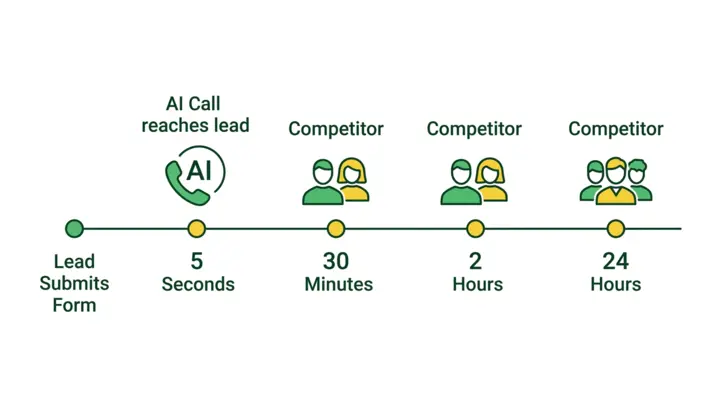
Be careful with the arithmetic anyone shows you here, including ours. Faster contact reliably lifts contact rate, and contact rate is upstream of everything else, but the size of the lift depends on lead source quality, your credit box, and how good your loan officers are on the transfer. Measure it against your own baseline for thirty days rather than adopting a vendor’s number.
What it does for a lending operation
Qualification at the top of the funnel
When an applicant submits a form, the system calls within seconds and works through your criteria. Amount range. Employment type. Monthly income. Stated credit band. Purpose. It captures the answers, handles the usual clarifications, and routes qualified applicants to a loan officer on a live transfer.
The officer picks up with the context already gathered. They step into a conversation with someone who has been screened rather than a cold dial to a person who may not remember filling out a form at all. If you also write mortgages, our pages for lending and other regulated industries show how the qualification logic changes by product.
Abandoned applications
A meaningful share of applications for personal loans are started and never finished. The applicant got interrupted, hit a document request they were not ready for, or stalled on a question. These are warm leads that went cold by default rather than by decision.
AI calling can work every incomplete application on a schedule, find out where the process stopped, and either collect the missing information on the call or book time with a loan officer. Contact is faster and more consistent than manual follow-up, which is most of why recovery rates improve.
Dormant database reactivation
Most lenders sit on a database of leads that never converted. Some did not qualify at the time. Some funded with a competitor. Some just needed longer. When rates move, credit conditions loosen, or you add a product, that database becomes worth working again.
A list of five thousand dormant records can be worked in days instead of weeks, with interested contacts routed to an officer immediately. Before you launch, confirm consent has not been revoked and rescrub the list, because an old record is exactly where a stale opt-out hides.
Status follow-up during underwriting
After submission, applicants go quiet. They stop answering email and they do not log into the portal. AI calling can run status check-ins, chase missing documentation, and keep the applicant engaged through underwriting without spending loan officer hours on it. These are informational calls rather than marketing calls, which changes the consent analysis, so have counsel confirm how you classify them.
TCPA compliance for personal loans calling
Consumer lending is a regulated business and the compliance requirements here are real. This is the part to get right before anything else.
The FCC February 2024 ruling
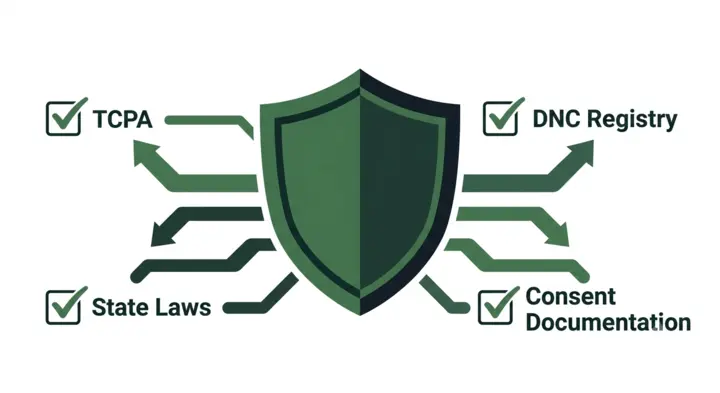
The FCC issued a declaratory ruling in February 2024 confirming that AI-generated voices fall under the Telephone Consumer Protection Act’s restrictions on artificial or prerecorded voice calls. Using an AI voice agent to call a cell phone therefore requires prior express consent, and prior express written consent when the call is marketing.
This is not a proposal. It is current law, and statutory damages run $500 per negligent violation and up to $1,500 per willful one, assessed per call. Our guide to the FTC and FCC AI calling rules covers the full regulatory picture, including which widely reported rule was vacated in court and never took effect.
What consent documentation looks like
For personal loans, consent normally lives in the web form at the point of application. The language has to be clear, specific, and separate from general terms of service. It should name the company that will call, describe the type of call including AI-generated voice, and give a way to revoke.
If you buy third-party leads, do not assume the source’s consent covers AI-generated calls to cell phones. Read the actual disclosure the consumer saw, in the version they saw it, and keep a copy. This is the single most common gap in lending campaigns and the easiest one to close before launch.
Do Not Call scrubbing
Scrub against the National Do Not Call Registry before every campaign run rather than once at list ingestion, and keep your internal do-not-call list in the same step. The Federal Trade Commission sets out the operative telemarketing obligations in its guide to complying with the Telemarketing Sales Rule, which also carries a five-year recordkeeping requirement for call and consent records.
State requirements and revocation
Texas, Virginia, Florida, and Colorado all impose obligations beyond federal law, and calling windows vary by state. Enforce them per record using the applicant’s time zone. Separately, a revocation of consent has to be honored by any reasonable method and now has to carry across channels, so a stop request on a call must suppress your text and email programs too.
A platform that does not enforce calling windows, scrubbing, and cross-channel suppression automatically should be treated as a risk you are absorbing yourself. See what those controls look like when they are native to the platform in our overview of TCPA compliant AI calling platforms.
For lenders
Call every applicant before your competitor does
See a compliant personal loans campaign built end to end, from consent checks to the live transfer your officers receive. About 20 minutes.
Managed platform or a build of your own
Evaluating AI calling for a consumer lending desk means choosing between two different models. Cost, risk, and time to production all differ sharply.
Fully managed services
A managed platform handles deployment, script configuration, compliance controls, CRM integration, and ongoing campaign management. You define the qualification criteria and the products. The platform does the rest.
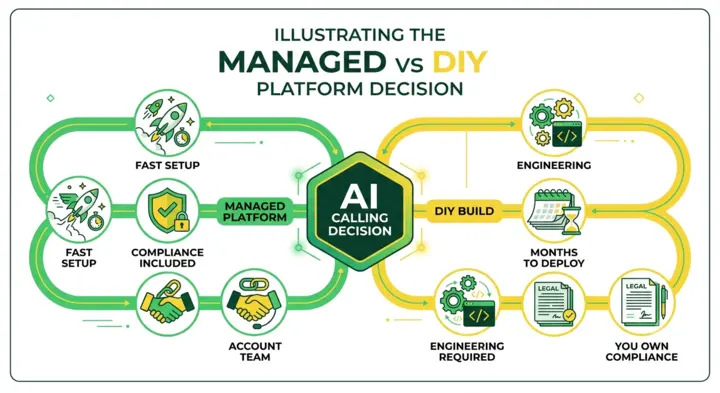
Bigly Sales operates in this category, so read the comparison with that in mind. A lending operation typically goes from contract to first live call in three to five business days, with scrubbing, calling windows, and CRM integration handled by the account team. The model fits operations that need compliance working immediately, have no engineering capacity for voice infrastructure, and care about pipeline quality rather than owning the stack.
Developer API platforms
Platforms including Bland AI, Retell AI, and Vapi give engineering teams the raw infrastructure to build a voice agent. Your team writes the conversation logic, the compliance controls, and the CRM integration.
For a fintech building AI calling as part of its own product, that is the right choice. For a lender that needs a compliant production system, the real cost is well above the API fee, because you are also building consent verification, scrubbing, calling window enforcement, and audit-ready logging, then maintaining all of it as rules change.
The two models side by side
| Factor | Managed platform | Developer API build | Predictive dialer |
|---|---|---|---|
| Time to first live call | Three to five business days | Weeks to months | Days, once seats are staffed |
| Who builds compliance controls | The vendor, as part of the platform | Your engineering team, then maintains them | Your team, in configuration |
| Who holds the first conversation | Software, then a live transfer | Software, then a live transfer | Your loan officer |
| Capacity limit | Concurrency you pay for | Concurrency and your own uptime | Number of officers logged in |
| Best fit | Lenders wanting pipeline, not infrastructure | Fintechs shipping calling as a product | Teams with idle officer capacity |
Bigly Sales does not sell predictive dialers, so treat that column as context rather than a recommendation against them. Plenty of lending desks run a dialer for outbound campaigns and an AI layer for instant response, and that combination works.
What to evaluate when comparing platforms
- Consent workflow. How does the platform verify and store consent at the record level, and can it produce the consent document for one number quickly if a regulator or plaintiff asks?
- Scrubbing cadence. Before every campaign run or only at list ingestion? Before every run is the compliant standard.
- Calling window enforcement. Automatic and based on the called party’s time zone, or a manual configuration your team maintains?
- Opt-out propagation. How fast does a verbal stop request reach suppression, and does it reach your text and email systems as well?
- Live transfer quality. What does the loan officer see before the call connects? A warm transfer with full context is a different product from a blind transfer.
- CRM integration. Which systems are native, and how do call outcomes and qualification fields sync back?
- Response latency. Anything much above 800 milliseconds is an audible pause that signals automation and raises hang-ups. Ask to hear a live call, not a produced demo reel.
- Recordings and retention. Can you pull full recordings and transcripts on demand, and how long are they kept against the five-year record requirement?
- Off-script behavior. Ask them to demonstrate a call where the applicant says something unexpected. How the agent recovers matters more than how it performs on the happy path.
Setting up a personal loans campaign
Whichever platform you pick, the sequence is the same.
Verify consent on every record first
Before a single record enters the campaign, confirm each cell number carries documented prior express written consent for AI-generated voice calls. Records that fail this check do not go in the campaign. There is no version of this step you can defer to week two, because the violation happens on the first call, not on the first complaint.
Define qualification precisely
Decide exactly what the agent asks, which answers qualify, and which thresholds trigger a transfer, a callback, or a disqualification. Vague criteria produce inconsistent transfer quality, and loan officers lose faith in transfers faster than they lose faith in anything else.
Configure calling windows and suppression
Set windows for every state your leads originate from, using the applicant’s time zone. Load your internal do-not-call list alongside the national registry, and define how an opt-out captured mid-call gets logged and suppressed before the next dial.
Brief your loan officers on the handoff
An officer taking a transferred call needs to know what is already captured, where it appears on screen, and what not to re-ask. Fifteen minutes of alignment on the transfer format changes conversion more than any script tweak, because applicants who have to repeat themselves assume nobody was listening.
Review the first week of recordings
Listen to a real sample of calls after week one, including the disqualifications. The pattern in why applicants fail qualification, or why transfers do not convert, tells you more than any dashboard. Adjust thresholds and transfer triggers from what you hear, then review again at week three.
What to avoid
The failures repeat across lenders. Importing purchased lists without reading the consent disclosure. Scrubbing once at ingestion and never again. Running one national configuration when four states need their own. Letting the agent quote rates or approval odds it has no basis to state, which is a misrepresentation problem on top of a compliance one.
The other failure is expecting the software to replace selling. It does not. It puts more qualified applicants in front of the officers you already have. Teams that cut headcount and expect volume to carry them consistently underperform teams that keep their best people and feed them better conversations.
Who should not buy this
If your volume is low enough that officers already reach every applicant inside five minutes, this will not change your funded numbers much. Spend the money on lead quality or pricing instead.
If you cannot produce written consent for the numbers you intend to call, start with a consent audit rather than a campaign. And if you are a small operation without anyone to own configuration and weekly call review, a managed service is the only version of this that will work, because an unmonitored campaign drifts within a month.
Personal loans AI calling FAQ
What is AI calling for personal loans?
It is an outbound system that contacts applicants for personal loans immediately after submission, holds a live qualifying conversation in natural language, and routes qualified applicants to a loan officer on a live transfer. The software handles first contact and qualification on its own, capturing income, employment, amount and purpose. A human officer joins only for applicants who are qualified and ready to talk.
Is AI calling legal for personal loan lenders?
Yes, with proper consent documentation and compliance controls in place. The FCC confirmed in February 2024 that AI-generated voices are artificial voices under the TCPA, so calls to cell phones require prior express consent, and written consent when the purpose is marketing. Lenders also have to meet state telemarketing rules, honor revocation across channels, and scrub against the Do Not Call Registry before each campaign run.
How fast does AI reach a new applicant?
Within seconds of form submission on a properly configured system. The real delay is how quickly lead data moves from your application form or CRM to the calling platform, which is an integration question rather than a calling one. Most managed platforms are dialing inside 30 seconds of submission. If your form posts to a queue that batches every few minutes, fix that before blaming the platform.
What does a warm transfer look like for personal loans?
The agent runs the qualifying conversation, captures the answers, and connects the call to a loan officer once the applicant meets your criteria. Before the officer speaks, they see the name, amount requested, stated income, employment type, and anything else captured. The officer enters informed rather than cold, which is the entire point. A transfer that arrives without context converts far worse.
How does the AI handle applicants who say unexpected things?
Conversational platforms are built to handle answers outside the script by clarifying, rephrasing, or escalating to a live transfer instead of failing the call. Quality varies a lot between vendors here, and it is the most useful thing to test. Ask for a live demonstration where someone deliberately goes off script, interrupts, or asks about something the agent was not configured for.
What is the difference between AI calling and a predictive dialer?
A predictive dialer automates dialing and connects a live agent when a person answers, so a human still holds every conversation and capacity is capped by seats. An AI system holds the qualifying conversation itself and brings in a loan officer only when the applicant qualifies. The difference is automation of the conversation rather than the dialing, which is why throughput stops tracking headcount.
Do purchased leads come with usable consent?
Often not for this purpose. A lead vendor’s consent language may cover calls and texts generally without ever mentioning automated or artificial voice contact, which is the specific authorization the TCPA analysis turns on. Ask for the exact disclosure the consumer saw, with a timestamp and the page it appeared on, and keep it in your records for five years alongside the call logs.
Can AI calling work a dormant lending database?
Yes, and reactivation is often where the return appears first because the inventory is already paid for. A list of several thousand aged records can be worked in days rather than weeks. Before launching, confirm consent has not been revoked, rescrub against the national registry and your internal list, and ask counsel how old a consent record can be before you stop relying on it.
How do I measure the return on AI calling for personal loans?
Track cost per qualified conversation and cost per funded loan against your current baseline. Count calls placed, conversations that reached qualification, qualified leads that became applications, and applications that funded, then compare with what manual follow-up costs you today. Speed to lead effects usually show up inside the first 30 days. Watch officer-side conversion separately, since a drop there means thresholds are too loose.
Does the AI have to say it is not human?
No federal rule requires a spoken AI disclosure yet, though the FCC proposed one in August 2024 and several states are moving that direction. Disclose anyway. Applicants react badly to discovering it partway through, complaint rates are lower when the opening is honest, and a call that presents itself as human invites a deception claim under the FTC’s rules even without a specific mandate.
The bottom line
Personal loans are won on speed and lost on silence. An applicant who submits at 8pm and hears nothing until Tuesday has already funded somewhere else. AI calling is the cheapest reliable way to be the first real conversation on every lead, on every incomplete application, and across a database nobody has worked in a year.
Treat consent as the first project rather than the last. Read the disclosure your lead source actually showed the consumer, configure by state, disclose the AI, and keep your best loan officers on the loan conversation. The technology is the straightforward part. The record you can produce two years from now is what decides whether it was worth doing.
Lending teams
Turn form submissions into live conversations
Bring one lead source and we will show you the call flow, the qualification logic, and what your officers receive on transfer. No obligation.